
⚠ Before you read this: this is what I personally do when one of my covered calls is about to get my shares called away and I don’t want that yet – not a recommendation, not financial advice, and not a guarantee it makes sense for your position, your tax situation, or your account. Rolling to avoid assignment usually costs money; I’m documenting how I decide whether that cost is worth paying, not telling you it always is.
Most of what I’ve written in this Playbook so far is about a stock moving against me. This one’s the opposite problem: a stock I own moves too well, blows through my covered call strike, and I’m suddenly staring down assignment on a trade that was only ever supposed to generate a little extra income – not force me to sell shares I wanted to keep. Here’s what I actually do about it.
Why I’d Even Want to Avoid Assignment
Getting assigned on a covered call isn’t a disaster – I sell my shares at the strike, keep the premium I collected, and lock in a gain. The reason I sometimes don’t want that outcome is simple: I might still believe in the stock beyond the strike price, or I might not want to realize the gain right now for my own reasons. Either way, if I’ve decided I want to keep the shares, I need to act before expiration does the deciding for me.
My Starting Position
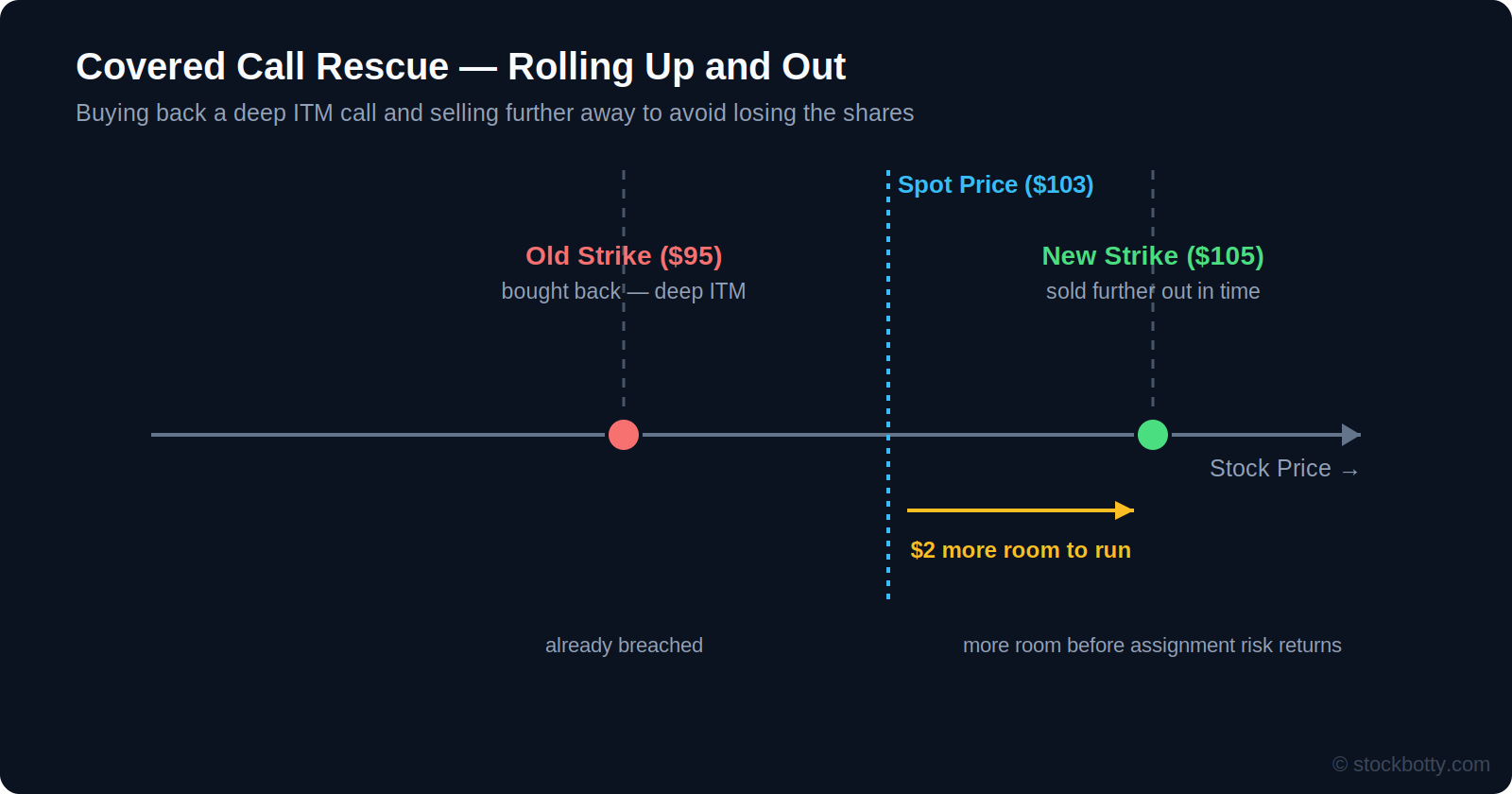
I own 100 shares with a cost basis of $80. I sell the $95 call, 30 days out, for $1.50 ($150 collected), thinking $95 was a reasonable stretch target. The stock rallies hard – a strong earnings report, a sector-wide move, whatever the catalyst – and with 5 days left until expiration, it’s sitting at $103. My $95 call is deep in the money, trading around $8.20, almost entirely intrinsic value with very little time value left in it.
What I Do: Roll Up and Out
I buy back my $95 call for $8.20 – a $6.70 debit against the $1.50 I originally collected, which on its own looks like a losing trade. At the same time, I sell a new call further out: the $105 strike, 30 days out, for $3.00 ($300 collected).
Net effect of the roll itself: −$6.70 (buy back) + $3.00 (new sale) = −$3.70. Combined with the $1.50 I collected originally, I’m down $2.20 in net premium across both cycles – but I’ve kept my shares, and I’ve moved my ceiling from $95 to $105, giving the stock $10 more room to run while I still own it.
I want to be plain about what just happened: I paid $2.20 to keep holding a position that’s already up $23 a share from my cost basis. Whether that’s worth it depends entirely on why I wanted to keep the shares in the first place – it isn’t a free adjustment, and I don’t pretend it is.
When This Stops Working
- If the stock keeps running past whatever strike I roll to, I end up doing this again and again, paying a debit each time. A stock in a genuine strong uptrend can outrun several rolls in a row, and each one chips away at the trade’s overall profitability.
- If there’s very little time left before expiration, the call I’m buying back has almost no extrinsic value cushioning the cost, which makes the roll more expensive and narrows my options – sometimes to the point where a further-out roll doesn’t offer enough room to be worth the debit.
- If my reason for wanting to keep the shares wasn’t that strong to begin with, I try to be honest with myself that paying repeated debits to avoid a profitable assignment isn’t protecting anything – it’s just delaying a good outcome at a cost.
- Early assignment can happen before I get the chance to roll, particularly around dividend dates on a deep in-the-money call with little time value left – this is the same American-style exercise risk that shows up throughout the rest of this site, and it’s a real possibility here, not just a theoretical one.
⚠ Risks Beyond the Basics
A few things I keep in mind before rolling a covered call to avoid assignment.
Rolling for a debit reduces my overall return, even when it “works”
Even in the best case – the stock keeps climbing and I never get near the new strike – I’ve still paid a real cost to hold shares I already owned. That cost has to be weighed against whatever benefit I’m getting from not selling, not treated as incidental.
Tax considerations are a real part of my decision, but I’m not a tax advisor
Wanting to defer realizing a gain is one legitimate reason I might roll instead of accepting assignment. How that actually plays out for a given position depends on individual tax circumstances I’m not qualified to advise on – I make this decision with my own accountant’s input, not from anything written here.
Repeated rolling can tie up a position indefinitely
Without deciding in advance how many times I’m willing to roll, or at what added cost, this can turn into an open-ended commitment to keep defending a strike against a stock that has no obligation to slow down.
I’m still exposed to the stock falling while I hold onto it
Rolling to avoid assignment keeps me long the shares. If the rally reverses after I’ve rolled, I still own the stock and I’ve spent money defending a strike the stock may never threaten again – the downside risk of ownership doesn’t go away just because I was managing the upside.
Frequently Asked Questions
How do you avoid assignment on a covered call that’s deep in the money?
I buy back the current short call and sell a new one, usually at a higher strike and a later expiration – rolling up and out. This costs a net debit more often than not, since I’m buying back an option that’s mostly intrinsic value and only partly recovering that cost with the new sale.
Does rolling a covered call up and out always cost money?
Not always, but often, especially when the stock has moved deep past the strike with little time left. The further in the money the call is, the less extrinsic value is left to offset the cost of buying it back, which is why I treat this as a paid decision, not a free adjustment.
Why not just let the shares get called away?
Sometimes I do. Rolling only makes sense to me when I have a specific reason to keep the shares – a longer-term thesis on the stock, or wanting to avoid realizing the gain right now. If neither applies, taking the assignment and the profit is often the simpler outcome.
Is there a point where rolling a covered call stops making sense?
Yes. If a stock keeps running well past every strike I roll to, I end up paying repeated debits to keep chasing it, which erodes the trade’s overall return. At some point the cost of continuing to roll outweighs whatever reason I had for not wanting to be assigned.