
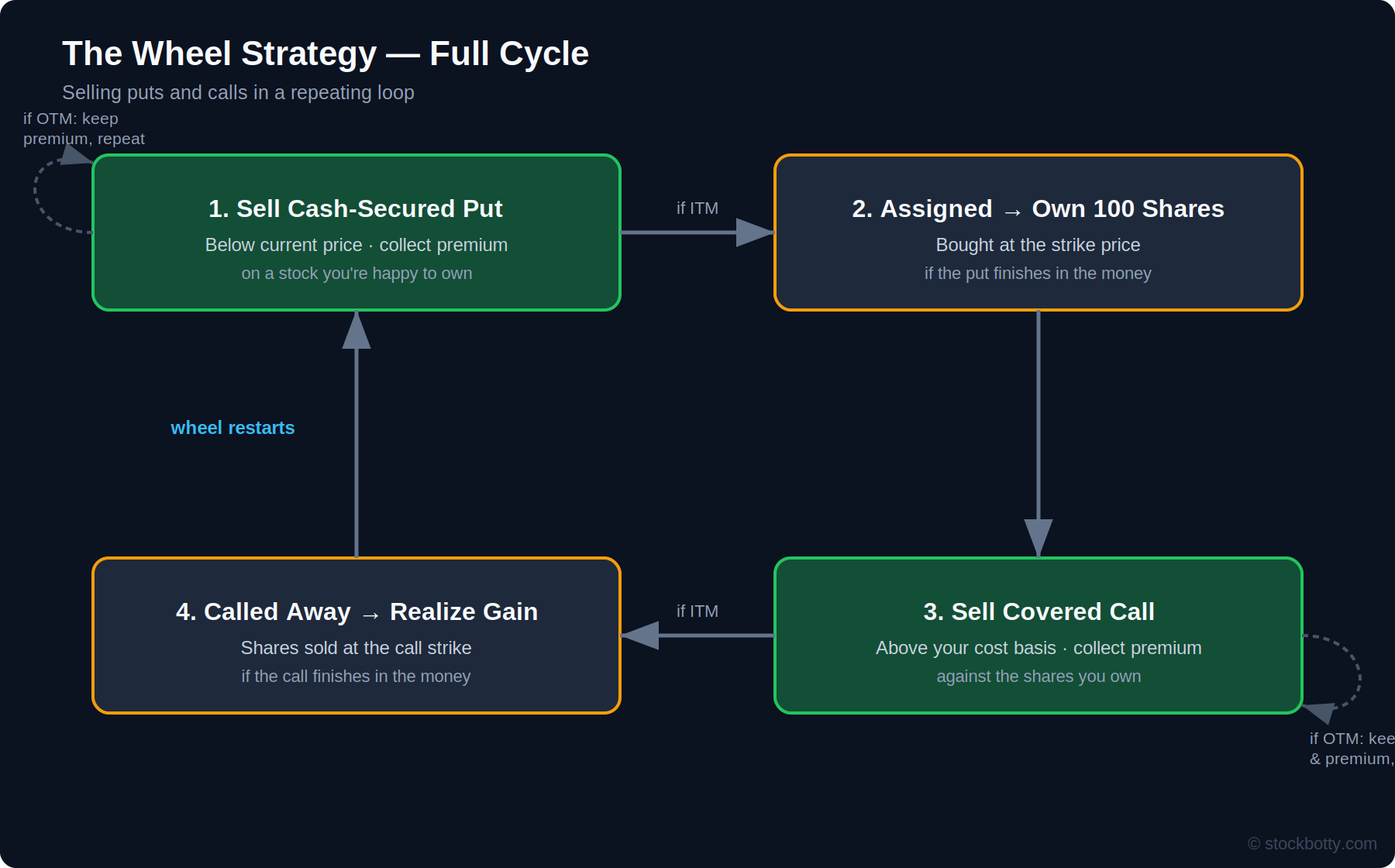
The wheel strategy is a repeating cycle of selling cash-secured puts and covered calls on a stock you’re willing to own. Unlike defined-risk spreads such as the iron condor, the wheel carries full stock ownership risk once you’re assigned – but in exchange it generates ongoing premium income whether you’re waiting to buy the stock or already holding it. It’s one of the more approachable options strategies for beginners because each individual step is simple on its own; the skill is in managing the cycle over time.
A Quick Refresher: Cash-Secured Puts and Covered Calls
- Cash-secured put: you sell a put option and set aside enough cash to buy 100 shares at the strike price if assigned. You collect a premium immediately, and either keep it if the stock stays above the strike, or use the reserved cash to buy the shares if it doesn’t.
- Covered call: once you own at least 100 shares, you sell a call option against them. You collect a premium immediately, and either keep the shares if the stock stays below the strike, or sell them at the strike if it’s called away.
The wheel simply alternates between these two, depending on whether you currently hold the shares or not.
The Full Cycle
The cycle has two possible paths at each stage. Selling a put either expires worthless (you keep the premium and sell another put) or gets assigned (you buy the shares). Once you own shares, selling a call either expires worthless (you keep the shares and premium, and sell another call) or gets assigned (the shares are sold and you go back to selling puts). As long as you keep repeating the cycle, the wheel keeps turning.
Step-by-Step: Working Through One Turn of the Wheel
Step 1 – Sell a Cash-Secured Put
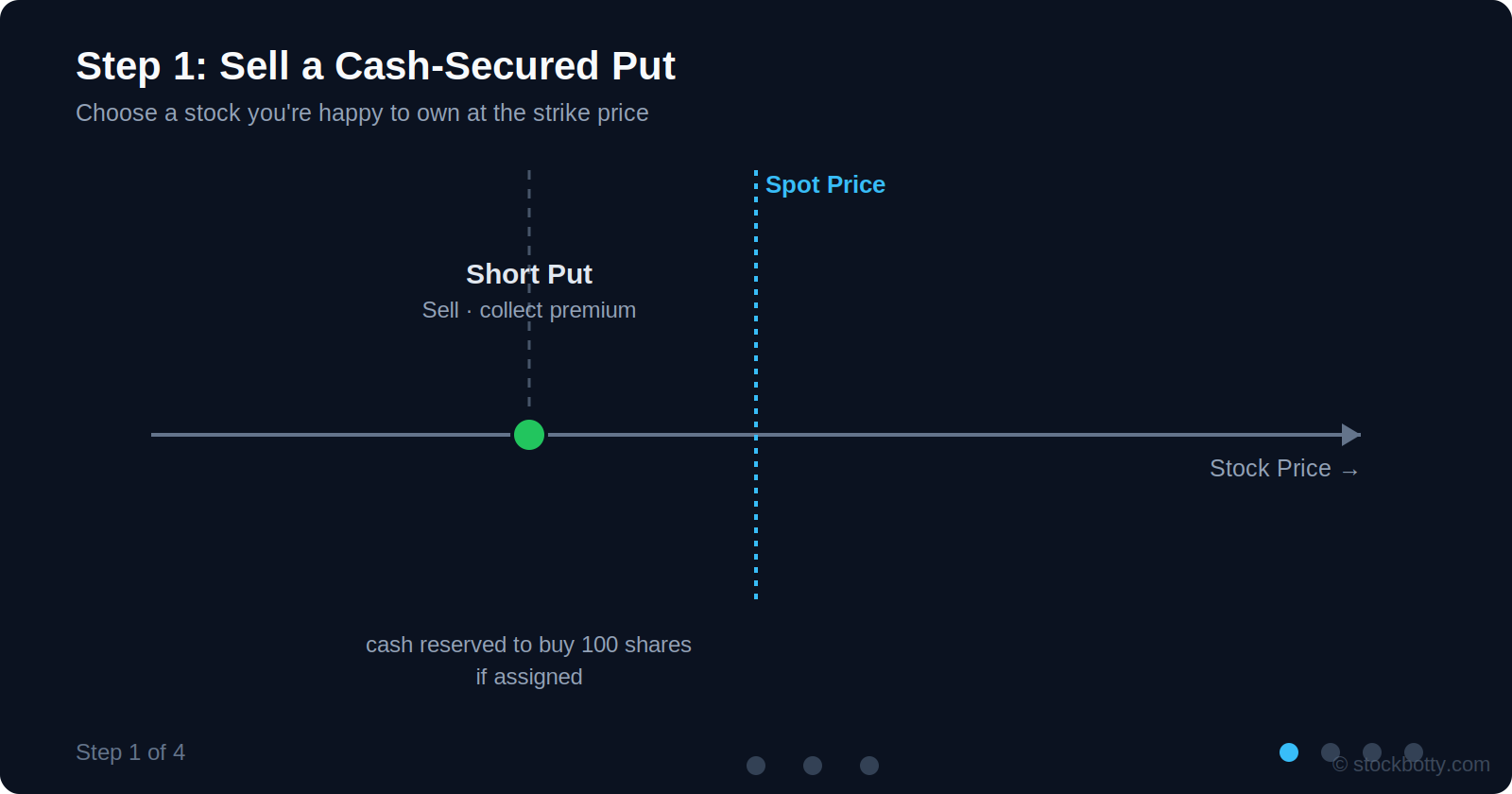
Pick a stock or ETF you’d genuinely be comfortable owning, and sell a put below the current price. Set aside the cash to buy 100 shares per contract at that strike – this is what makes the put “cash-secured” rather than naked. You collect the premium immediately, regardless of what happens next.
Step 2 – If Assigned, You Own 100 Shares
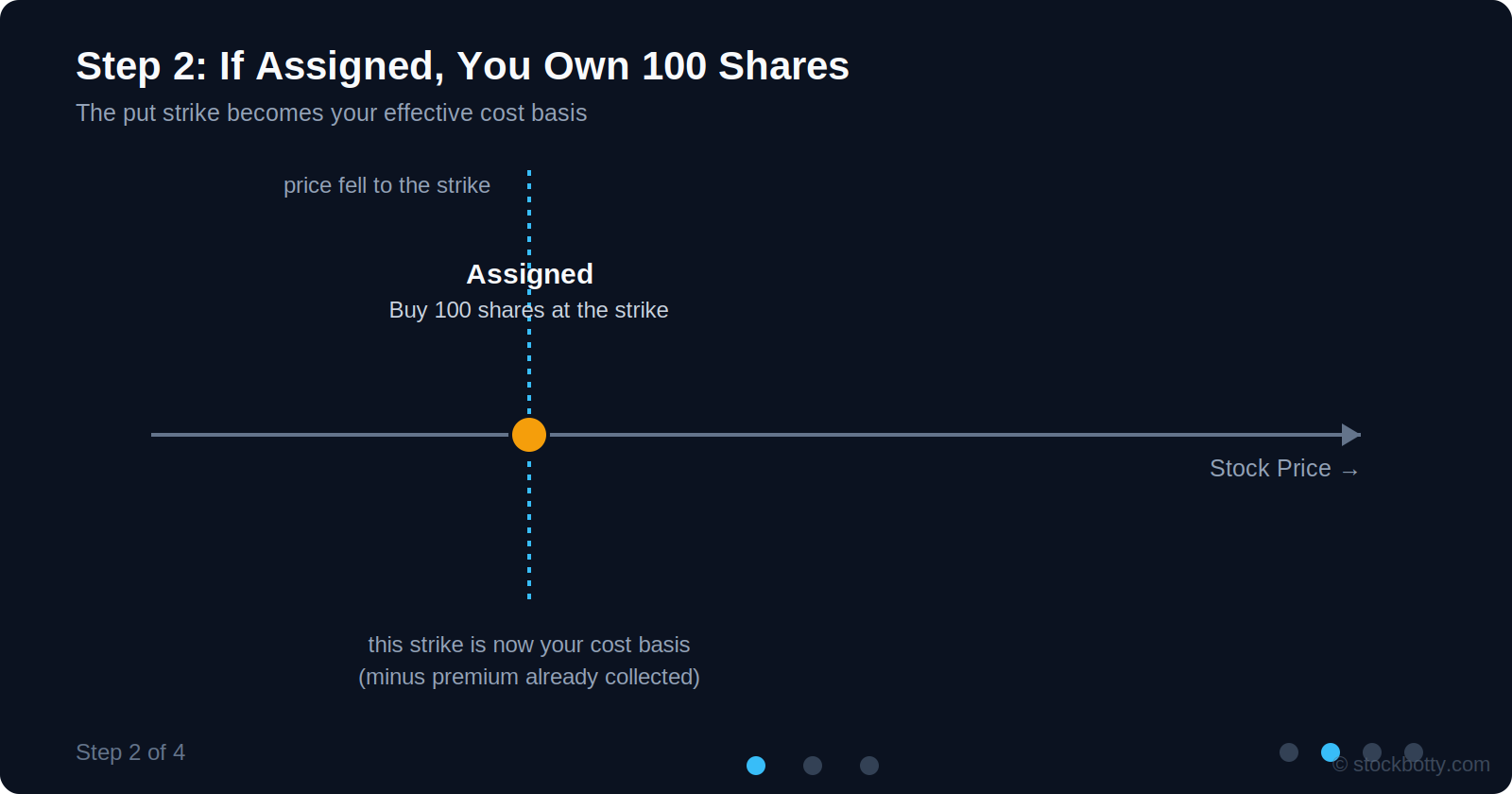
If the stock is below the strike at expiration, you’re assigned: your reserved cash is used to buy 100 shares per contract at the strike price. Your effective cost basis is the strike price minus the premium you already collected – slightly better than if you’d simply bought the stock outright at that price.
Step 3 – Sell a Covered Call
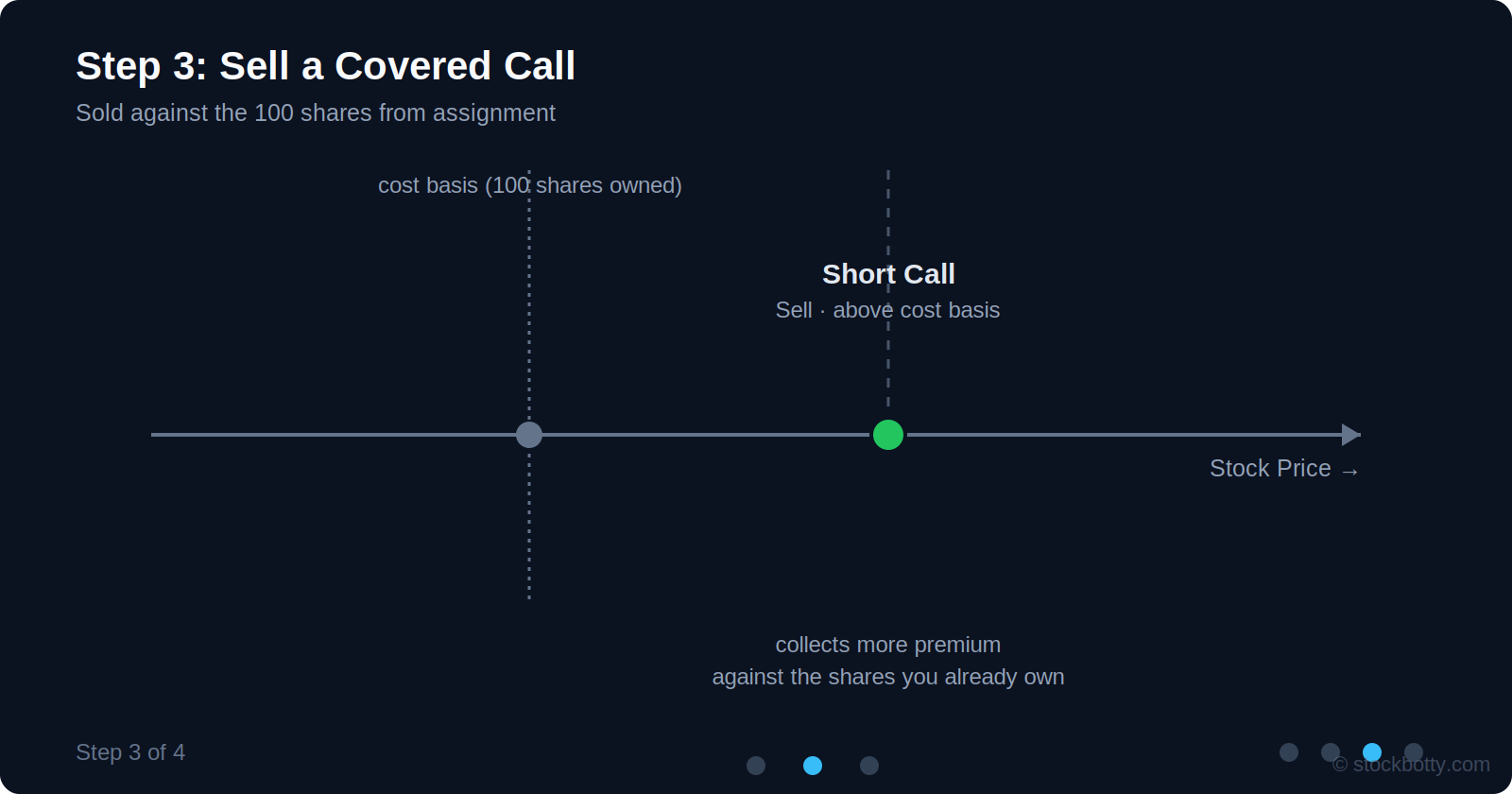
With shares in hand, sell a call above your cost basis. This generates more premium while you hold the stock, and sets a price at which you’re willing to sell if the stock rallies.
Step 4 – If Called Away, the Cycle Restarts
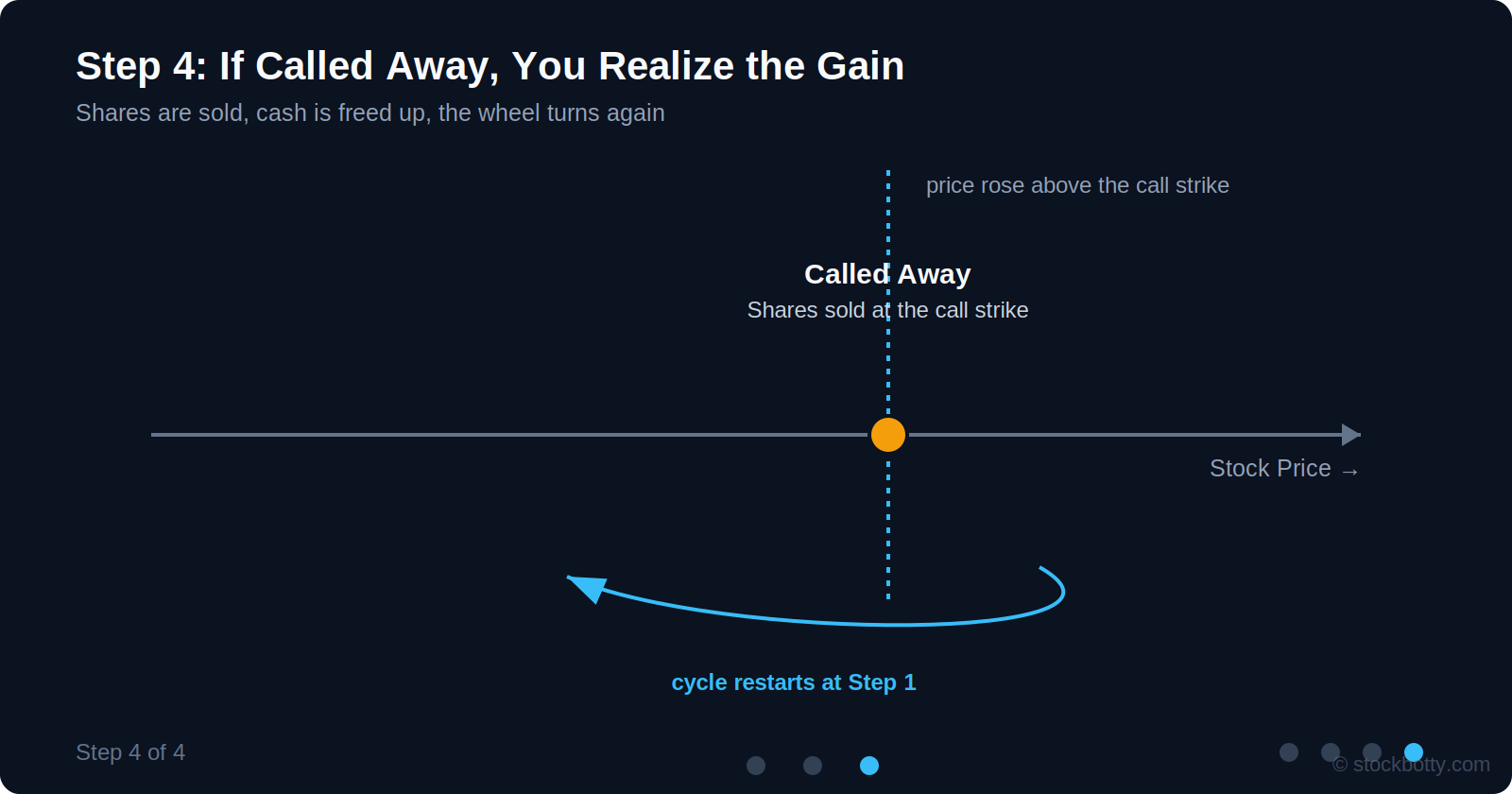
If the stock is above the call strike at expiration, your shares are sold at that strike. You realize the difference between your cost basis and the call strike as profit, on top of every premium collected along the way – and you’re back to Step 1 with free cash to sell another put.
Choosing Strikes and Expiration
- Delta-based selection: a common starting point is around a 20-30 delta on both the puts and the calls – enough premium to be worthwhile, without an excessively high chance of assignment on every cycle.
- Covered call strike vs. cost basis: selling calls at or above your cost basis avoids locking in a loss if shares are called away. Selling below cost basis can make sense if you’re trying to exit a losing position, but it guarantees a loss on the stock if assigned.
- Days to expiration: 30-45 days is common for both legs, balancing meaningful premium against how long capital or shares are tied up per cycle.
When to Enter the Wheel
- A stock you actually want to own: since assignment is a normal, expected outcome and not a failure, only run the wheel on names you’d be fine holding through a downturn – this is the single most important selection criterion.
- Elevated implied volatility: higher IV means richer premium on both the puts and the calls, improving the income side of the strategy.
- No major catalysts you want to avoid: earnings and other binary events increase premium but also increase the chance of a large gap that moves well past your strike, which is a different risk profile than steady range-bound decay.
Managing the Trade: Rolling and Assignment Risk
Rolling the put to avoid assignment
If the stock drops toward your short put strike and you’d prefer not to be assigned yet, you can roll the put down (to a lower strike) and out (to a later expiration), usually for an additional credit. This buys time and improves your effective entry price, but it doesn’t remove the risk – if the stock keeps falling, you can end up rolling repeatedly while the paper loss grows.
Rolling the call to avoid losing shares
If the stock rallies toward your short call strike and you want to keep the shares, you can roll the call up and out for a credit. This raises the price at which shares would be called away, at the cost of giving the stock more room to keep running past even the new strike.
Assignment isn’t a failure
New wheel traders sometimes treat assignment as something to avoid at all costs. In practice, it’s simply the strategy doing what it’s designed to do – you end up owning a stock you already chose to own, at a discount to where it was trading when you started, and you immediately begin collecting covered call premium on it. The real risk isn’t assignment itself, it’s a sustained decline in the underlying after assignment.
The Line Lifts Over Time (T+0)
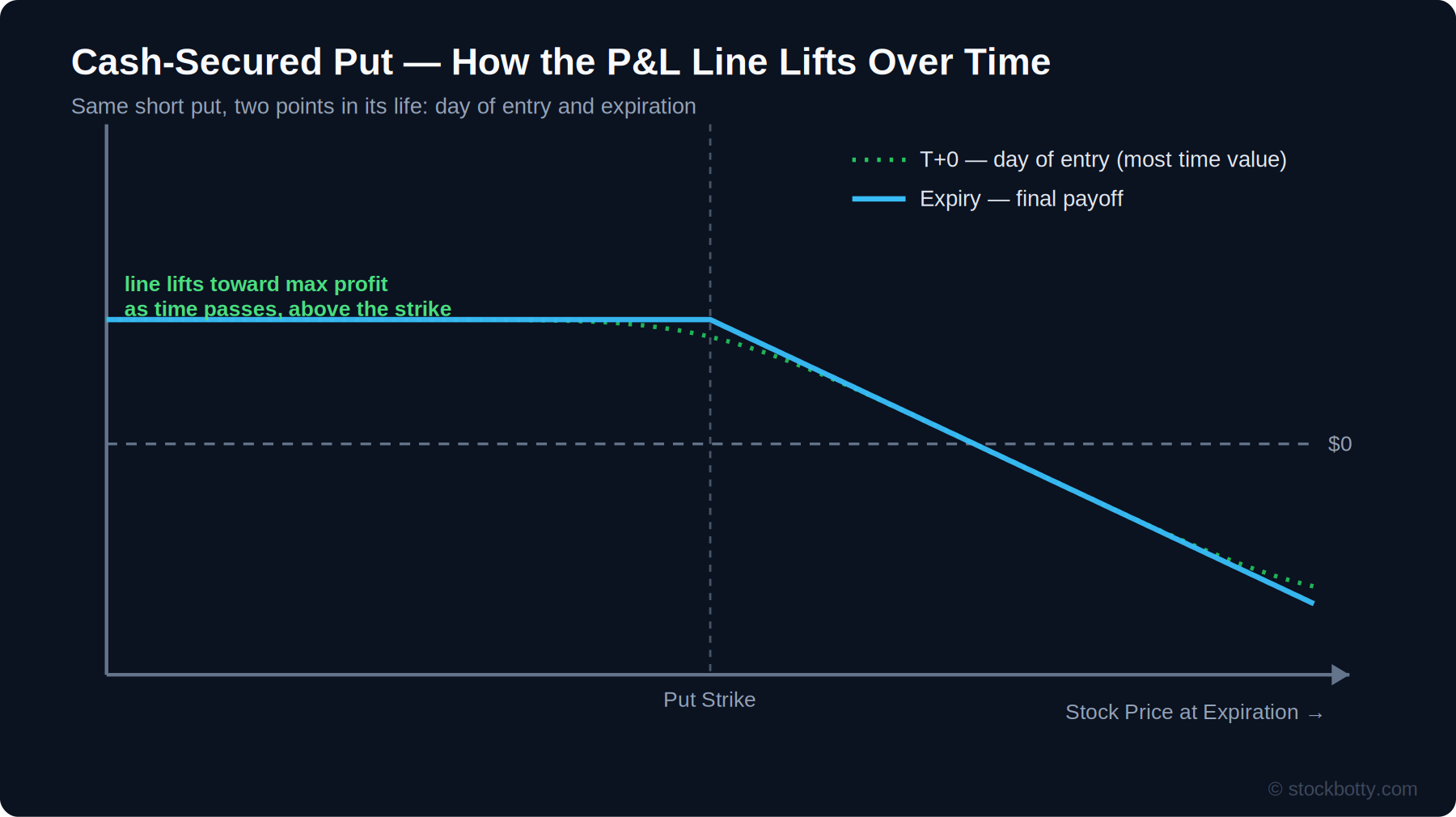
Each leg of the wheel – the short put while you’re waiting for assignment, the short call once you own shares – behaves the same way any short option does before expiration. The kinked payoff line above only describes the position on the exact day of expiration. Every day before that, the position is worth something between that final shape and a much more rounded curve, often called the T+0 line. It reflects the extrinsic (time) value still left in the option.
On the day you sell a put or call, the T+0 line is heavily rounded near the strike: even if the stock is sitting well above your short put strike, the position isn’t yet showing anything close to the full premium as profit, because the option still carries weeks of time value. As days pass and theta decay works in your favor, the line lifts and straightens toward the sharp expiry shape.
Practically, this is why many wheel traders don’t wait until expiration to manage a leg – closing a short put or call once most of the premium has decayed (commonly once 50-75% of it is gone) locks in most of the available profit without holding through the last, riskiest stretch of time for a comparatively small amount of remaining premium.
Greeks and Volatility Behavior
- Theta (time decay): positive on both legs of the cycle – both the short put and the short call gain value from time decay as expiration approaches.
- Vega (volatility): negative – a drop in implied volatility helps the currently open short option; a rise in IV works against it.
-
⚡ Important: because whichever leg is open is short vega, a broad market volatility spike can push that leg into an unrealized loss even while the stock hasn’t moved past your strike. This is unrelated to the next premium you’ll collect on the following leg – a richer premium later doesn’t undo a mark-to-market loss on the position you’re holding right now.
- Delta (direction): while short a put, delta is positive – you benefit from the stock rising. Once assigned and short a call, delta is close to 1.00 from the shares themselves, partially offset by the short call.
- Gamma (acceleration): like any short option position, gamma rises sharply in the final one to two weeks before expiration. A stock that was comfortably away from your strike can approach it quickly in this window, which is when assignment risk becomes real rather than theoretical.
-
⚡ Important: gamma risk is worth repeating on its own – in the last 14 days before expiration, gamma can grow large enough that a stock move which would have been a minor delta adjustment a month out instead swings the position hard and fast. Many wheel traders check strikes daily once inside this window, rather than relying on a weekly review.
Example Trade
Stock trading at $100, a name the trader wants to own long-term. They sell the 95-strike put, 35-45 days out, for $2.00 per share ($200 per contract), reserving $9,500 in cash.
- If the put expires worthless: keep the $200 premium, sell another put.
- If assigned: buy 100 shares at $95, effective cost basis $93 after the premium. Then sell the 98-strike covered call for $1.50 ($150 per contract).
- If the call expires worthless: keep the shares and the $150 premium, sell another call.
- If called away at $98: realize $5 per share on the stock ($500) plus $200 + $150 in premium collected – $850 total per 100-share cycle, before commissions.
Pros and Cons
Pros: generates income in both the waiting phase and the holding phase, only ever puts you into stocks you’ve already chosen to own, straightforward to understand one leg at a time, works well in sideways-to-mildly-bullish markets.
Cons: full downside risk once assigned, unlike defined-risk spreads, upside is capped once a covered call is sold, ties up meaningful capital, a sustained downtrend can erode the position faster than premium collected can offset.
⚠ Risks Beyond the Basics
Most introductions to the wheel stop at “you get paid to buy stocks you already wanted.” That’s true, but it skips several risks that don’t show up in a simple premium calculation.
Early assignment and dividend risk on covered calls
Equity options are American-style, so a short call can be exercised early – most commonly right before an ex-dividend date, when a call holder exercises specifically to capture the dividend. If your covered call is in the money with little extrinsic value left going into an ex-dividend date, expect a real chance of losing the shares earlier than the option’s expiration would suggest.
Wash sale rule on repeated losing assignments
If you’re assigned stock at a loss, sell it, and then sell another put on the same underlying within 30 days, US wash sale rules can disallow the loss for tax purposes in that year, deferring it into the cost basis of the new position instead. Running the wheel repeatedly on the same ticker through a decline can trigger this without the trader realizing it until tax season.
Capital concentration
Each cash-secured put ties up the full strike value in reserved cash, and each covered call requires owning 100 actual shares. Compared to defined-risk spreads that use a fraction of that capital for similar premium, the wheel concentrates a large amount of capital into a single underlying – worth weighing against how diversified the rest of a portfolio is.
The averaging-down trap
After a stock declines and calls are sold below the cost basis, some traders refuse to do so in order to “protect” the cost basis, and instead just keep selling puts and adding to the position on every dip. This isn’t a flaw in the wheel itself, but a common behavioral trap: it quietly turns an income strategy into an unplanned, uncapped bet on a single stock recovering, funded by ever-larger cash reserves.
Weekend and overnight gap risk
A short put or covered call that looks safely positioned at Friday’s close can gap through the strike on Monday’s open on overnight news, with no opportunity to adjust in between. This is a structural risk of holding any short option over a weekend or earnings date, not something position sizing alone can remove.
Frequently Asked Questions
Is the wheel strategy safe?
No strategy involving stock ownership is risk-free. The wheel still carries full downside risk once you’re assigned shares – if the stock drops sharply and keeps dropping, you hold a losing position just like a buy-and-hold investor, offset only by the premium collected.
What stocks should I use for the wheel strategy?
Stocks or ETFs you would be comfortable owning for the long term at the strike price, ideally with stable price action, decent options liquidity, and no major binary events pending. Highly volatile or speculative stocks increase premium but also increase the chance of a large, sustained drop.
What happens if the stock price drops a lot after I’m assigned?
You own the shares at your cost basis and are exposed to further declines like any shareholder. You can sell covered calls at or near your cost basis to keep collecting premium while you wait for the stock to recover, but this does not protect against continued downside.
How is the wheel strategy different from just buying and holding the stock?
The wheel collects premium income during both the waiting period before assignment and while holding the shares, which buy-and-hold does not. In exchange, it caps the upside on the stock once a covered call is sold, since shares can be called away at the strike.
What delta should I use for cash-secured puts and covered calls?
Many traders sell around a 20-30 delta on both legs as a starting point, balancing meaningful premium against a moderate probability of assignment. More conservative traders use a lower delta to reduce assignment frequency; more aggressive traders use a higher delta for more premium.
Can you lose money on the wheel strategy?
Yes. The main risk is a sustained decline in the underlying stock after assignment, where losses on the shares exceed the premium collected from selling puts and calls over time.