
Every call option has two sides: someone buys it, someone sells it. The buyer holds a long call – the right to purchase the stock at the strike price, paid for with a premium. The seller holds a short call – the obligation to deliver the stock at the strike if assigned, in exchange for collecting that same premium. They’re the simplest options positions there are, and every multi-leg strategy covered elsewhere in this series is ultimately built out of combinations of these building blocks.
A Quick Refresher: Rights vs. Obligations
- Long call (buyer): pays a premium up front for the right, but not the obligation, to buy the stock at the strike price. If the trade doesn’t work out, the buyer simply lets the option expire and loses only what was paid.
- Short call (seller): collects the premium up front and takes on the obligation to sell the stock at the strike if the buyer chooses to exercise. The seller doesn’t get to decide whether the trade continues – the buyer does.
Long Call – Structure
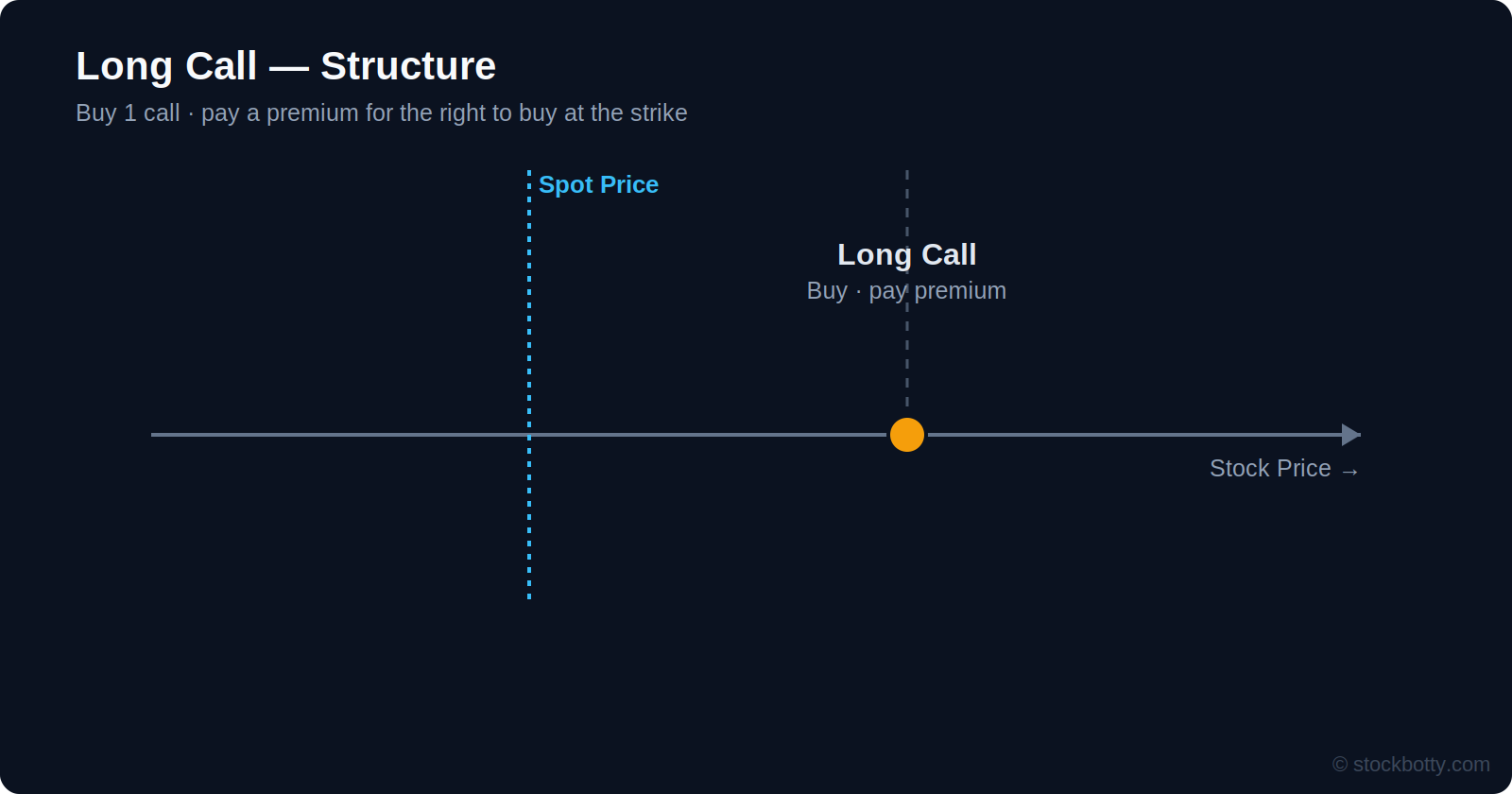
Buy 1 call at a chosen strike and expiration. That’s the entire structure – one contract, one premium paid, nothing else to manage on the position itself.
Short Call – Structure
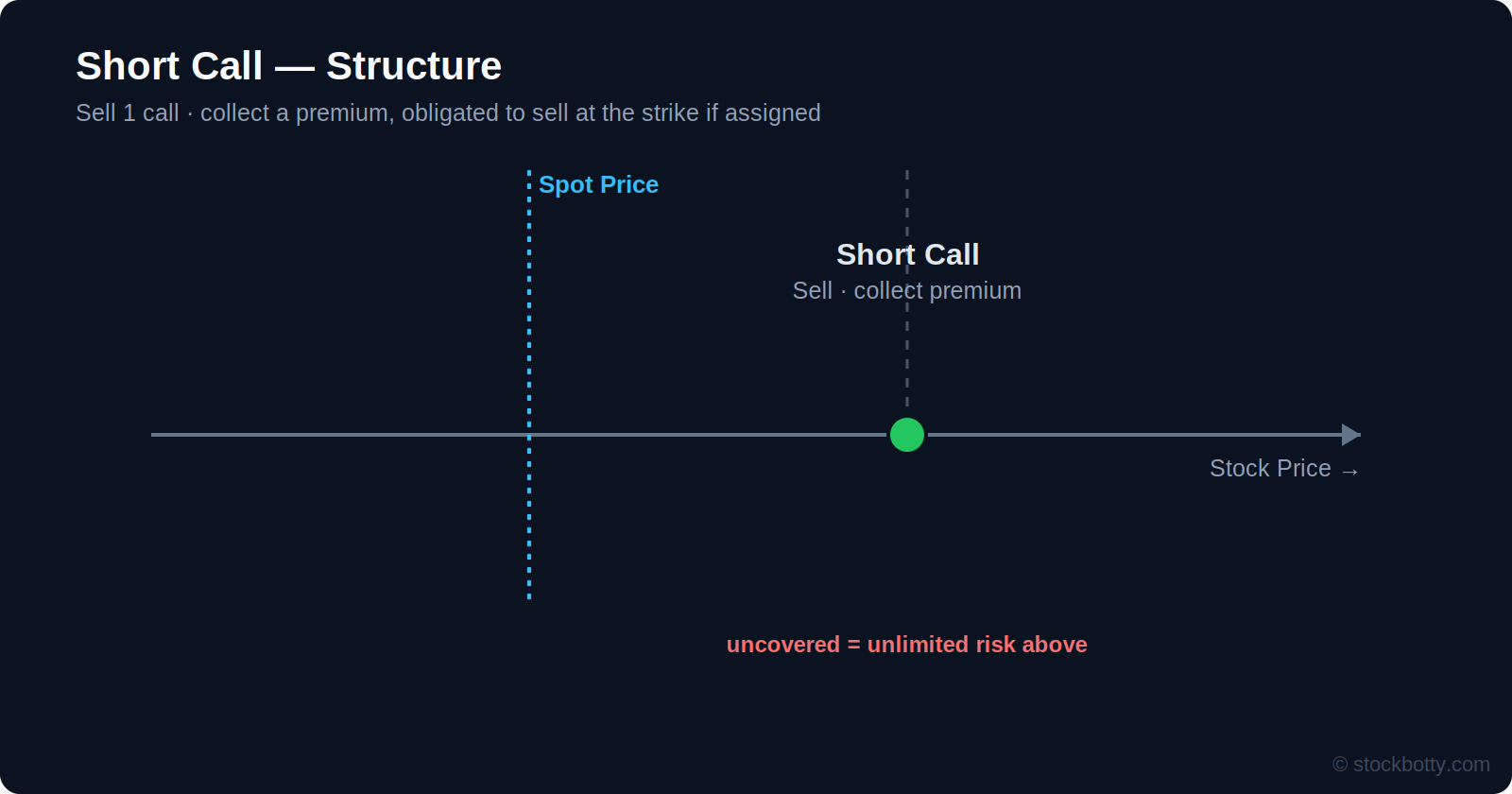
Sell 1 call at a chosen strike and expiration. If this is done without owning 100 shares per contract, the position is uncovered – there’s nothing capping how much the stock can rise against it. Selling a call against shares already owned (a covered call) is a different risk profile, covered in its own guide.
Payoff at Expiration
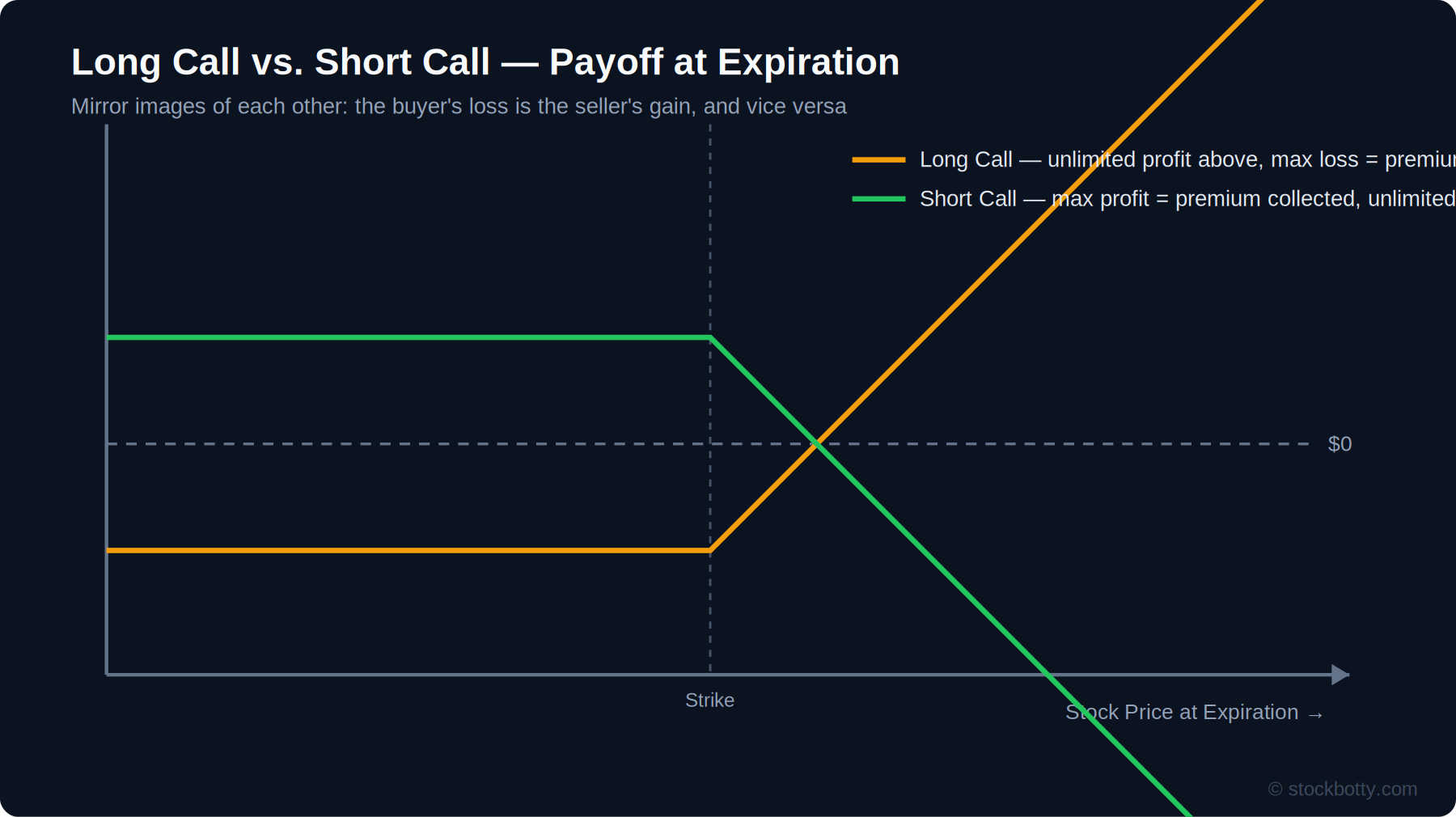
The two positions are exact mirror images. Below the strike, the long call is worth nothing and the buyer loses the full premium paid – while the short call keeps the full premium as profit, since it also expires worthless. Above the strike, the relationship flips: the long call’s value rises without limit as the stock climbs, dollar for dollar, while the short call’s losses grow without limit in exactly the same way. One side’s unlimited upside is the other side’s unlimited downside.
Choosing Strikes and Expiration
- Long call strike selection: a strike near or in the money behaves more like owning the stock (higher delta, more expensive, less time-decay-sensitive relative to its price), while a strike further out of the money is cheaper and more leveraged, but needs a larger move to become profitable and decays faster in percentage terms.
- Short call strike selection: for a covered call, strikes are typically chosen above the current price or cost basis, often in a similar 20-30 delta range used elsewhere in this series, balancing premium collected against the odds of the shares being called away.
- Days to expiration: buyers generally want more time than they think they need, since time decay accelerates as expiration nears and a move that’s “eventually right” can still lose money if it comes too late. Sellers often prefer 30-45 days for a similar balance of theta versus gamma discussed throughout this series.
When to Use a Long Call vs. a Short Call
- Long call: used for a clearly bullish view with defined, limited risk – appropriate when a trader wants leveraged upside exposure without the capital outlay or downside risk of owning the stock outright.
- Short call (covered): used to generate income against shares already owned, or to set a target price at which the trader is willing to sell.
- Short call (naked): used by more advanced traders with a bearish-to-neutral view and a plan for managing the uncapped risk – generally not a starting point for beginners.
Managing the Trade
- Long call: many traders set a plan before entering – a profit target, a time-based exit if the move hasn’t happened by a certain point, and a stop-loss level – since a call can lose its entire premium not just from being wrong on direction, but simply from running out of time.
- Short call (covered): can be rolled up and out if the stock rallies and the trader wants to keep the shares, or simply allowed to have the shares called away at the strike if that outcome is acceptable.
- Short call (naked): requires active monitoring and a firm risk limit, since there’s no structural cap on the loss the way there is with covered or spread positions elsewhere in this series.
The Line Lifts – or Sinks – Over Time (T+0)
Every other strategy in this series so far has been on the selling side, where time decay works in the trader’s favor and the T+0 line lifts toward the final payoff as expiration approaches. A long call flips that entirely: time decay works against the buyer. The option’s value today sits above the flat, kinked expiration line near the strike, cushioned by remaining time value – and that cushion shrinks every day, sinking the curve down toward the sharp expiration shape rather than lifting it up. A stock that goes nowhere doesn’t just fail to help a long call; it actively costs the buyer money, day after day.
The short call side is the mirror: the seller’s T+0 line behaves the same way described throughout the rest of this series – it lifts toward the flat, profitable region as time passes, which is exactly why time decay is a headwind for the buyer and a tailwind for the seller of the very same contract.
Greeks and Volatility Behavior
- Theta (time decay): negative for the long call – it loses value every day, all else equal. Positive for the short call – the mirror image.
- Vega (volatility): positive for the long call – a rise in implied volatility increases its value. Negative for the short call.
- Delta (direction): positive for the long call, growing toward 1.00 as it moves deeper in the money. Negative for the short call, in exactly the same magnitude.
- Gamma (acceleration): highest for both positions when the stock is near the strike close to expiration – this cuts both ways: it can turn a long call from worthless into valuable very quickly, and it can do the same to a short call’s losses.
Example Trade
Long call: stock trading at $100. Buy the 105-strike call, 45 days out, for $2.50 ($250 per contract). Max loss: $250, if the stock is below $105 at expiration. Breakeven: $107.50. If the stock reaches $115 at expiration, the call is worth $10.00 ($1,000) – a $750 profit on $250 risked.
Short call (covered): same stock at $100, trader owns 100 shares. Sell the 105-strike call for the same $2.50 ($250 collected). If the stock stays below $105, keep the $250 and the shares. If it’s above $105 at expiration, the shares are sold at $105 – a $5 gain on the stock plus the $250 premium, but no further upside beyond that.
Pros and Cons
Long call pros: defined, limited risk, unlimited profit potential, leveraged exposure without the capital of owning the stock outright.
Long call cons: loses value to time decay every day, can lose the entire premium even if eventually right about direction but wrong about timing, needs a move large enough to overcome the premium paid.
Short call pros: benefits from time decay, can generate steady income when covered, high probability of keeping some or all of the premium if range-bound or falling.
Short call cons: unlimited risk if uncovered, caps the upside if covered (shares can be called away), requires active management if naked.
⚠ Risks Beyond the Basics
Long and short calls look simple, but a few risks are easy to underestimate specifically because the structure looks so basic.
A naked short call is genuinely unlimited risk, not just “large”
It’s worth saying plainly: there is no ceiling on how high a stock’s price can go, and an uncovered short call’s loss grows without limit alongside it. This isn’t a defined-risk strategy with an unusually wide range – it’s structurally different from every spread covered elsewhere in this series, and brokers require substantial margin to reflect that.
Time decay is a real cost, not just an absence of gain
A long call that’s “roughly right” about direction can still lose money if the move happens too slowly. Time decay isn’t neutral for the buyer – every day the stock doesn’t move meaningfully in the right direction, the option is worth measurably less than it was the day before.
IV crush on long calls bought ahead of known events
Buying a call ahead of earnings or another catalyst, expecting a big move, carries a specific risk: implied volatility is often elevated going in and collapses immediately after the event, regardless of direction. A stock can move the “right” way and the long call can still underperform, or even lose money, if the IV crush outweighs the directional gain.
Early assignment and dividend risk on short calls
An in-the-money short call with little extrinsic value left can be exercised early, particularly around an ex-dividend date. Covered call sellers on dividend-paying stocks should expect this as a real possibility, not an edge case.
Weekend and overnight gap risk on naked short calls
Because the risk is uncapped, a large overnight gap on unexpected news is the single most dangerous scenario for a naked short call – there’s no opportunity to adjust intraday, and the loss can be severe before the market even opens for a reaction.
Frequently Asked Questions
What’s the difference between a long call and a short call?
A long call buys the right to purchase the stock at the strike price, paying a premium up front. A short call sells that right to someone else, collecting the premium but taking on the obligation to deliver the stock at the strike if assigned. They are mirror images of the same contract.
What is the maximum loss on a long call?
The premium paid to buy it. That’s the most a long call can ever lose, regardless of how far the stock falls.
What is the maximum risk on a short call?
If the call is uncovered (naked, without owning the underlying shares), the risk is theoretically unlimited, since a stock’s price can rise without any ceiling. If it’s covered by owning 100 shares per contract, the risk is limited to the stock’s own downside, offset by the premium collected.
Is a short call the same as a covered call?
A covered call is a short call sold against shares you already own, which caps the otherwise unlimited risk. A short call without owning the shares is uncovered, or naked, and carries unlimited risk if the stock rallies.
How does time decay affect a long call?
Negatively. A long call loses value from time decay every day, all else equal, since it’s a wasting asset that must overcome that decay with a large enough move in the stock to be profitable.
When does a short call make sense?
As a covered call against shares already owned, to generate income and set a target sale price, or as a bearish-to-neutral bet by more advanced traders comfortable managing the uncapped risk of a naked position.