
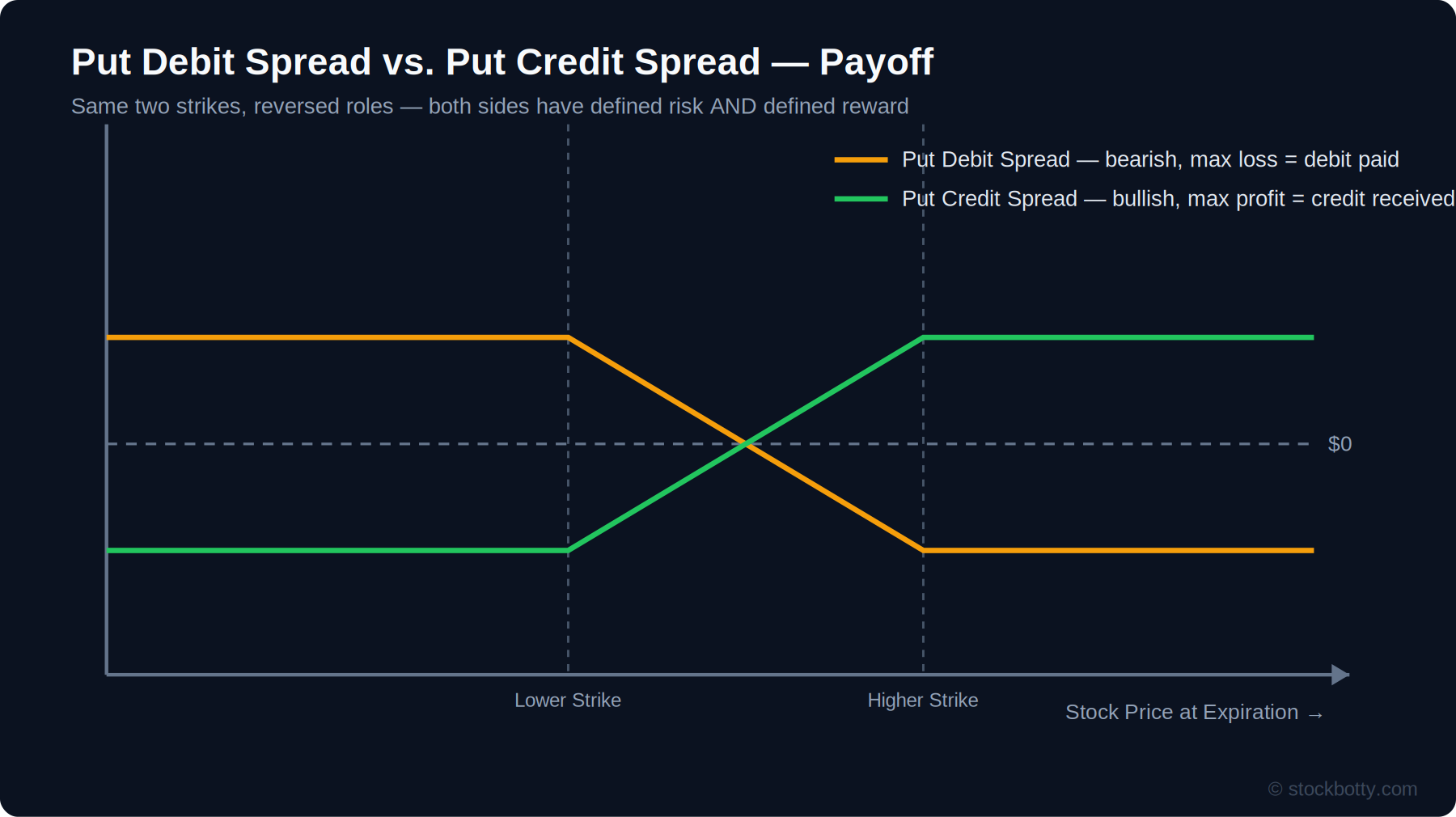
A put debit spread and a put credit spread both use two put strikes in the same expiration – the difference is entirely in which one is bought and which one is sold. Buy the higher strike and sell the lower strike, and it’s a put debit spread: a bearish position paid for with a net debit. Sell the higher strike and buy the lower strike, and it’s a put credit spread: a bullish position that collects a net credit. On the same two strikes, they’re exact opposites of each other – and like their call-spread counterparts, both versions have defined risk and defined reward.
A Quick Refresher: Vertical Spreads
A single long put has large profit potential as the stock falls but loses its entire premium if the stock doesn’t move enough. A single naked short put has the mirror problem: steady income, but a large risk if the stock drops hard. A vertical spread – buying one strike and selling another in the same expiration – trades away some of that open-ended profit or risk in exchange for a fully defined outcome on both sides.
Put Debit Spread – Structure
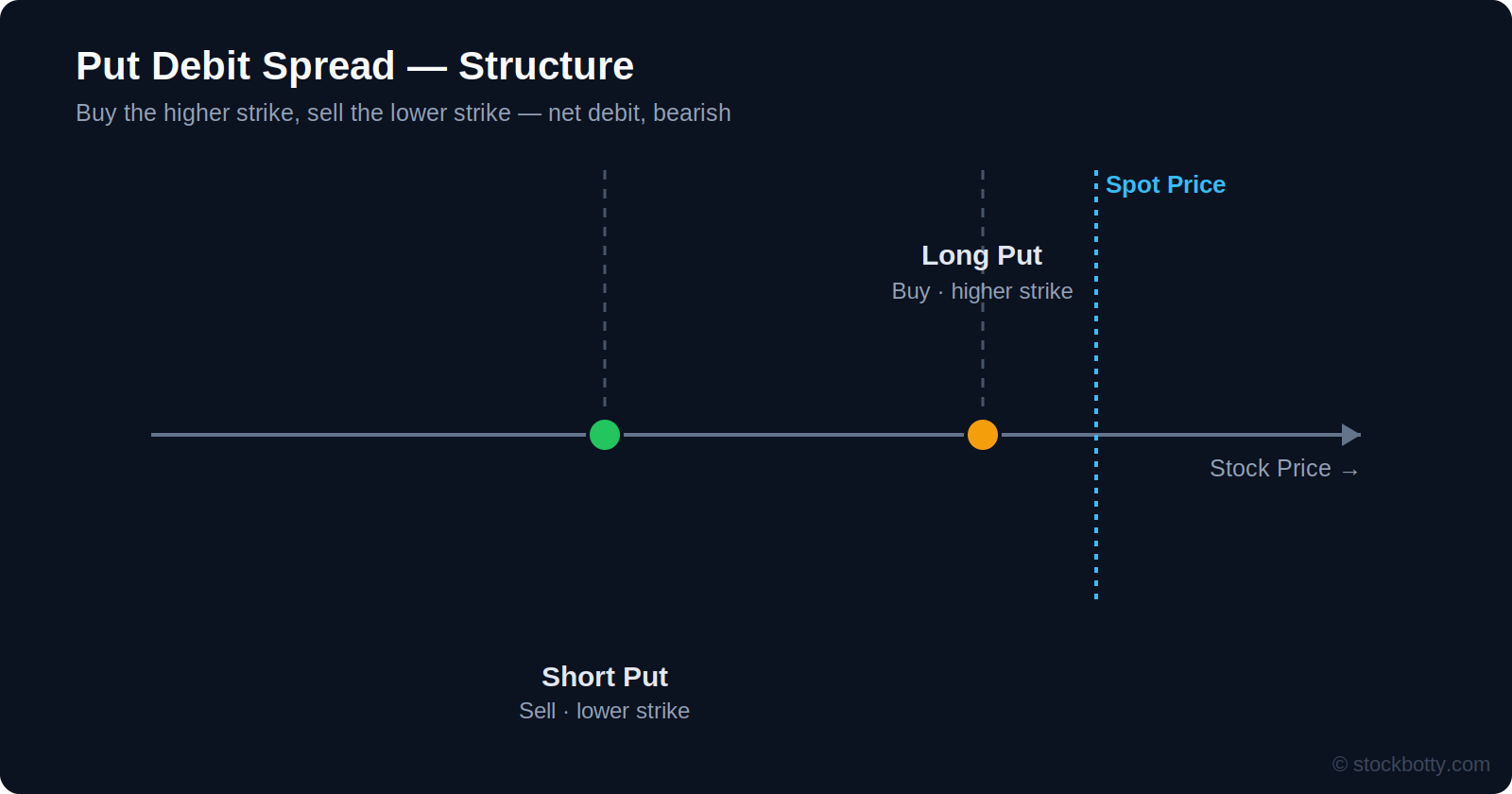
Buy 1 put at a higher strike, sell 1 put at a lower strike, same expiration. The premium collected from the short put partially offsets the cost of the long put, so the position costs less than buying the put alone – but the profit is capped once the stock reaches the lower strike.
Put Credit Spread – Structure
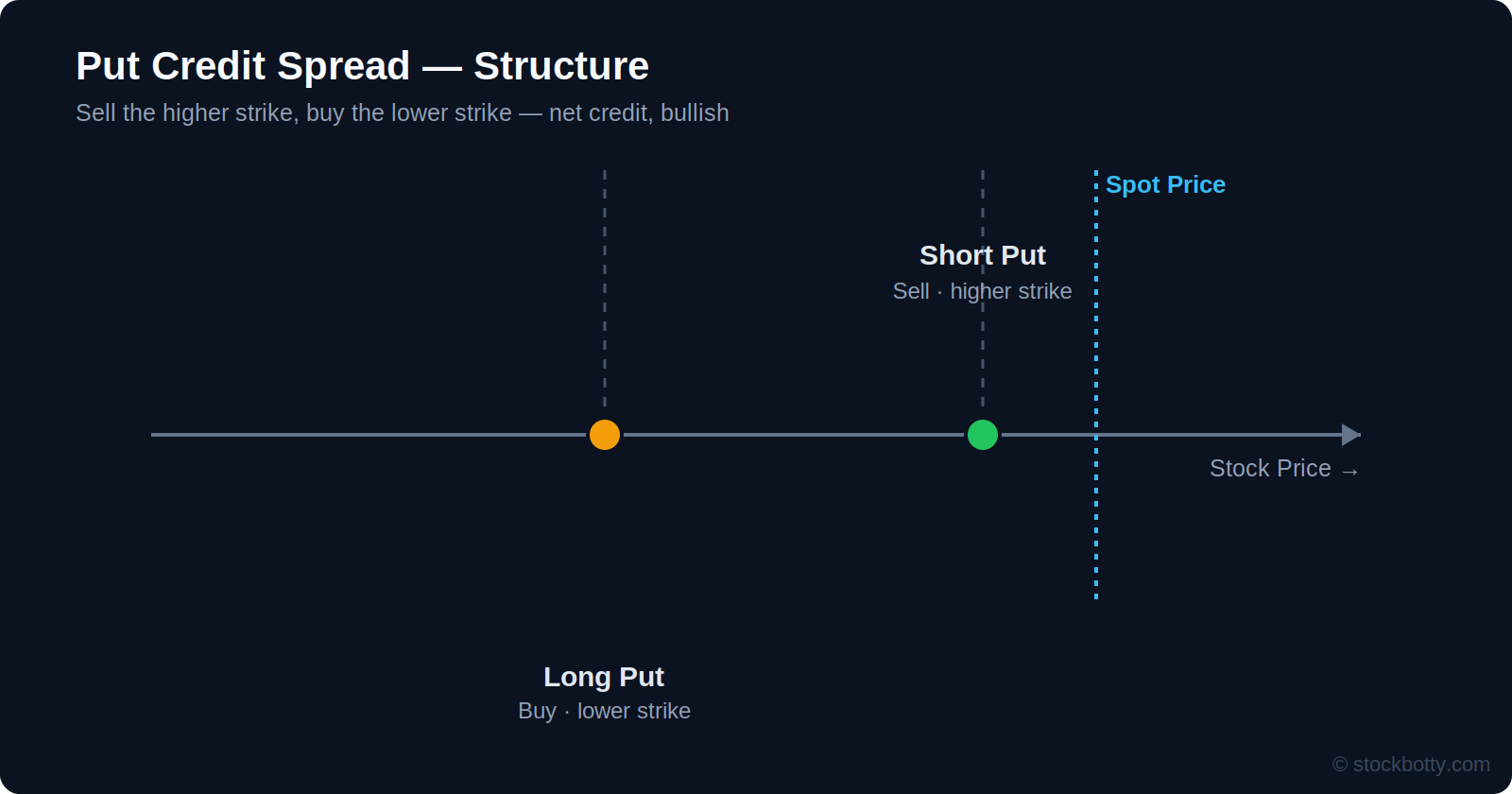
Sell 1 put at a higher strike, buy 1 put at a lower strike, same expiration. The long put caps what would otherwise be a large, largely unbounded risk on the short put, turning it into a defined-risk position – at the cost of collecting less premium than selling the put alone would bring in.
Payoff at Expiration
Above the higher strike, the debit spread is worth nothing and the buyer loses the full debit paid, while the credit spread keeps the full credit as profit. Below the lower strike, it’s reversed: the debit spread is worth its maximum, capped value, while the credit spread has hit its maximum, capped loss. Between the two strikes, one position’s value rises exactly as fast as the other’s falls – true mirror images on the same two strikes.
Choosing Strikes and Expiration
- Put debit spread: the higher (long) strike is often placed near or slightly above the current price for a higher-probability, lower-leverage trade, or further out of the money for a cheaper, higher-leverage one. The short strike sets the profit cap.
- Put credit spread: the short strike is often placed with a similar delta-based approach used elsewhere in this series – commonly in the 20-30 delta range – with the long strike set far enough away to define an acceptable maximum loss relative to the credit collected.
- Days to expiration: debit spread buyers generally want enough time for the thesis to play out, similar to a single long put. Credit spread sellers often use the 30-45 day range common to other premium-selling strategies in this series.
When to Use Each
- Put debit spread: a bearish view where the trader wants defined risk and a lower cost than buying a put outright, and is comfortable capping the downside profit in exchange.
- Put credit spread: a bullish-to-neutral view – profits if the stock stays above the short strike, without needing the stock to actually rise, similar in spirit to a cash-secured short put but with the risk capped and generally without the intent of owning the shares.
Managing the Trade
- Put debit spread: some traders close once a large share of the maximum profit is captured, rather than waiting for the short strike to be fully reached, similar to the early-exit logic used with other spreads in this series.
- Put credit spread: can be rolled down and out if the stock falls toward the short strike and the thesis still seems intact, or closed once a large share of the credit has decayed – the same 50-75% guideline discussed for other credit strategies applies here too.
The Line Lifts Over Time (T+0)
The put credit spread behaves like the short-premium strategies covered throughout this series: its T+0 line lifts toward the flat, profitable region as theta decay works in its favor, provided the stock stays above the short strike. The put debit spread behaves like the long put covered earlier: its value is cushioned by time value early on, and that cushion sinks toward the sharp expiration shape as expiration approaches – time decay is a mild headwind for the debit spread’s near-strike value, though less severe than for an outright long put, since the short leg’s decay partially offsets the long leg’s decay.
Greeks and Volatility Behavior
- Theta (time decay): generally positive for the put credit spread, mildly negative for the put debit spread – smaller in magnitude than a single option in both cases, since the two legs partially offset each other.
- Vega (volatility): generally negative for the put credit spread, generally positive for the put debit spread – again smaller in magnitude than a single option due to the offsetting legs.
- Delta (direction): negative for the put debit spread (bearish), positive for the put credit spread (bullish), though both are smaller in magnitude than an outright long or short put at the same primary strike, since the second leg partially offsets it.
- Gamma (acceleration): most pronounced near whichever strike is closer to the current price, and – as with every strategy in this series – grows sharply in the final one to two weeks before expiration.
Example Trade
Put debit spread: stock trading at $100. Buy the 100-strike put for $4.00 ($400), sell the 90-strike put for $1.50 ($150). Net debit: $2.50 ($250 per contract).
- Max profit: $750 (the $10 width, ×100, minus the $250 debit), if the stock is at or below $90 at expiration
- Max loss: $250, if the stock is at or above $100 at expiration
- Breakeven: $97.50
Put credit spread: same stock at $100. Sell the 95-strike put for $2.20 ($220), buy the 90-strike put for $0.90 ($90). Net credit: $1.30 ($130 per contract).
- Max profit: $130, if the stock is at or above $95 at expiration
- Max loss: $370 (the $5 width, ×100, minus the $130 credit), if the stock is at or below $90 at expiration
- Breakeven: $93.70
Pros and Cons
Put debit spread pros: lower cost and higher breakeven than an outright long put, defined risk, still profits from a bearish move.
Put debit spread cons: profit is capped, still loses to time decay if the stock doesn’t move, two-leg execution instead of one.
Put credit spread pros: defined risk unlike a naked or even cash-secured short put, benefits from time decay, doesn’t require the stock to rise – just to stay above the short strike.
Put credit spread cons: collects less premium than a cash-secured put at the same strike, profit is capped, still requires margin for the defined-risk width.
⚠ Risks Beyond the Basics
Vertical spreads are often introduced as the “safe,” simple version of a single option – but a few real risks are specific to the two-leg structure.
Early assignment on the short leg
Both the put credit spread’s short strike and the put debit spread’s short strike are American-style and can be exercised early, particularly once deep in the money with little time value left. This can temporarily leave the trader long shares (or obligated to be) against a long put that doesn’t automatically offset the assignment.
Pin risk right at the short strike
If the stock closes very close to the short strike at expiration, it may be unclear until after the close whether the short leg will be assigned, while the long leg’s exercise decision has to be made independently – this can leave an unintended, unhedged position over a weekend.
Execution and liquidity on both legs
Filling both legs as a single spread order is standard, but on less liquid underlyings the combined bid-ask spread can meaningfully affect the actual debit paid or credit received relative to the theoretical midpoint – and the same applies when closing or rolling later.
The capped profit is easy to overweight in a debit spread
A put debit spread’s maximum profit looks attractive as a percentage of the debit paid, but it requires the stock to reach or fall below the short strike – a smaller move than that still loses money at expiration even though the stock moved in the right direction, unlike an outright long put which profits from any move past its own breakeven.
Weekend and overnight gap risk
A put credit spread sitting safely above its short strike on Friday’s close can gap through both strikes at Monday’s open on unexpected news, moving straight to the maximum defined loss with no opportunity to adjust in between.
Frequently Asked Questions
What’s the difference between a put debit spread and a put credit spread?
A put debit spread buys the higher strike and sells the lower strike, paying a net debit for a bearish position. A put credit spread sells the higher strike and buys the lower strike, collecting a net credit for a bullish position. On the same two strikes, they are exact opposites of each other.
What is the maximum loss on a put debit spread?
The net debit paid to open the trade. This is the most it can lose, if the stock finishes at or above the higher strike at expiration.
What is the maximum loss on a put credit spread?
The width between the two strikes minus the net credit received. This is the most it can lose, if the stock finishes at or below the lower strike at expiration.
Why use a put debit spread instead of just buying a put?
Selling the lower strike put reduces the cost of the position and raises the breakeven price, at the cost of capping the maximum profit. It trades some downside potential for a cheaper entry and less dependence on a very large move.
Why use a put credit spread instead of a naked short put?
Buying the lower strike put caps the large risk of a naked short put, turning it into a defined-risk position, at the cost of collecting less premium than the naked put alone would provide.
How is a put credit spread different from a cash-secured put?
A cash-secured put reserves enough cash to buy 100 shares if assigned and has a large maximum loss down to zero. A put credit spread’s long put caps that risk at a defined amount, at the cost of a smaller credit collected, and generally doesn’t lead to owning the shares.