
⚠ Before you read this: this is how I personally manage my own losing short puts – not a recommendation, not financial advice, and not a guarantee that the same rule fits your capital, risk tolerance, or account size. What follows is a record of my own decision-making, including the parts where it could go wrong. Nothing here is a suggestion to replicate what I do.
Selling a put is simple to describe and hard to manage well once it moves against me. Without a rule, I’ve watched a small, manageable loss quietly turn into a large one – not because the trade was wrong, but because I hadn’t decided in advance when “wait and see” should turn into “do something.” This is the rule I actually use, built around a single, easy-to-track number: the loss as a multiple of the premium I originally collected.
Why I Needed a Rule Before I Needed It
The hardest part of managing a losing short put for me isn’t figuring out what to do – it’s figuring out when. Left to my own judgment in the moment, a small loss is easy to rationalize away (“it’ll come back”), and by the time it’s undeniable that the trade has gone wrong, I’ve sometimes found the good adjustment options already gone. Setting the rule in advance fixes the timing question before I’m in the position, so I’m not making the decision under the emotional pressure of watching it bleed in real time.
The Premium-Multiple Framework I Use
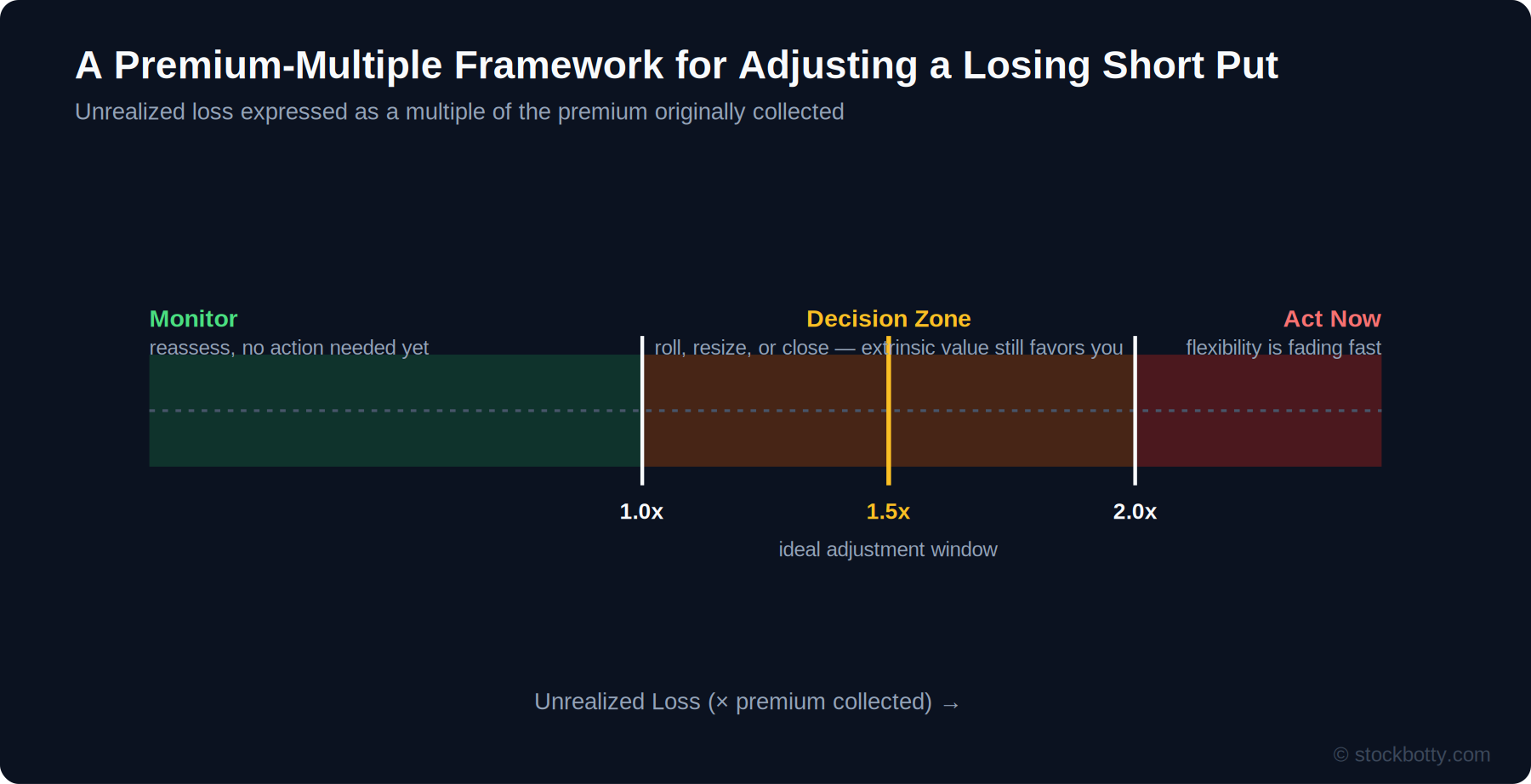
The practical way I’ve set this rule: I measure the unrealized loss as a multiple of the premium I originally collected, and I’ve defined what I do at each stage.
- Around 1x the premium I collected: my monitor zone. This isn’t automatically a reason for me to act – it’s a prompt to reassess. Has implied volatility expanded, or has the stock genuinely moved? Is the move emotional (news, panic) or does it reflect something fundamentally different about the company? Do I still want to own the stock at this strike?
- Around 1.5x the premium I collected: my decision zone, and usually the most useful window for me to actually act in. There’s typically still enough extrinsic value left that I can roll for a credit rather than a debit, and the position still has flexibility that starts disappearing as it moves further against me.
- Beyond 2x the premium I collected: my flexibility has usually faded by this point. Rolling may only be possible for a smaller credit or even a debit, and my range of good options has narrowed. Waiting much beyond this often means the decision gets made for me – by assignment, not by my plan.
A Worked Example From My Own Approach
Stock trading at $60. I sell the 57-strike put, 45 days out, for $1.50 ($150 collected). My breakeven: $55.50. Max profit: $150. Capital at risk (cash-secured): $5,700.
1x premium loss (~$150): the stock has drifted to around $58.50 and the put is now worth roughly $3.00. This is where I reassess, not necessarily where I act – I check whether the move is IV-driven, news-driven, or a genuine change in the stock’s trajectory.
1.5x premium loss (~$225): the stock is around $57.50 and the put is worth roughly $3.75. With 20 or fewer days left, this is usually where I still have the two roll options below available on favorable terms.
Three Ways I Respond in the Decision Zone
I roll out
I close the current put and open the same strike in a later expiration. If my $57 put trading at $3.75 can be replaced by a $57 put in the next monthly cycle trading at $5.00, that’s a $1.25 net credit for me – meaning I’ve now collected $2.75 in total premium on the position, and the trade has more time to work. The trade-off I’m accepting: more time also means more exposure if the stock keeps falling.
I roll down and out
I close the current put and open a lower strike in a later expiration. If my $57 put at $3.75 is replaced by a $54 put in the next cycle also trading around $3.75, that’s roughly cost-neutral on the roll itself, but my breakeven drops from $55.50 to somewhere near $50.25 (the new $54 strike minus my total credit collected), and my odds of ending up assigned shares drop with it. This is the adjustment I reach for when my goal has shifted from “still like this trade” to “would like this to resolve without owning the stock.”
I close and move on
If there’s no strike worth rolling into for me – implied volatility has dropped and there’s no meaningful credit available, or my thesis on the stock itself has changed – I close at a defined, known loss. I’ve learned that extending a trade for its own sake, on a stock I no longer want, isn’t managing risk for me; it’s postponing a decision the market has already made.
Why I Don’t Treat Assignment as My Default Outcome
Assignment is completely fine for me when it’s part of the plan – my wheel strategy trades are built entirely around cycling through it deliberately. The distinction that matters to me is between choosing assignment and drifting into it. Once I’m assigned, my capital is committed to 100 shares per contract, my range of choices narrows, and what was previously an active decision becomes a passive one. If assignment wasn’t the goal for a given trade of mine, arriving at it by default is usually a sign I missed my earlier decision points.
How I’d Suggest Building Your Own Version of This
The specific multiples I use (1x, 1.5x, 2x) work for me – they’re not a law of nature. I’ve seen other traders use tighter or wider thresholds, and the right setting depends on position size, how actively you monitor your trades, and how much conviction you have in the underlying. What’s mattered more for me than the exact numbers is deciding them before I open the trade, writing them down, and following them the same way regardless of what the position happens to be doing on any given day. The value of a rule for me isn’t that it’s optimal – it’s that it removes the need to make a high-stakes decision from scratch, under pressure, every single time.
When This Stops Working
I want to be direct about the limits of this rule, because I’ve run into them:
- If the stock keeps falling no matter how I roll, this framework doesn’t rescue the trade – it just gives me a structured way to keep losing more slowly, or to recognize sooner that I should close instead. A rule for timing my decisions isn’t a rule that fixes a broken thesis.
- If I can’t roll for a credit anymore, the whole “flexibility in the decision zone” argument stops applying. Once rolling only works for a debit, I’m paying to stay in a losing trade, and I have to ask myself honestly whether that’s still worth it.
- If my reason for holding the stock has actually changed, no adjustment technique fixes that. I try not to let a rule about timing substitute for a real answer to “do I still want this position at all.”
⚠ Risks Beyond the Basics
A mechanical adjustment rule has reduced my own decision paralysis, but it isn’t a guarantee – a few things I keep in mind before relying on it.
A credit roll doesn’t mean I’ve improved the trade
Rolling for a net credit adds premium and can lower my breakeven, but it also extends how long I’m in the trade and keeps my capital committed longer. I’ve had a string of small credits collected while a stock grinds lower still add up to a larger eventual loss than closing earlier would have – a credit on the roll is a partial offset for me, not proof the adjustment was the right call.
Rolling isn’t always available on terms I like
My framework assumes there’s usually still a decent net credit available in the 1x-2x window. In a fast decline, especially one with falling implied volatility, I’ve seen that credit shrink or disappear – rolling down and out can end up costing me a net debit instead, which changes my math on whether adjusting still makes sense versus simply closing.
Repeated rolling without a hard stop can compound my loss
Nothing about rolling caps how many times I can do it. Without a final threshold where my answer becomes “close, no more rolling regardless of what the roll would look like,” I could end up several cycles deep in a position that was never going to recover, tying up capital and paying commissions the whole way down.
Closing and reopening a similar position can trigger wash sale considerations
In the US, closing a losing position at a loss and opening a substantially similar one shortly after can fall under wash sale rules, which defer the loss for tax purposes rather than letting me claim it immediately. This is a tax mechanics question for me, not a trading one, but it’s something I stay aware of when I’m rolling repeatedly on the same underlying.
My rule only works if I actually follow it under pressure
The entire point of setting my thresholds in advance is to remove emotional decision-making in the moment – which only works if I actually respect them when the position is down and uncomfortable. If I override my own rule “just this once” during the exact situation it was built for, it isn’t giving me the discipline it’s supposed to.
Frequently Asked Questions
When do you adjust a losing short put?
I use the unrealized loss as a multiple of the premium I collected as my trigger – I reassess around 1x the original premium, and I treat roughly 1.5x as my ideal window to roll or resize, before the extrinsic value I could still capture erodes further.
What does it mean to roll a short put?
Rolling means closing the current short put and opening a new one, typically at a later expiration and sometimes at a different strike, ideally for a net credit. It extends the trade rather than resolving it, and it doesn’t remove the underlying risk – I still think through that trade-off every time.
What is the difference between rolling out and rolling down and out?
Rolling out keeps the same strike but moves to a later expiration, buying time for the stock to recover. Rolling down and out moves to both a lower strike and a later expiration, which lowers my breakeven and reduces the odds of assignment, usually at the cost of less premium collected on the new leg.
Do you always roll a losing put instead of taking the loss?
No. I only roll when there’s still enough extrinsic value to do it for a credit and I still believe in the underlying stock. If implied volatility has collapsed or my thesis has broken, I close at a defined loss instead of extending exposure to a stock I no longer want to hold.
Why not just wait until assignment?
Once I’m assigned, my capital is locked into 100 shares per contract and my choices narrow substantially. If assignment wasn’t the plan to begin with, waiting until it happens by default is usually a sign I left the position unmanaged for too long.