
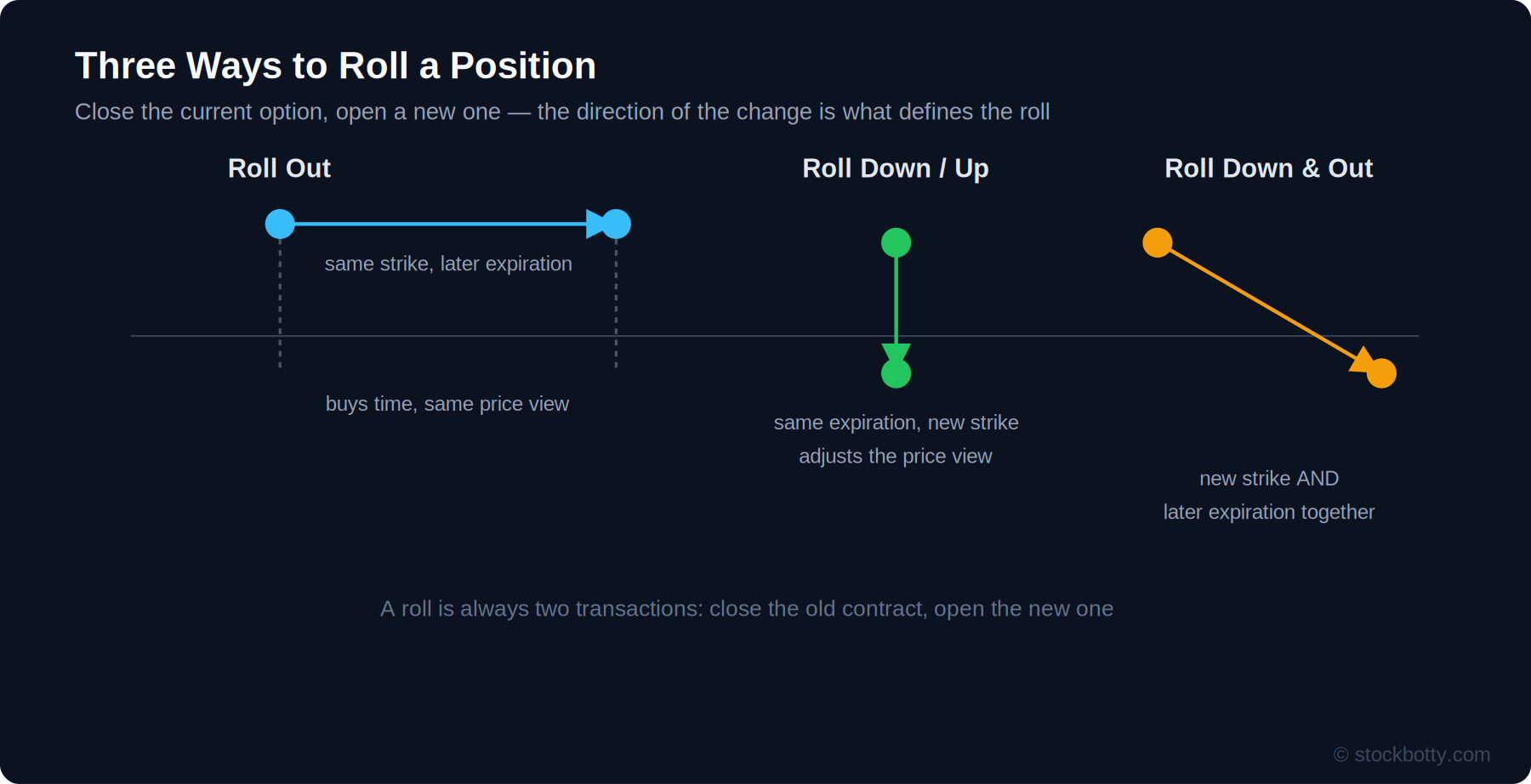
Rolling comes up as a management technique in nearly every strategy guide on this site, described briefly each time in the context of that specific position. This page covers rolling as its own concept – what it actually is mechanically, the different ways it can be done, and the central question that matters more than the mechanics: whether rolling is actually improving the trade, or just postponing a decision.
What Rolling Actually Is
A roll is two transactions treated as one: closing an existing option position and opening a new one, usually submitted together as a single combined order so both legs fill close to simultaneously. What makes it a “roll” rather than two unrelated trades is that the new position is meant to replace the old one in an ongoing strategy, not start something unrelated.
Three Types of Rolls
- Roll out: the strike stays the same, only the expiration changes, typically to a later date. This buys time without changing the underlying price view.
- Roll up or down: the expiration stays the same, only the strike changes. This adjusts the price view without changing the timeline.
- Roll up/down and out: both change together – the most common type of roll in active position management, since defending a threatened position usually means both moving the strike away from danger and buying more time for the adjustment to work.
Credit Rolls vs. Debit Rolls
Every roll results in either a net credit or a net debit, depending on whether the new position is worth more or less than the one being closed. This distinction matters more than which specific type of roll is being done:
- A credit roll collects additional premium on top of what’s already been received, and can improve the position’s breakeven. It does not, by itself, mean the trade has improved – it also extends how long the position remains open and how long capital stays committed.
- A debit roll costs money to execute, meaning the trader is paying to adjust the position rather than being paid. This is a meaningfully different decision than a credit roll, since it’s an explicit, immediate cost rather than an offset against existing premium.
When to Roll vs. Close vs. Do Nothing
- Roll when the original thesis is still reasonably intact, and a credit roll is available that meaningfully improves the position’s odds or breakeven.
- Close when rolling is only available for a debit, or when the reason the position was opened in the first place no longer holds – a stock that’s broken its trend, a thesis that’s been invalidated by news, or an underlying situation that’s genuinely different from when the trade was placed.
- Do nothing when the position is still within the normal range of outcomes it was designed for – not every adverse move requires immediate action, and the various premium-multiple and threshold frameworks covered throughout the Playbook exist specifically to make this decision systematically rather than reactively.
Rolling a Winning Position vs. a Losing Position
Rolling isn’t only a defensive technique. A short option that’s decayed significantly and is close to its short strike can be rolled to a new cycle specifically to keep collecting premium on a position that’s working – closer in spirit to reinvesting a winning trade’s proceeds than to defending a losing one. The mechanics are identical; the intent and the underlying question (“is this still a good trade to be in”) are different in each case.
The Cumulative Cost of Rolling
Each roll is a closing transaction and an opening transaction, meaning each one incurs its own commissions and bid-ask slippage. A position rolled several times over its life accumulates these costs even when each individual roll looks reasonable in isolation – worth factoring into whether continued rolling is actually still worthwhile compared to closing and starting fresh, or simply closing and moving on.
Rolling Doesn’t Fix What’s Actually Happening
The most important thing to understand about rolling: it repositions an existing position in time, in strike, or both – it does not change what the underlying is actually doing. A stock in a genuine, sustained decline doesn’t stop declining because a put was rolled down and out; the roll simply changes where and when the position’s outcome will ultimately be determined. This distinction is central to every technique covered in the Playbook, and it’s worth internalizing as a general rule rather than relearning for every individual strategy: a rule for adjusting timing and price is not the same thing as a rule for whether the trade is still a good idea.
Frequently Asked Questions
What does it mean to roll an option?
Rolling closes an existing option position and opens a new one, usually done as a single combined order. It extends or adjusts a trade rather than resolving it, and can move the strike, the expiration, or both at once.
What is the difference between rolling out and rolling down and out?
Rolling out changes only the expiration, keeping the same strike. Rolling down and out (or up and out) changes both the strike and the expiration at the same time, which is the most common type of roll used to actively manage a position.
Does rolling for a credit mean the trade has improved?
Not necessarily. A credit roll adds premium and can improve the breakeven, but it also extends how long the position is exposed and keeps capital committed longer. A string of small credits collected while a position keeps losing can still add up to a larger eventual loss.
When should I roll instead of closing the position?
Rolling generally makes sense when the original thesis is still intact and a credit roll is available. It stops making sense once rolling is only possible for a debit, or once the reason for holding the position in the first place has genuinely changed.
Does rolling fix a losing trade?
No. Rolling repositions an existing position in time or price – it doesn’t change what the underlying is actually doing. If the move against the position continues, rolling can extend the exposure rather than resolve it.