
A calendar spread sells a near-term option and buys a longer-dated option at the same strike. Unlike every other strategy in this series so far, it isn’t really about where the stock’s price ends up relative to a set of different strikes – it’s about time. The trade profits from the difference in how fast the two options lose time value, and it’s one of the few common strategies that actually benefits from rising implied volatility rather than falling volatility.
A Quick Refresher: Why Time Decay Isn’t Uniform
All options lose time value as expiration approaches, but not at a constant rate – time decay accelerates as an option gets closer to expiring. A near-term option loses its remaining time value faster, day by day, than a longer-dated option at the same strike. A calendar spread is built specifically to profit from that gap: sell the option that’s decaying faster, buy the option that’s decaying slower, both at the same strike.
Structure
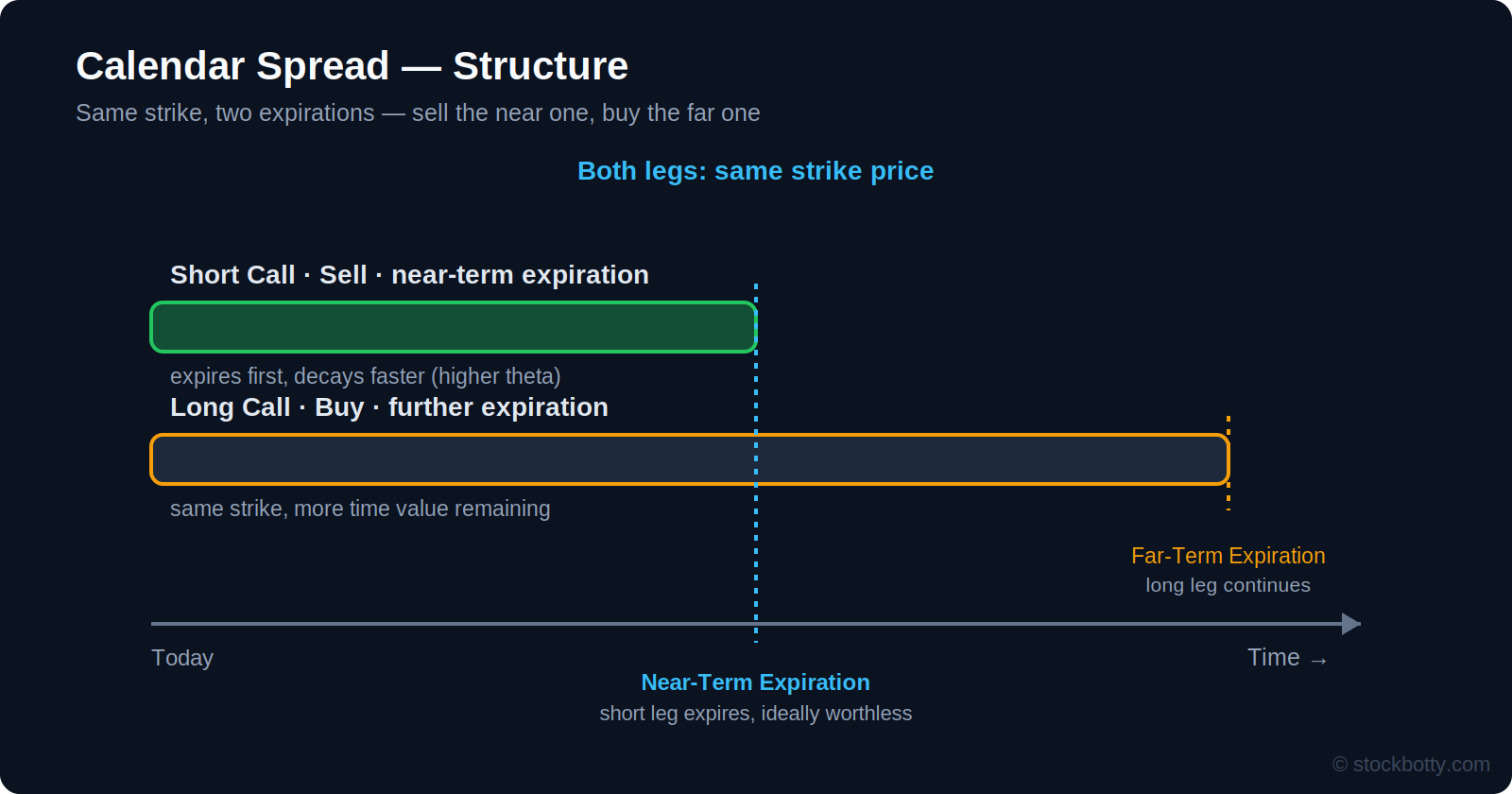
Sell 1 option at a chosen strike, near-term expiration. Buy 1 option at the same strike, a later expiration. Both are typically the same type – both calls or both puts. Because the longer-dated option costs more (more time value), this is normally opened for a net debit, which also happens to be the maximum possible loss on the trade.
Payoff Near Expiration
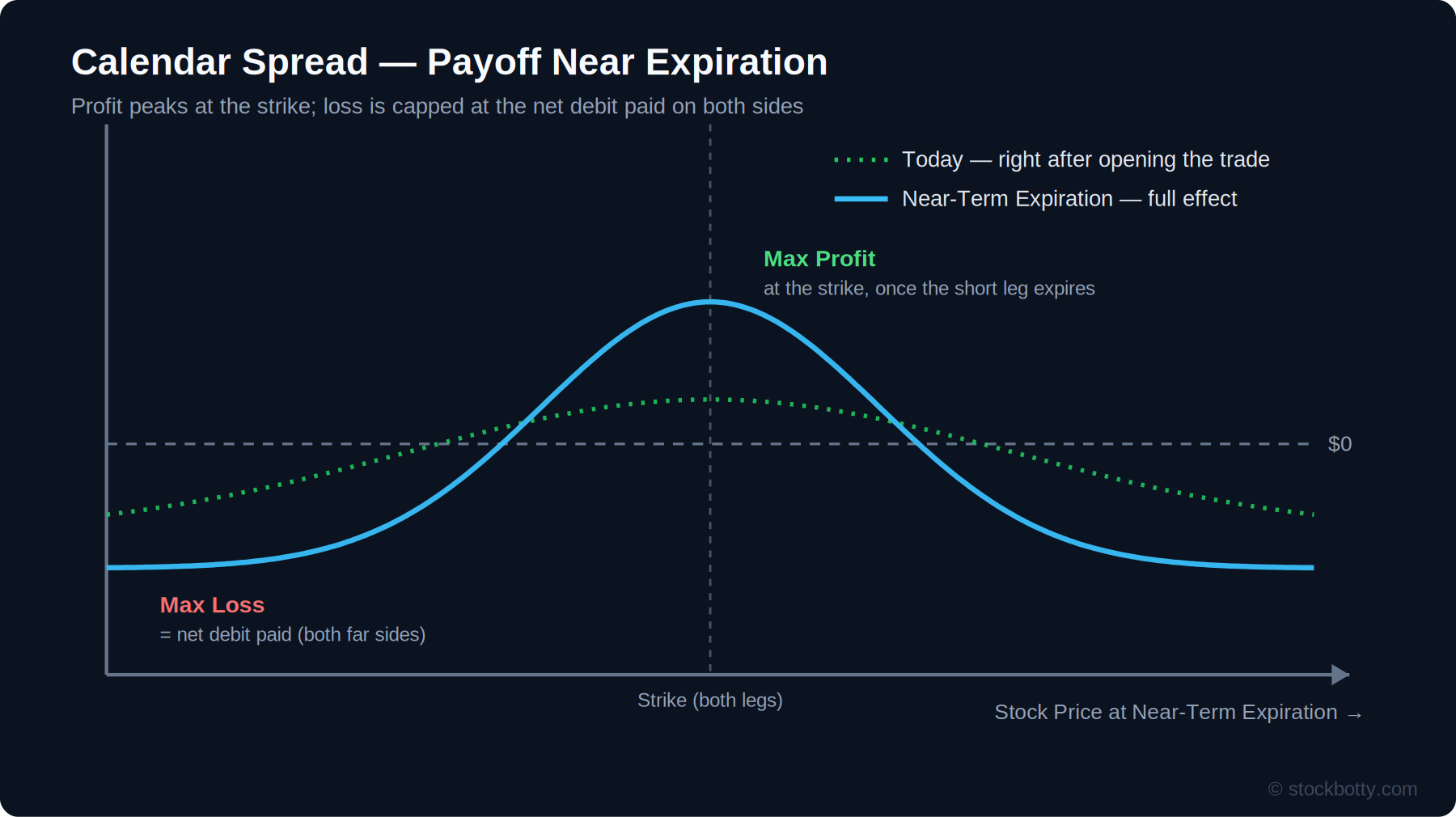
Unlike the tent- or trapezoid-shaped diagrams of a spread with several distinct strikes, a calendar spread’s payoff is a smooth curve that peaks at the single shared strike and tapers off symmetrically on both sides. If the stock finishes right at the strike when the near-term option expires, the short leg is worthless while the long leg still holds meaningful time value – that’s the maximum profit. If the stock finishes far away in either direction, both options converge toward the same value and the position is left near its maximum loss, which is the net debit paid.
The diagram also shows two curves: a flatter one for the day the trade is opened, and a sharper one for the day the near-term option expires. This isn’t a separate concept from the “T+0 line” idea used elsewhere in this series – it’s the same effect, just more visually dramatic here because the whole strategy is built around that time-decay difference rather than incidental to it. As the front-month option’s remaining life shrinks day by day, the curve sharpens and the peak grows, right up until the near-term expiration date.
Call Calendar vs. Put Calendar
At the same strike, a call calendar and a put calendar have nearly identical payoff shapes and Greek exposure – the trade is fundamentally about the difference in time decay between two expirations, not about being bullish or bearish. In practice, the choice usually comes down to one specific difference:
- Call calendars carry early assignment and dividend risk on the short near-term call, the same as any short call, particularly around ex-dividend dates.
- Put calendars don’t have that specific driver, since early exercise to capture a dividend doesn’t apply to puts the same way – some traders prefer put calendars specifically to sidestep that risk around dividend-paying stocks.
Outside of that distinction, the two are close enough to interchangeable that the choice often comes down to which side has better liquidity or a slightly more favorable IV term structure at the chosen strike.
Choosing Strikes and Expiration
- Strike selection: typically placed at or near the current price, or at a specific level the trader expects the stock to be at (or near) when the near-term option expires – the strike is the single most important decision, since profit is maximized exactly there.
- Expiration spacing: a common setup sells an option 20-30 days out and buys one 45-60 days out, though the exact spacing varies by how much time-decay differential and vega exposure the trader wants.
- IV term structure: the trade is most attractively priced when near-term implied volatility is elevated relative to the longer-dated option – this makes the option being sold relatively rich and the option being bought relatively cheap.
When to Enter a Calendar Spread
- A stock you expect to stay near a specific level through the near-term expiration – the strategy is fundamentally a bet on limited movement over that shorter window.
- Elevated near-term IV relative to longer-dated IV (an inverted or flattening term structure), which is common ahead of a known event like earnings and improves the economics of the trade.
- An expectation that volatility will rise or stay elevated going forward, since the position is net long vega overall – this is the opposite condition from most of the credit-selling strategies covered elsewhere in this series.
Managing the Trade
- Decide before near-term expiration: as the short leg approaches expiration, the trader typically closes the whole spread, lets the short leg expire and holds the long leg naked, or rolls the short leg out to a new near-term expiration to start another cycle against the same long option.
- Watch the stock relative to the strike: if the price has drifted well away from the strike, the trade’s edge has largely eroded regardless of what happens next – many traders close and reassess rather than waiting to see if it drifts back.
- Rolling the short leg repeatedly against the same long-dated option is a common way to extract more than one cycle of time-decay differential from a single long-option purchase.
Greeks and Volatility Behavior
- Theta (time decay): positive when the stock is near the strike – this is the core mechanism of the trade, since the short leg decays faster than the long leg.
- Vega (volatility): positive overall, since the longer-dated option carries more vega per contract than the shorter-dated one at the same strike.
-
⚡ Important – this cuts the other way from most of this series: a calendar spread benefits from implied volatility rising, not falling. Every credit-based strategy covered elsewhere here (iron condor, ratio spread, broken wing butterfly) is hurt by a volatility spike; a calendar spread is generally helped by one, as long as the stock doesn’t also move too far from the strike at the same time.
- Delta (direction): close to neutral at entry when the strike is at the money, but becomes more directional as the stock moves away from the strike, since the two legs’ deltas no longer offset as closely.
- Gamma (acceleration): concentrated in the short near-term leg as its expiration approaches – the front-month option’s gamma grows sharply in its final days, which is exactly when the trader has to decide whether to close, roll, or let it expire.
Example Trade
Stock trading at $100. Sell the 100-strike call expiring in 25 days for $2.00 ($200), buy the 100-strike call expiring in 55 days for $3.60 ($360). Net debit: $1.60 per share ($160 per contract) – this is also the maximum loss.
- If the stock is at $100 at the 25-day expiration: the short call expires worthless, the long call still has roughly a month of time value left – a realistic best case might see the position worth $2.60-$3.00, a $100-$140 profit on the $160 risked.
- If the stock is at $85 or $115 at the 25-day expiration: both options are far from the money (or both deep in the money, converging), and the position is close to its maximum loss of $160.
Pros and Cons
Pros: defined, known maximum loss, benefits from rising implied volatility unlike most premium-selling strategies, can be rolled repeatedly against the same long-dated option, works well around events with elevated near-term IV.
Cons: requires the stock to stay near a specific level rather than just range-bound generally, profit zone is narrower than a defined-width credit spread, decisions must be made actively at each near-term expiration, two different expirations mean liquidity and pricing on the far-dated leg matter more than in single-expiration strategies.
⚠ Risks Beyond the Basics
The defined max loss makes a calendar spread sound simple, but the two-expiration structure introduces risks that don’t show up in a single-expiration strategy.
Early assignment and dividend risk on the short leg (call calendars)
The short near-term call can be exercised early, particularly around an ex-dividend date if it’s in the money with little time value left. This can leave the trader short 100 shares against a long call that doesn’t automatically offset that position the way it would in a same-expiration spread.
Directional gap risk despite a correct volatility view
A calendar spread can lose money even when the volatility thesis was right, if the stock gaps away from the strike before the near-term expiration – for example, on earnings-related news. Being long vega doesn’t protect against the position simply moving out of its profitable price range.
A broad volatility crush can still hurt, despite being “long vega”
The position is long vega on net, but that assumes a roughly parallel shift in implied volatility across both expirations. In practice, a sharp IV crush immediately after an event (like earnings) often hits the near-term option hardest – which is the leg you’re short, so that part helps – but if the crush also pulls down the longer-dated option’s IV meaningfully, the net effect can be smaller than the simple “long vega” label suggests, or even negative if the far leg’s IV drops more than expected.
Liquidity on the far-dated leg
Longer-dated options, especially several months out, often trade with wider bid-ask spreads and less volume than near-term options on the same underlying. This affects both the entry price and how easily the position can be adjusted or closed later.
The decision point at every near-term expiration
Unlike a single-expiration strategy that simply resolves, a calendar spread forces an active decision every time the short leg approaches expiration: close, roll, or hold the remaining long option naked. Traders who default to “just let it ride” without a plan can end up holding a bare directional long option they didn’t intend to carry.
Frequently Asked Questions
Is a calendar spread the same with calls or puts?
At the same strike, a call calendar and a put calendar have nearly identical risk profiles, since the trade is really about the difference in time decay between two expirations rather than direction. The main practical difference is early assignment and dividend risk on the short leg, which only applies to calls.
Does a calendar spread benefit from rising or falling volatility?
Rising. A calendar spread is net long vega, because the longer-dated option has more vega than the shorter-dated one at the same strike. This is the opposite of most credit-based strategies like the iron condor, which benefit from falling volatility.
What is the maximum loss on a calendar spread?
The net debit paid to open the trade. This is the maximum loss on both sides if the stock finishes far away from the strike at near-term expiration, since both options converge toward the same value.
What happens to a calendar spread after the near-term option expires?
If the near-term option expires worthless, the trader is left holding a single long option with no offsetting short leg – at that point it behaves like a simple directional long call or put and can be closed, held, or rolled into a new calendar.
When is the best time to enter a calendar spread?
When near-term implied volatility is elevated relative to longer-dated volatility, which makes the short leg richer to sell relative to the cost of the long leg. This is common ahead of known events like earnings.