
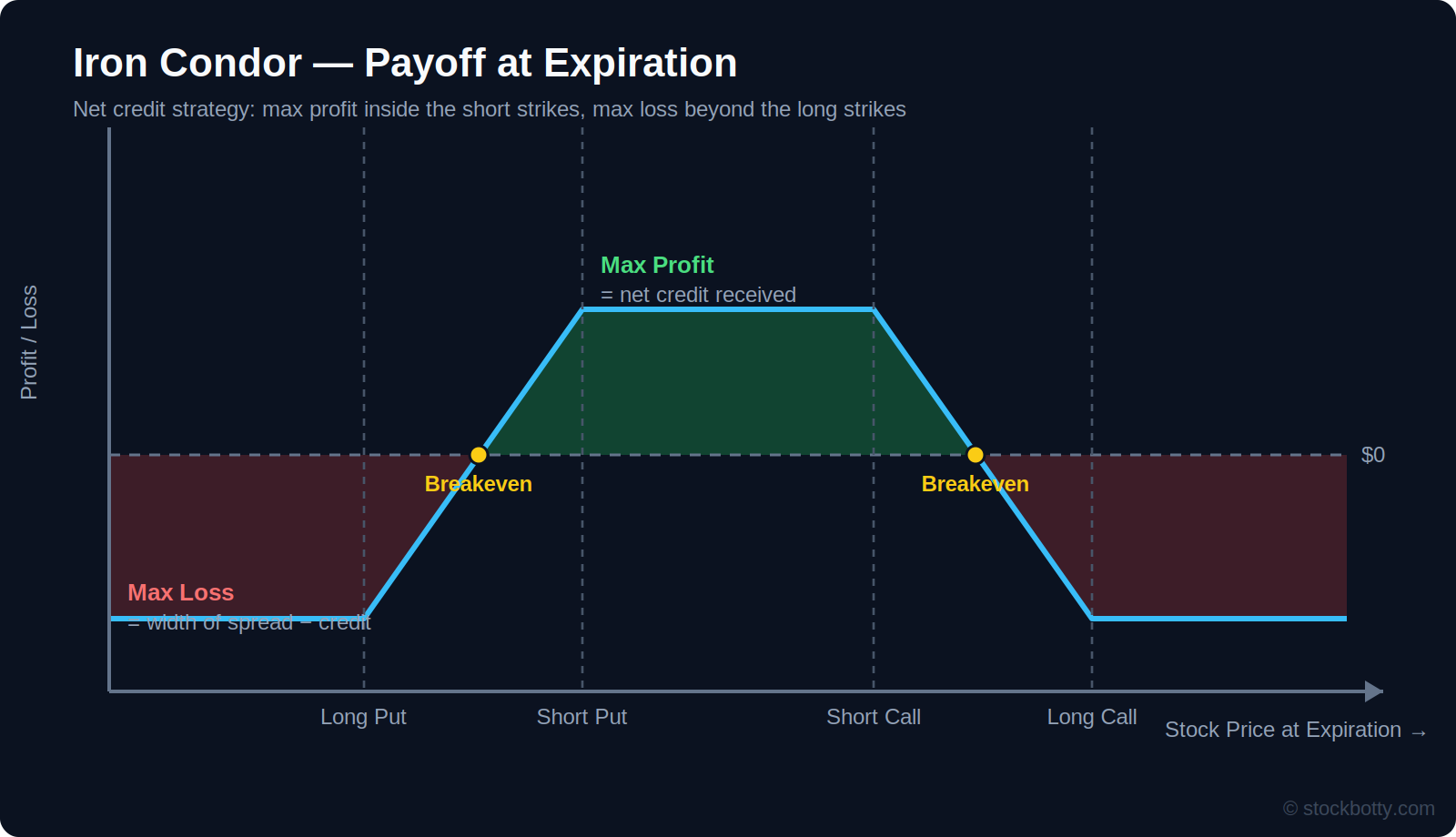
An iron condor is a four-legged, defined-risk options strategy that profits when a stock trades sideways. It’s one of the most widely used income strategies because the risk is capped and known before you place the trade – unlike a naked short strangle, where losses are theoretically unlimited. This guide walks through what an iron condor is, how to build one leg by leg, when it makes sense to open one, and what to do if the trade moves against you.
A Quick Refresher: What “Short” and “Long” Mean
If you’re new to options, two terms come up constantly in this guide:
- Short (selling) an option means you collect a premium up front. In exchange, you take on an obligation – to buy the stock (short put) or sell the stock (short call) if the option is exercised against you.
- Long (buying) an option means you pay a premium up front. You gain the right, but not the obligation, to buy (long call) or sell (long put) the stock at the strike price.
An iron condor combines both: you sell options close to the current price to collect premium, and buy options further away to limit how much you can lose if you’re wrong.
What an Iron Condor Actually Is
Structurally, an iron condor is two vertical credit spreads opened at the same time, in the same expiration:
- A put credit spread below the current stock price (sell a put, buy a further put lower down)
- A call credit spread above the current stock price (sell a call, buy a further call higher up)
Together, these four legs collect a net credit. That credit is the maximum you can profit. If the stock finishes between your two short strikes at expiration, all four options expire worthless and you keep the full credit. If the stock finishes beyond one of your long strikes, you lose a fixed, predefined amount – no more, no less.
Step-by-Step: How to Build an Iron Condor
Here is the construction broken into four individual steps. Each step adds one leg, so you can see exactly how the position takes shape.
Step 1 – Sell the Short Put
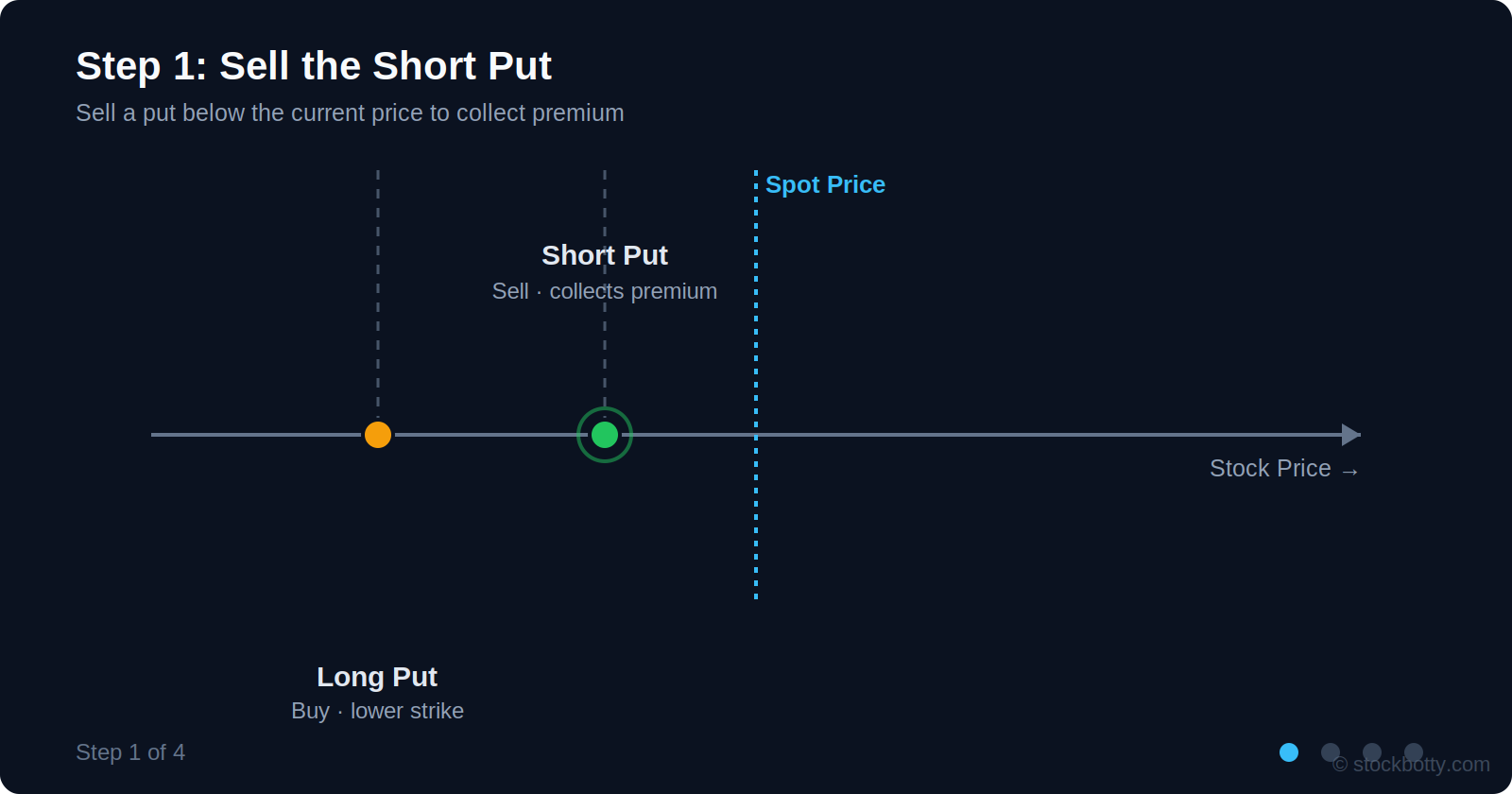
Start by selling a put option below the current stock price. This is the first half of your credit – you’re being paid because you’re agreeing to buy the stock at that strike if it falls that far. On its own, this leg has large risk if the stock drops sharply, which is exactly what the next step fixes.
Step 2 – Buy the Long Put
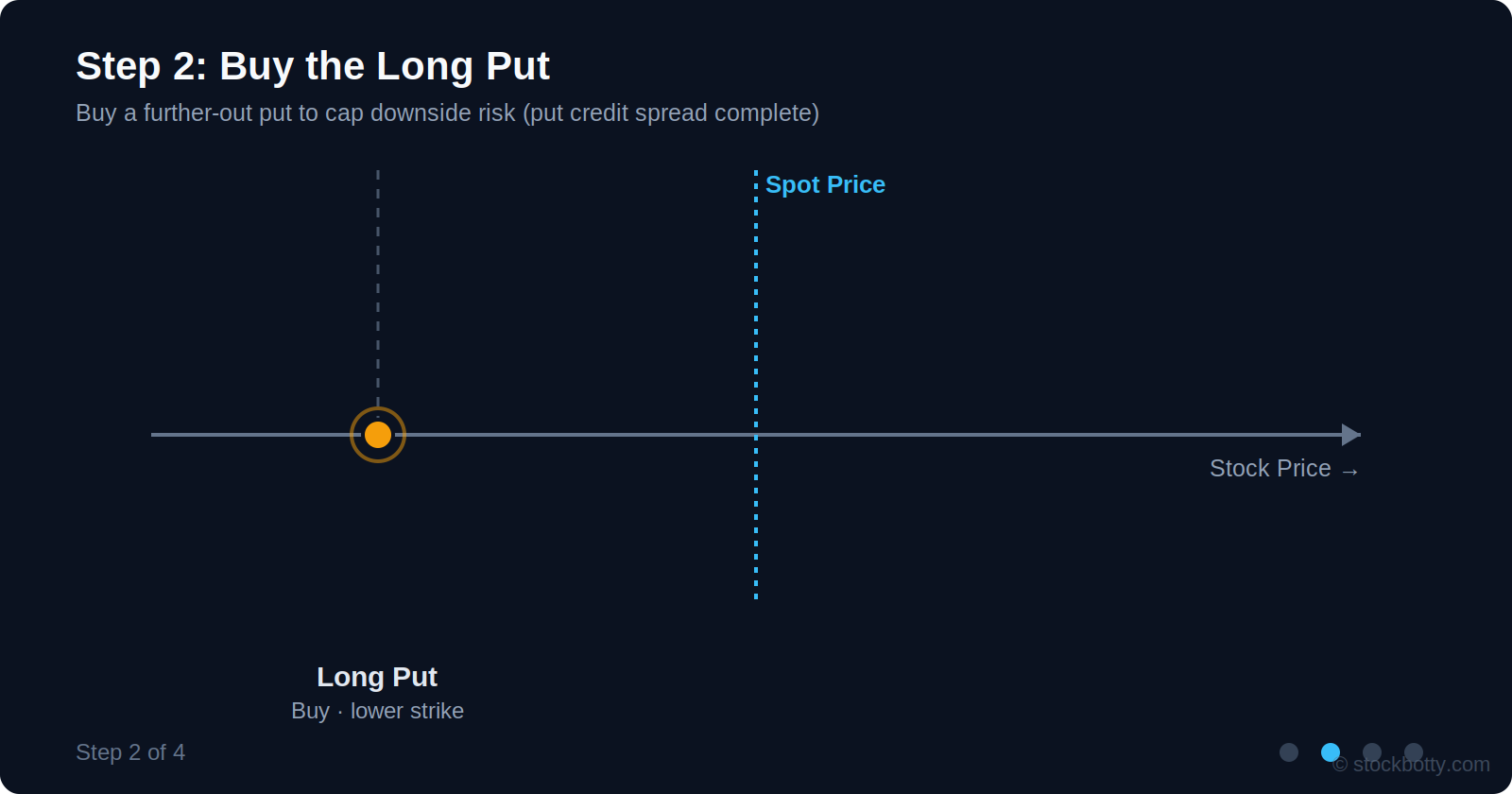
Buy a second put at a lower strike, same expiration. This costs part of the premium you just collected, but it caps your maximum loss on the downside. You now have a put credit spread – your risk below the lower strike is fixed and known.
Step 3 – Sell the Short Call
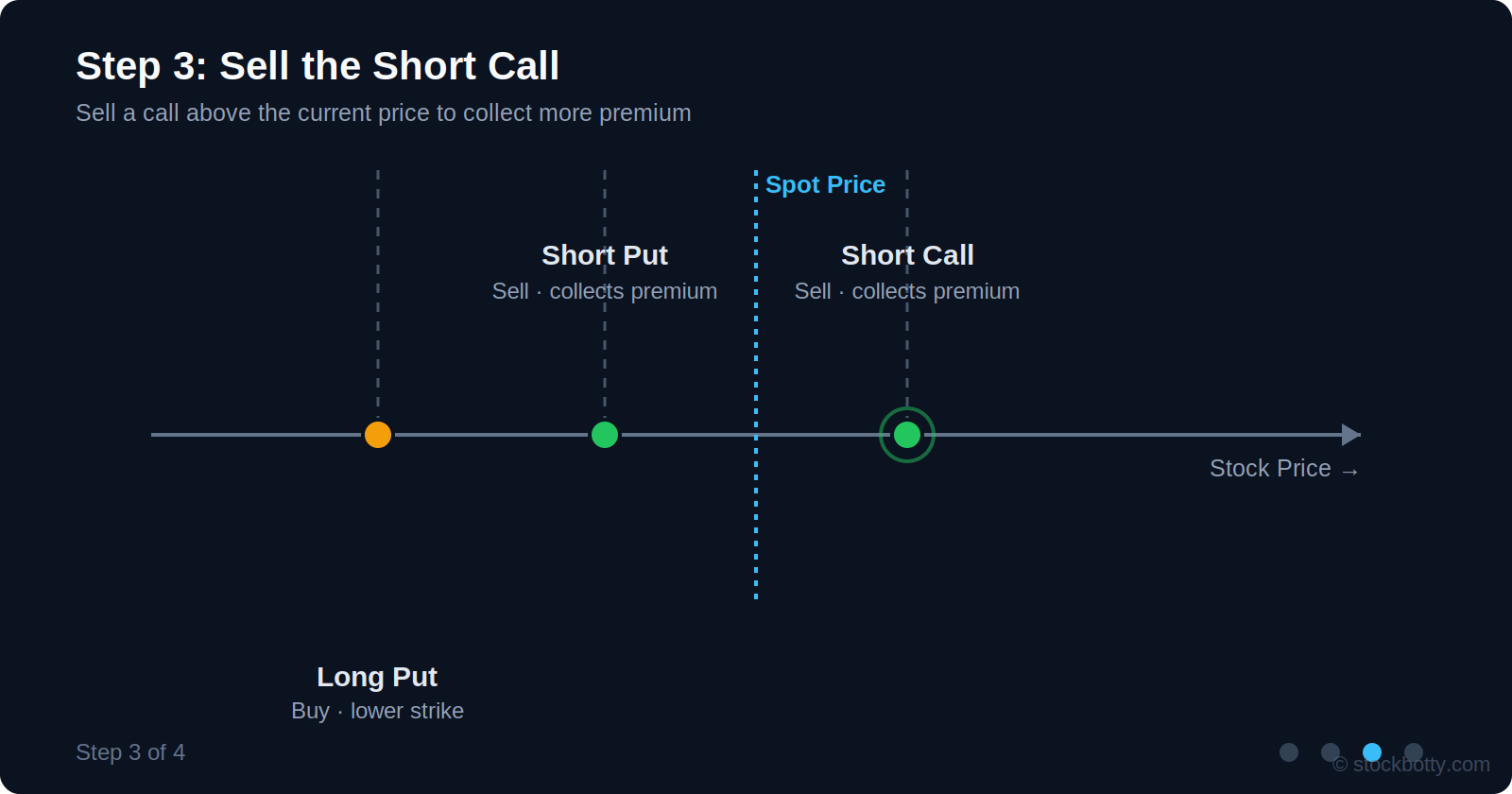
On the other side, sell a call option above the current stock price. This adds more credit to the position and is the mirror image of Step 1 – now you’re exposed if the stock rallies sharply.
Step 4 – Buy the Long Call
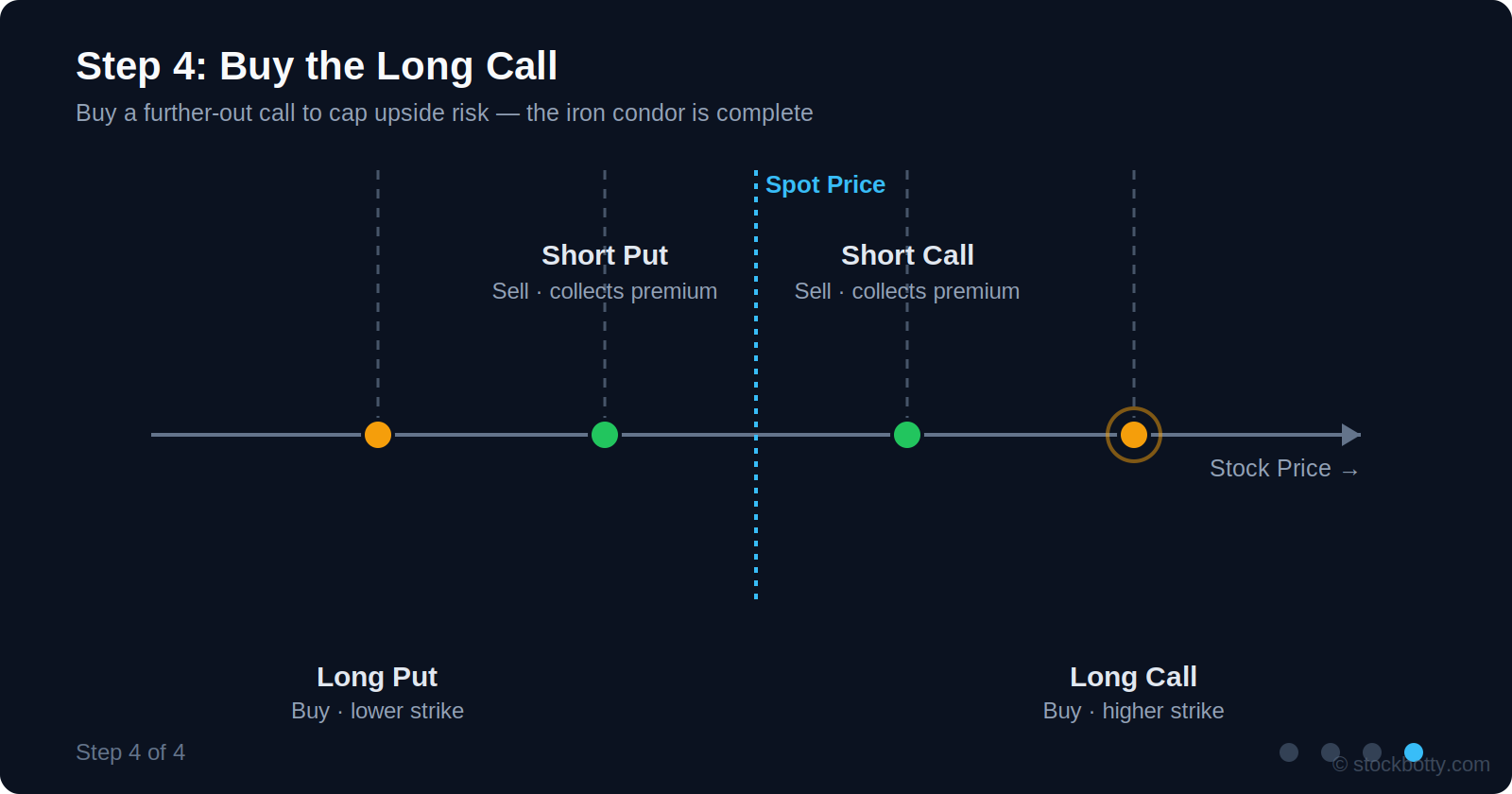
Buy a further call above your short call. This caps the upside risk the same way the long put capped the downside. With all four legs in place, both sides of the trade have a known maximum loss, and the iron condor is complete.
Choosing Strikes and Expiration
There’s no single correct way to pick strikes, but a few practical approaches are common:
- Delta-based selection: many traders sell the short strikes around a 10-20 delta, meaning roughly a 10-20% probability of finishing in the money at expiration. This gives a statistical edge without collecting so little premium that the trade isn’t worth the risk.
- Spread width: the distance between short and long strikes on each side sets your max loss. Wider spreads collect more credit but risk more; narrower spreads risk less but often aren’t worth the commissions.
- Days to expiration: 30-45 days is a common range. This window tends to have a good balance of time decay (theta) working in your favor without excessive daily price sensitivity (gamma) close to expiration.
When to Enter an Iron Condor
Iron condors work best under a specific set of conditions, not in every market environment:
- Elevated implied volatility: since the strategy is short vega, it benefits when IV contracts. Entering when IV is high relative to its recent range (high IV rank) gives you more room and richer premium.
- No major catalysts expected: earnings, FDA decisions, and similar binary events can cause the stock to jump past your strikes overnight, when you have no ability to adjust. Many traders avoid holding an iron condor through such events, or specifically use them to fade an anticipated volatility crush right after the event.
- A stock or index you expect to consolidate: range-bound price action, weak trend, or a stock sitting between clear support and resistance levels all support the range-bound assumption the strategy depends on.
Managing the Trade: Hedging, Rolling, and Taking the Loss
An iron condor isn’t a “set and forget” trade. Price can move toward either side, and you have several options for what to do next.
Taking profits early
Many traders don’t hold to expiration. A common rule of thumb is to close the position once it has captured 50-75% of the maximum profit. The remaining credit left to collect is often small compared to the risk of holding through a late move, so closing early frees up capital and reduces exposure to a surprise. This is also why many traders avoid holding through the final 14 days: that’s when gamma rises sharply (see the Greeks section below) and a small stock move can undo weeks of slow, steady theta gains in a very short time.
Defending the untested side
If the stock moves toward one short strike while the other side stays far out of the money, you can roll the untested side closer to collect additional credit. This increases the total premium in the trade and can offset some of the loss building on the tested side – but it also increases risk if the stock reverses and challenges the side you just rolled in.
Rolling the tested side
If a short strike is being tested, you can roll that spread out in time (to a later expiration) and further away in strike, usually for an additional credit. This buys the trade more time to work out and moves the danger zone further from the current price. It does not remove the risk – it repositions it, and if the stock keeps trending, a roll can turn one loss into a larger one over multiple attempts.
When to just take the loss
Rolling makes sense when the thesis (the stock stays range-bound) is still plausible and the adjustment meaningfully improves your position. It stops making sense when the stock has clearly broken trend and is running – at that point, rolling often just delays a similar or larger loss while tying up more capital and commissions. Because the max loss on an iron condor is defined from the start, many traders set a hard rule in advance (for example, exit once a short strike is breached) rather than deciding in the moment under pressure.
Payoff at Expiration
The payoff diagram has a flat top between the two short strikes – this is the maximum profit zone, equal to the net credit received. Moving outside either short strike, the position loses value on a slope until it reaches the corresponding long strike, where the loss flattens out at the maximum loss level.
There are two breakeven points: one below the short put strike and one above the short call strike, each offset from the short strike by the amount of credit received per side.
The Line Lifts Over Time (T+0)
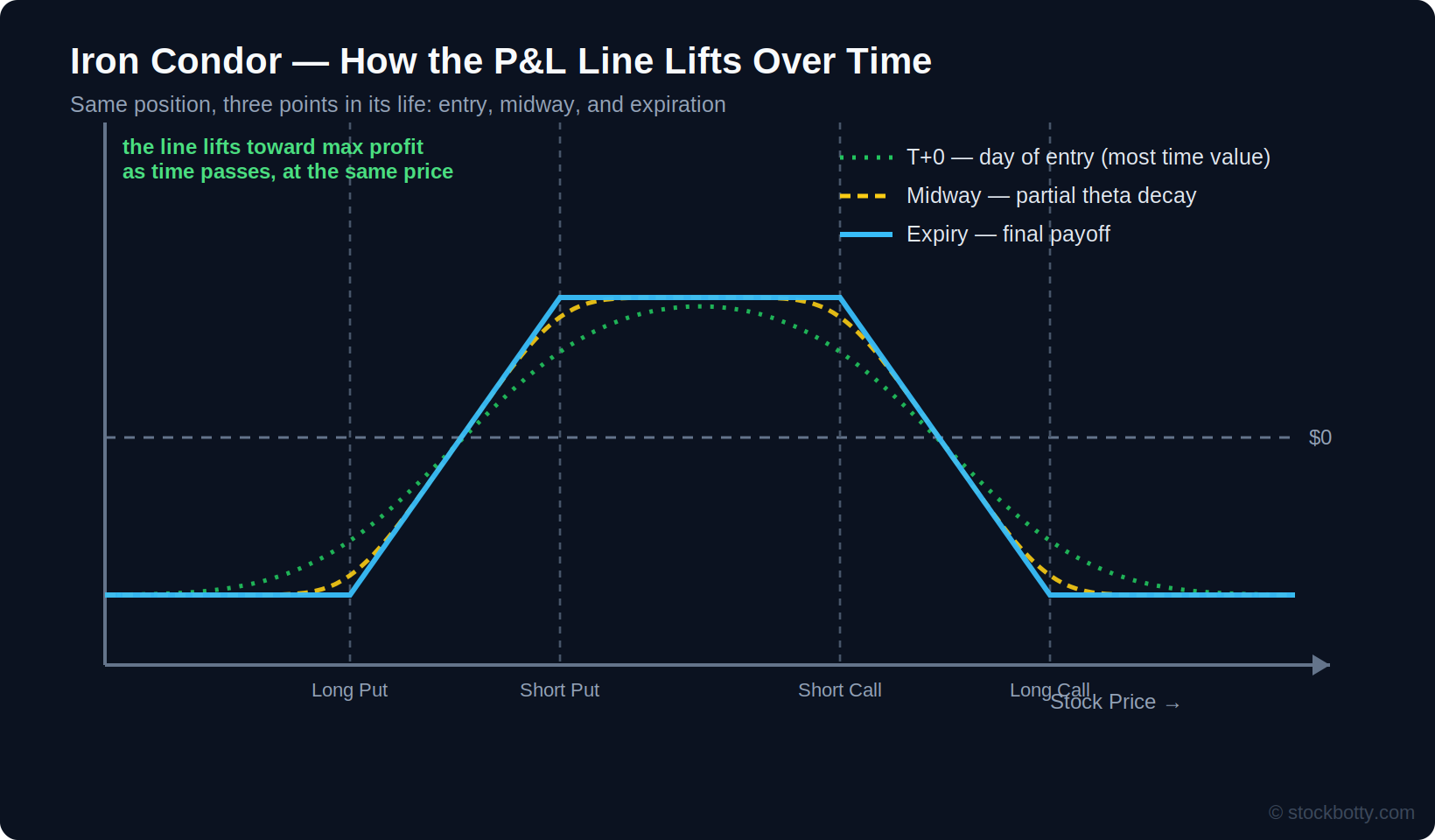
The flat-topped payoff diagram above only describes the position on the exact day of expiration. On every day before that, the position is worth something between that final shape and a much more rounded curve – this rounded, real-time curve is often called the T+0 line (sometimes just “the now line”). It reflects the extrinsic (time) value still left in all four options.
On the day you open the trade, the T+0 line is heavily rounded: even if the stock is sitting right in the middle of your short strikes, your position isn’t yet showing anything close to the full credit as profit, because the options still carry weeks of time value. As days pass and theta decay works in your favor, that line gradually lifts and straightens toward the sharp expiry shape – at the same stock price, the position is worth more today than it was a week ago, simply because time has passed.
This is the practical reason many traders don’t need the stock to land in an exact spot at expiration to make good money, and why closing early (the 50-75% rule mentioned above) makes sense: a large share of the eventual profit is often captured well before expiration, once the T+0 line has lifted close to the flat expiry level – without taking on the last stretch of gamma risk for a comparatively small amount of remaining credit.
Greeks and Volatility Behavior
- Theta (time decay): positive – the position gains value as expiration approaches, as long as the stock stays in range. This is the main engine of profit in the trade.
- Vega (volatility): negative – a drop in implied volatility increases the value of the position; a rise in IV works against it, even if the stock hasn’t moved.
-
⚡ Important: because the position is short vega, a sharp rise in implied volatility – a broad market volatility spike, not necessarily anything specific to the stock – can push the position into an unrealized loss even while the price is still comfortably between both short strikes. The threshold hasn’t been touched, but every option in the structure gets more expensive to buy back, and that shows up as a loss on the position. This tends to recover as IV normalizes and time passes, but it’s a real source of mark-to-market drawdown that has nothing to do with direction.
- Delta (direction): near zero at entry when strikes are placed symmetrically, meaning limited sensitivity to small directional moves. Delta grows as the stock approaches either short strike, which is what creates the need to manage the trade.
- Gamma (acceleration): stays low for most of the trade’s life, but rises sharply in the final one to two weeks before expiration. In this window, a move toward a short strike no longer changes delta gradually – it can accelerate fast enough to flip the trade from comfortably profitable to a full loss within a day or two. This is the main reason many traders close or roll iron condors well before expiration instead of holding into the last two weeks.
-
⚡ Important: gamma risk is worth repeating on its own – in the last 14 days before expiration, gamma can grow large enough that a stock move which would have been a minor delta adjustment a month out instead swings the position hard and fast. If you’re holding into this window, check the trade daily; waiting for a weekly review is often too slow.
Example Trade
Stock trading at $100. A trader sells the 95-strike put and buys the 90-strike put (put spread), while selling the 105-strike call and buying the 110-strike call (call spread), all in the same expiration, roughly 35-45 days out. Net credit received: $1.50 per share ($150 per contract).
- Max profit: $150 per contract (stock finishes between $95 and $105)
- Max loss: $350 per contract ($5 wide spread − $1.50 credit = $3.50, × 100 shares)
- Breakevens: $93.50 and $106.50
- Possible plan: close at 50-75% of max profit (roughly $0.35-$0.75 remaining to buy back), or defend/roll if the stock approaches $95 or $105 before then
Pros and Cons
Pros: defined risk on both sides, benefits from time decay, works without predicting direction, position sizing is straightforward since max loss is known upfront, can be adjusted or rolled if the trade is threatened.
Cons: profit potential is capped and often small relative to the max loss, requires the stock to stay range-bound, four legs mean higher transaction costs and more complex management, a sharp move in either direction can result in the full max loss, rolling can extend losing trades rather than resolve them.
⚠ Risks Beyond the Basics
Most introductions to the iron condor stop at “max loss is defined.” That’s true at expiration, but it skips several risks that don’t show up in a payoff diagram and rarely get mentioned outside trading forums.
Early assignment and pin risk
Equity options are American-style, meaning the counterparty on your short put or short call can exercise at any time before expiration – not just at expiration. This is uncommon while an option still has meaningful extrinsic value, but becomes a real possibility once a short strike is deep in the money with little time value left, or right around expiration when the stock is sitting close to a strike (“pin risk”). Early assignment on a Friday close can leave you holding an unplanned stock position over the weekend before your long option can be exercised to offset it – with full market risk on that position until Monday. Index options like SPX or XSP are cash-settled and European-style, which removes this specific risk entirely; that’s one reason some traders prefer index iron condors over single-stock ones.
Dividend risk on the short call
If the underlying goes ex-dividend while your short call is in the money and has little extrinsic value remaining, the holder may exercise early to capture the dividend. This can hand you an unexpected short stock position the day before the ex-dividend date – worth checking explicitly if you’re running iron condors on dividend-paying stocks around their ex-dividend dates.
Multi-leg execution and slippage
An iron condor is four separate contracts. Filling them as a single combo order is standard, but on less liquid underlyings the bid-ask spread on each leg – especially the further out-of-the-money long strikes – can meaningfully erode the credit you actually receive versus the theoretical midpoint. The same applies in reverse when closing or rolling: wide spreads on illiquid strikes make adjustments more expensive than the model price suggests.
Portfolio-level vega concentration
Running iron condors on several different, seemingly uncorrelated tickers diversifies single-stock and delta risk, but it does not diversify vega risk. Implied volatility across most equities tends to rise together during a broad market selloff or VIX spike. A portfolio of ten “diversified” iron condors can still see all ten mark-to-market losses expand at once during a single volatility event, even if none of the individual stocks moved dramatically.
Weekend and overnight gap risk
Price only moves during market hours, but news doesn’t wait for the open. A position that looks safely inside both short strikes on Friday’s close can gap past a strike at Monday’s open on overnight news, with no opportunity to adjust in between. This risk is structurally impossible to fully eliminate in a strategy that’s held over a weekend or earnings date, and it’s a real argument for closing or reducing size ahead of known event risk rather than assuming the defined max loss will always be reachable gradually.
Frequently Asked Questions
Is an iron condor bullish or bearish?
Neither. An iron condor is a neutral, range-bound strategy. It profits when the underlying stays between the two short strikes through expiration, regardless of small moves up or down.
What is the maximum profit on an iron condor?
Maximum profit equals the net credit received when opening the trade. It is realized if the stock closes between the short put and short call strikes at expiration.
What is the maximum loss on an iron condor?
Maximum loss is the width of either spread minus the net credit received. Both sides are typically the same width, so this loss is capped and known in advance.
How does implied volatility affect an iron condor?
An iron condor has negative vega, meaning it benefits from a decline in implied volatility. Traders often open iron condors when IV is elevated relative to its recent range, expecting it to contract.
Can you roll an iron condor?
Yes. The untested side can be rolled closer to collect more credit, or the tested side can be rolled out in time and away in strike to reduce risk. Rolling does not eliminate risk, it repositions it, and it can lock in a worse outcome if the stock keeps moving.
When should I close an iron condor?
Many traders close at 50-75% of max profit rather than holding to expiration, since the remaining credit is small relative to the risk of a late move. On the loss side, a common rule is to exit or adjust once a short strike is breached, rather than waiting for the long strike to be tested.