
A broken wing butterfly is a butterfly spread with one wing stretched wider than the other. That asymmetry is the whole idea: it shifts the cost of the wings so the trade can often be opened for a net credit, and it removes risk entirely on one side of the position. Like the ratio spread, it comes in a call version (bullish-to-neutral) and a put version (bearish-to-neutral) – this guide covers both.
A Quick Refresher: Butterflies and Why “Broken” Matters
A standard butterfly buys 1 option, sells 2 at a further strike, and buys 1 more at an equally further strike on the other side – symmetric wings, defined risk on both sides, but usually a small net debit to open. A broken wing butterfly keeps the same three-strike, buy-sell2-buy structure, but makes one wing wider than the other. The wider wing is further out of the money, so it’s cheaper to buy – often cheap enough that the trade turns into a net credit instead of a debit, at the cost of a defined (not unlimited) loss if the stock moves hard through the wide side.
⚡ Important – this is not the same risk profile as a ratio spread: a ratio spread’s extra short option is uncovered, which is what creates unlimited (or very large) risk. A broken wing butterfly adds a further long option beyond the short strikes specifically to cap that risk. The trade-off is a smaller profit zone in exchange for a defined maximum loss on both sides.
Call Broken Wing Butterfly – Structure
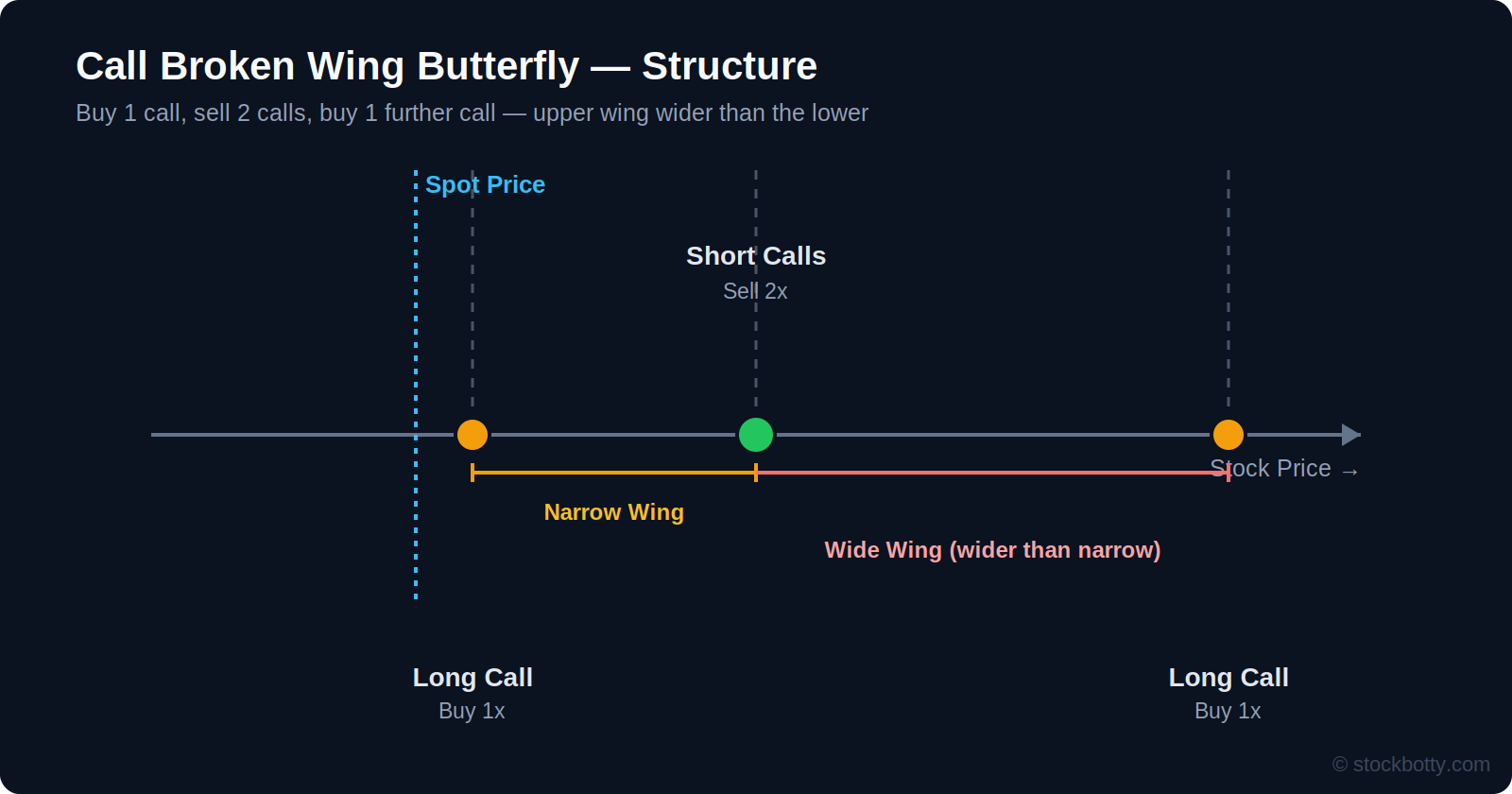
Buy 1 call at a strike close to the current price, sell 2 calls at a middle strike, and buy 1 more call at a strike further out – spaced wider than the distance between the first two strikes. Because the far call is cheaper than it would be in a symmetric butterfly, the whole structure often costs little or nothing, or brings in a small net credit.
Call Broken Wing Butterfly – Payoff at Expiration
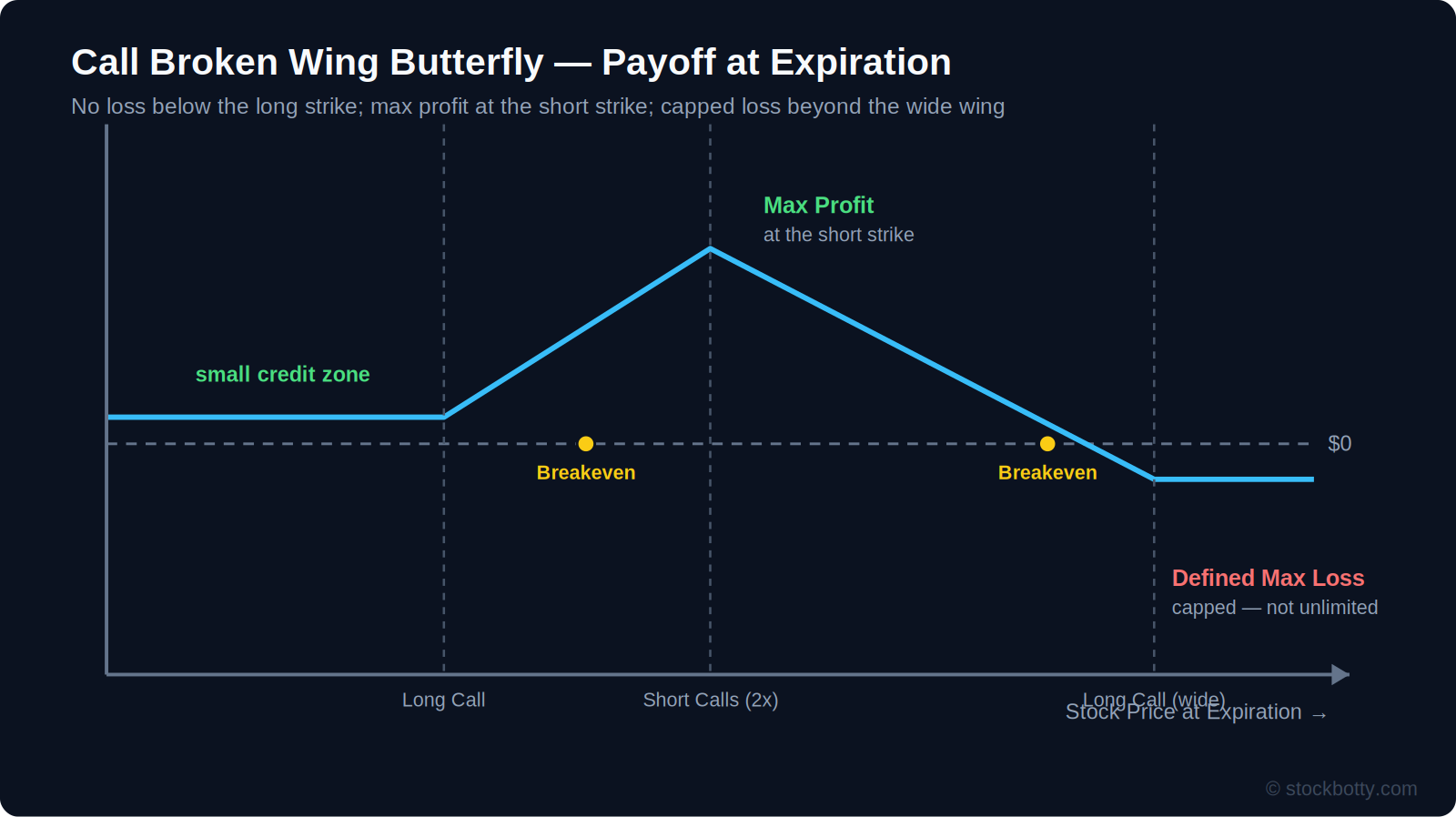
Below the near long call strike, everything expires worthless and the position keeps the small credit – no loss on this side. Between the near strike and the short strike, profit builds as the stock rises, peaking exactly at the short strike. Beyond that, the position gives back value as the stock keeps rising, but the loss stops growing once the stock passes the far long call – from there it’s flat at a defined, calculable maximum loss.
Put Broken Wing Butterfly – Structure
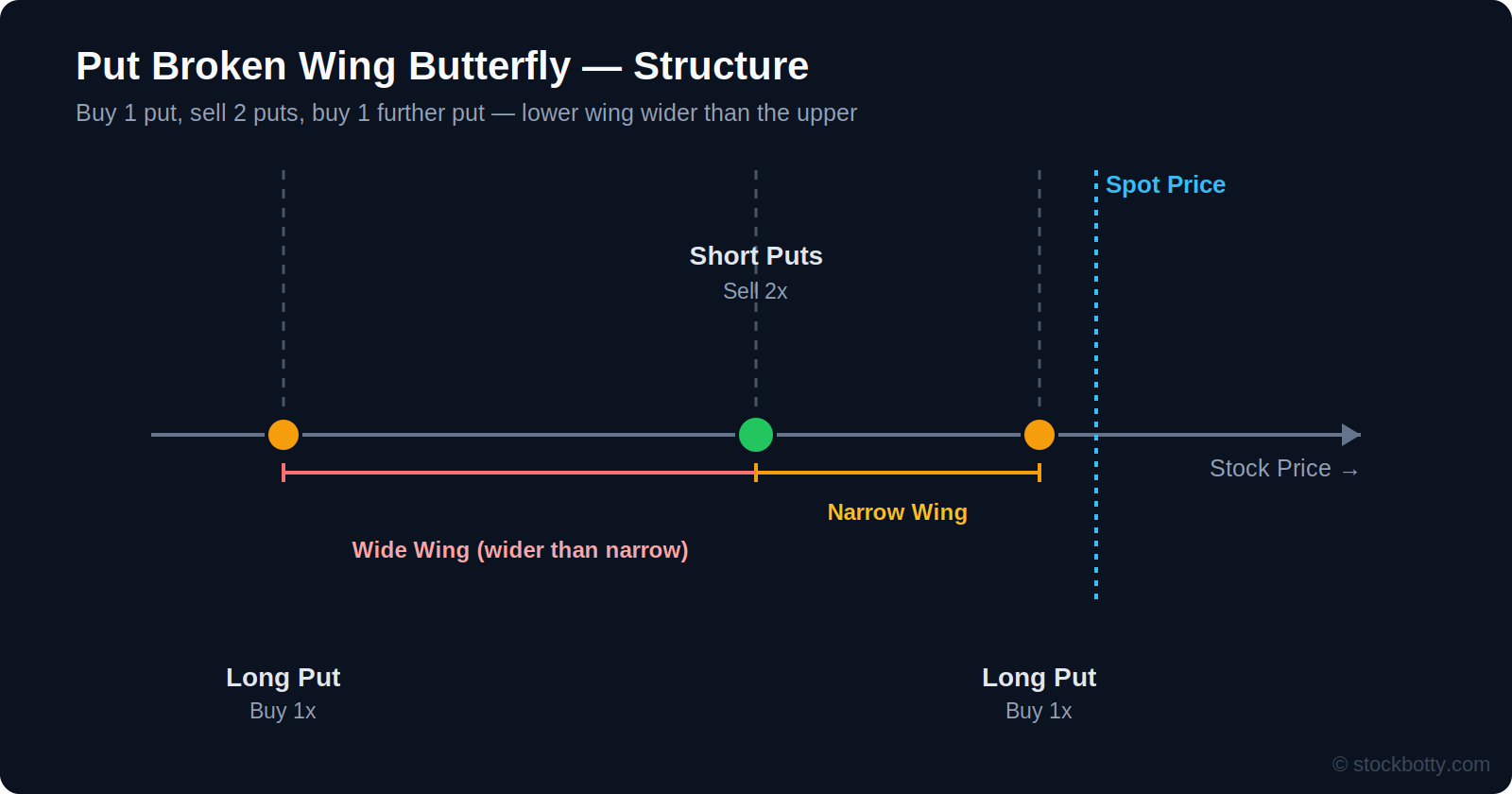
The mirror image: buy 1 put close to the current price, sell 2 puts at a middle strike, and buy 1 more put further down – spaced wider than the distance between the first two strikes.
Put Broken Wing Butterfly – Payoff at Expiration
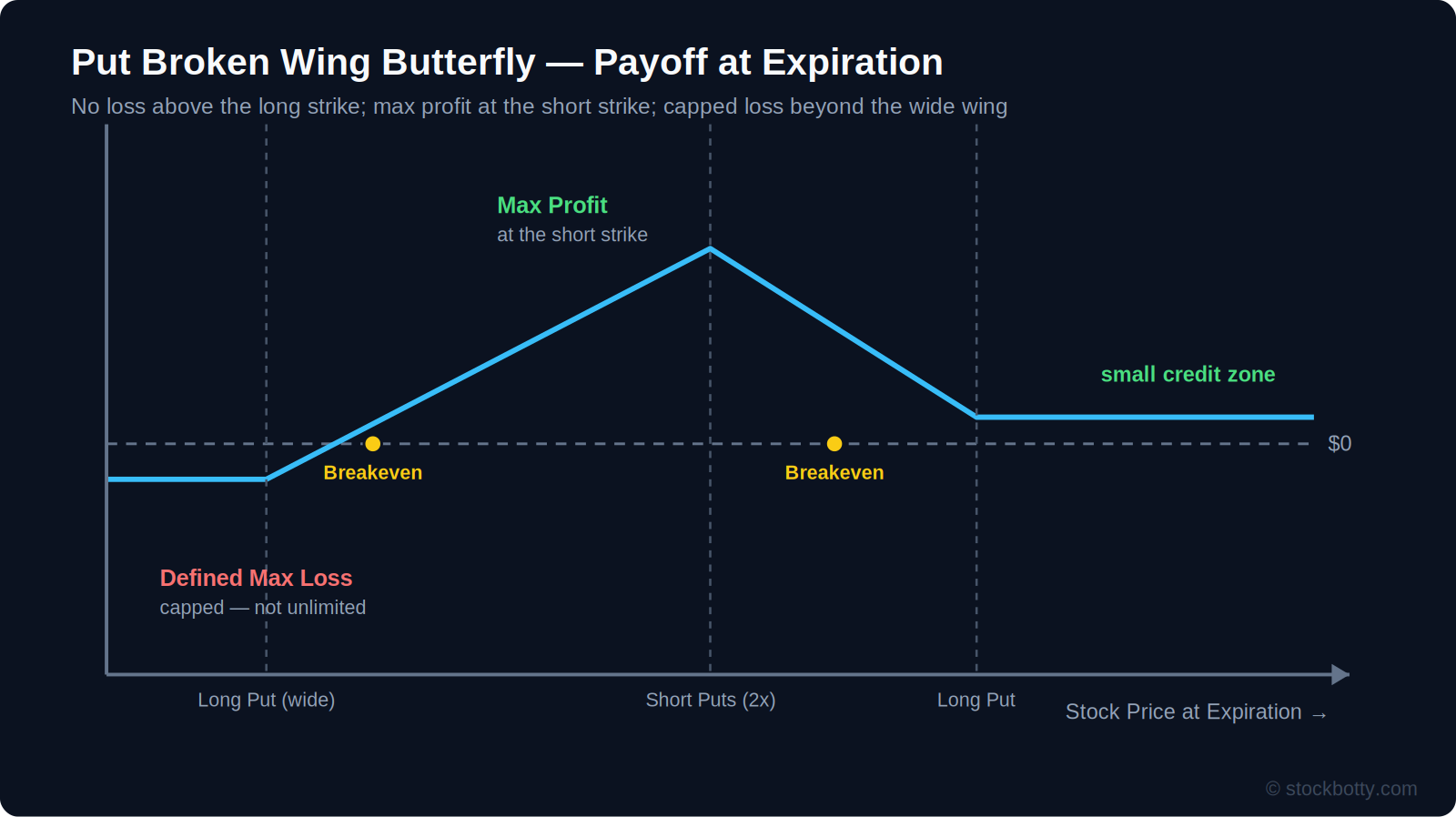
Above the near long put strike, everything expires worthless and the position keeps the small credit – no loss on this side. Between the near strike and the short strike, profit builds as the stock falls, peaking exactly at the short strike. Beyond that, the loss grows until the stock passes the far long put, after which it’s flat at a defined, calculable maximum loss.
Choosing Strikes and Expiration
- Wing width ratio: the wider the far wing relative to the near wing, the larger the credit collected and the larger the defined loss on the wide side – these move together, so it’s a direct trade-off, not a free lunch.
- Net credit as a target: similar to a ratio spread, many traders specifically size the wings to achieve a net credit, since it means the “wrong side” of the trade (price doesn’t move as expected) results in keeping a small profit rather than a loss.
- Days to expiration: 30-45 days is common, giving the position time to reach the short strike while still leaving room to manage it before gamma near the short strike becomes severe.
When to Enter a Broken Wing Butterfly
- Call version: a bullish-to-neutral view – comfortable if the stock does nothing or drops, ideally profiting from a moderate rise toward the short strike.
- Put version: a bearish-to-neutral view – comfortable if the stock does nothing or rises, ideally profiting from a moderate decline toward the short strike.
- Elevated implied volatility on the short strikes generally helps, similar to other strategies that are net short options at the middle strike, since it makes the premium collected there richer relative to the wings.
Managing the Trade
- Take profit near the short strike: the position is most valuable when the stock is sitting at or near the short strike shortly before expiration – many traders close well before that peak decays away.
- Let the credit side run: if the stock stays on the no-loss side of the trade, there’s often little need to manage it actively – the worst outcome there is simply keeping the small credit.
- Watch the transition into the defined-loss zone: once the stock moves through the short strike toward the wide wing, the loss is capped but still growing until it reaches the far strike – closing or rolling before it fully materializes can still improve the outcome, even though the downside is already bounded.
The Line Lifts Over Time (T+0)
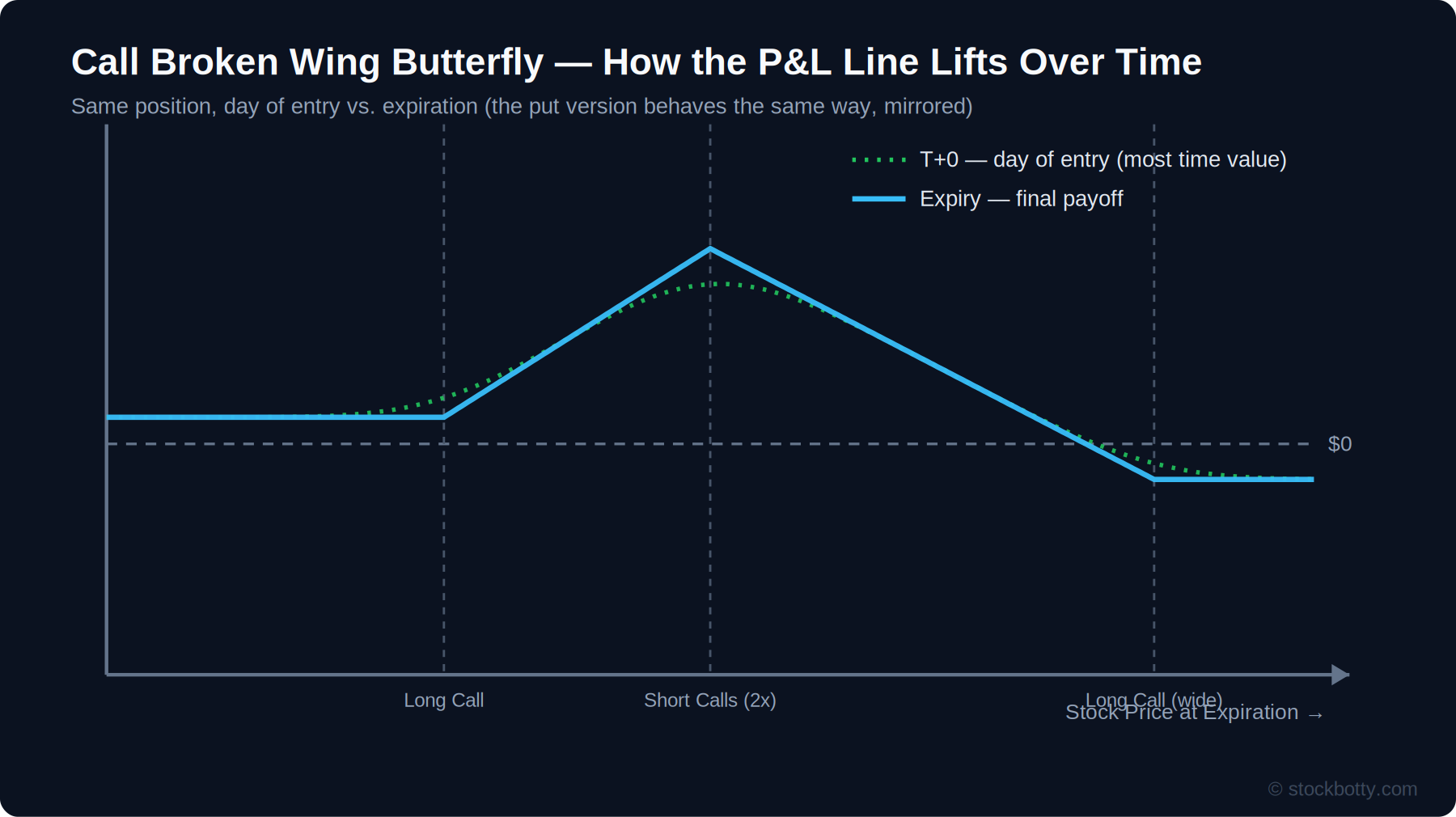
The sharp peak-and-plateau shape above only describes the position on the exact day of expiration. Before that, the position follows a rounder T+0 line, reflecting the time value still left in all three contracts. Early in the trade’s life, the peak near the short strike is far less pronounced, and the transition into the defined-loss zone is more gradual.
As with other multi-leg strategies, this is why many traders manage the position around the short strike well before expiration rather than waiting for the sharp, fully-realized shape to take effect – a large share of the eventual profit is often available earlier, without holding through the last stretch of gamma risk near the short strike.
Greeks and Volatility Behavior
- Theta (time decay): positive when the stock is near the short strike, where the position benefits most from time passing; closer to the long strikes, theta’s effect is smaller and can even work against the position on the near, no-loss side.
- Vega (volatility): similar to a ratio spread, the net vega depends on where the stock is trading relative to the three strikes – it isn’t a simple “always short vega” position the way an iron condor is.
-
⚡ Important: because the structure mixes a spread that behaves like a credit position with a further long option acting as insurance, a volatility spike can affect each part differently. Don’t assume the whole position reacts the same way a simple credit spread would.
- Delta (direction): starts modestly directional (bullish for the call version, bearish for the put version) and shifts as the stock moves through the short strike toward the wide wing.
- Gamma (acceleration): most pronounced right around the short strike, especially in the final one to two weeks before expiration – this is where the position’s value is most sensitive to a small stock move, since it’s the peak of the payoff curve.
-
⚡ Important: gamma risk peaks exactly where the trade is most profitable – right at the short strike, in the last two weeks. A stock sitting near the short strike can swing the position’s value quickly in either direction during this window, even though the ultimate loss is capped.
Example Trade
Call broken wing butterfly: stock trading at $100. Buy the 100-strike call for $4.00 ($400), sell two 105-strike calls for $2.20 each ($440 total), buy the 115-strike call for $0.60 ($60). Net credit: $-400+440-60 = -$20, i.e. a small $20 debit in this example – strike spacing can be adjusted further to flip it to a credit.
- Narrow wing: $5 wide (100 to 105); wide wing: $10 wide (105 to 115)
- Max profit: at $105, roughly $480 (the $5 narrow wing, ×100, minus the $20 debit)
- Below $100: lose the small $20 debit (or keep a small credit with wider spacing)
- Above $115: defined max loss, roughly $520 (the $5 difference between wing widths, ×100, plus the $20 debit)
Put broken wing butterfly: stock trading at $100. Buy the 100-strike put for $4.00 ($400), sell two 95-strike puts for $2.20 each ($440 total), buy the 85-strike put for $0.60 ($60). Same numbers, mirrored to the downside.
Pros and Cons
Pros: defined risk on both sides unlike a ratio spread, often opened for a net credit or small debit, no loss (or a profit) if the stock doesn’t move as expected, flexible wing widths let the risk/reward be tuned.
Cons: profit zone is narrower than a standard spread, three-leg execution is more complex than a simple vertical spread, requires the stock to move toward the short strike to realize meaningful profit, gamma near the short strike can move the position’s value quickly in the final weeks.
⚠ Risks Beyond the Basics
The defined risk is the main selling point of a broken wing butterfly over a ratio spread, but a few less obvious issues are worth knowing before trading one.
The “no-loss side” isn’t always truly riskless
A broken wing butterfly only avoids loss on the narrow-wing side if it was actually opened for a net credit (or breaks even). If the wings are priced such that the trade costs a net debit, that debit is at risk if the stock finishes on the “safe” side – the structure is only as safe as its actual pricing, not just its shape.
Assignment and pin risk on the short strikes
As with any structure holding two short contracts at the same strike, early assignment on American-style equity options can affect only part of the position, leaving an uneven remainder that’s harder to manage than a fully matched spread.
Execution and leg risk on a 3-strike structure
Filling three different strikes as a single order is standard, but on less liquid underlyings the combined bid-ask spread – especially on the far, thinly-traded wide wing – can meaningfully affect the actual credit or debit received versus the theoretical price.
The profit zone is narrower than it looks
Because maximum profit only occurs in a fairly tight range around the short strike, a broken wing butterfly can realize a mediocre result – not the max profit, not the max loss – across a wide range of outcomes. Traders sometimes overweight the best-case number in the payoff diagram relative to how often it’s actually achieved.
Weekend and overnight gap risk
A stock sitting safely on the no-loss side or comfortably near the short strike on Friday’s close can gap through several strikes at Monday’s open on overnight news, moving straight into or past the defined-loss zone with no chance to react in between.
Frequently Asked Questions
What makes a butterfly “broken wing”?
A standard butterfly has equal distances between the strikes on each side. A broken wing butterfly makes one side wider than the other, which shifts the cost of the wings and typically allows the trade to be opened for a net credit or close to cost-neutral, at the price of a defined loss on the wide-wing side.
How is a broken wing butterfly different from a ratio spread?
Both use an uneven number of long and short contracts, but a ratio spread leaves one short option uncovered, creating unlimited (or very large) risk. A broken wing butterfly adds a further long option beyond the short strikes, which caps the risk on both sides – the trade-off is a smaller profit zone.
Can a broken wing butterfly lose money if the stock doesn’t move?
If it’s constructed for a net credit, the side where the wing is wider is protected up to the point where the price stays on the narrow-wing side or doesn’t move much – in that case the position keeps the small credit rather than losing. The defined loss only occurs if the stock moves through the short strike and past the wide wing.
Is a call broken wing butterfly bullish or bearish?
A call broken wing butterfly is typically built with a bullish-to-neutral bias: it has no loss if the stock stays flat or falls, profits most if the stock rises to the short strike, and has a defined, capped loss if it rises much further.
Is a put broken wing butterfly bullish or bearish?
A put broken wing butterfly is typically built with a bearish-to-neutral bias: it has no loss if the stock stays flat or rises, profits most if the stock falls to the short strike, and has a defined, capped loss if it falls much further.
What is the maximum loss on a broken wing butterfly?
The difference between the wide wing and the narrow wing, minus the net credit received. Because this is a fixed, calculable number known before the trade is placed, the maximum loss is defined on both sides – unlike a ratio spread.