
An iron butterfly is close cousin to the iron condor covered elsewhere on this site – same four-leg, defined-risk structure, same range-bound thesis. The difference is where the two short strikes sit: instead of two separate strikes creating a wide profit zone, an iron butterfly sells both the put and the call at the exact same at-the-money strike, trading a wider range for a sharper, more concentrated payoff. This guide covers the structure on its own terms, and spends real time on how it compares to the iron condor, since that comparison is usually the actual question.
Structure
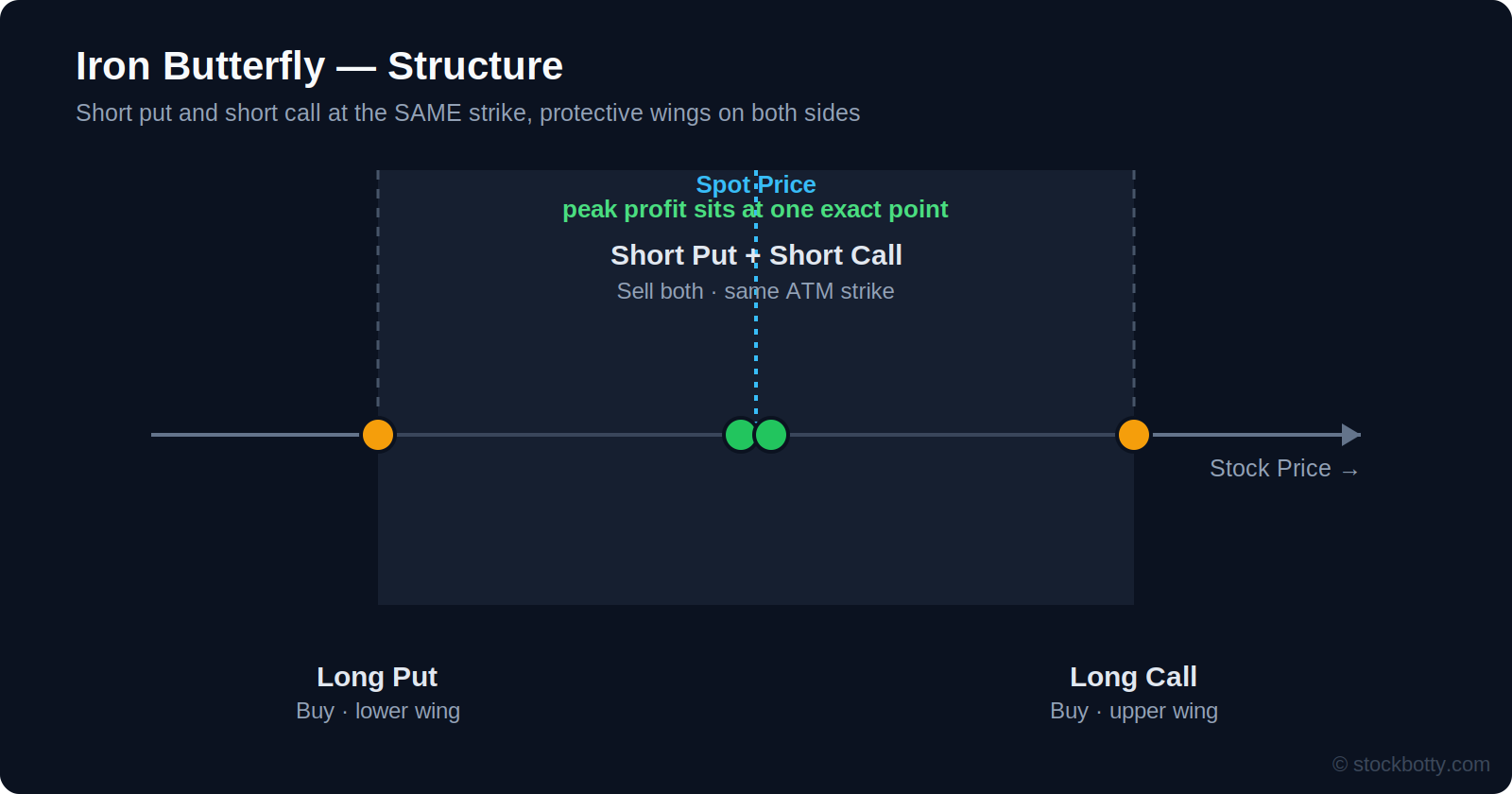
Sell 1 put and 1 call at the same strike, typically at or near the current stock price. Buy 1 put below that strike and 1 call above it as protective wings, the same expiration for all four legs. Selling both short options at the money collects significantly more premium per leg than an iron condor’s separated strikes, since at-the-money options carry the richest extrinsic value.
Payoff at Expiration
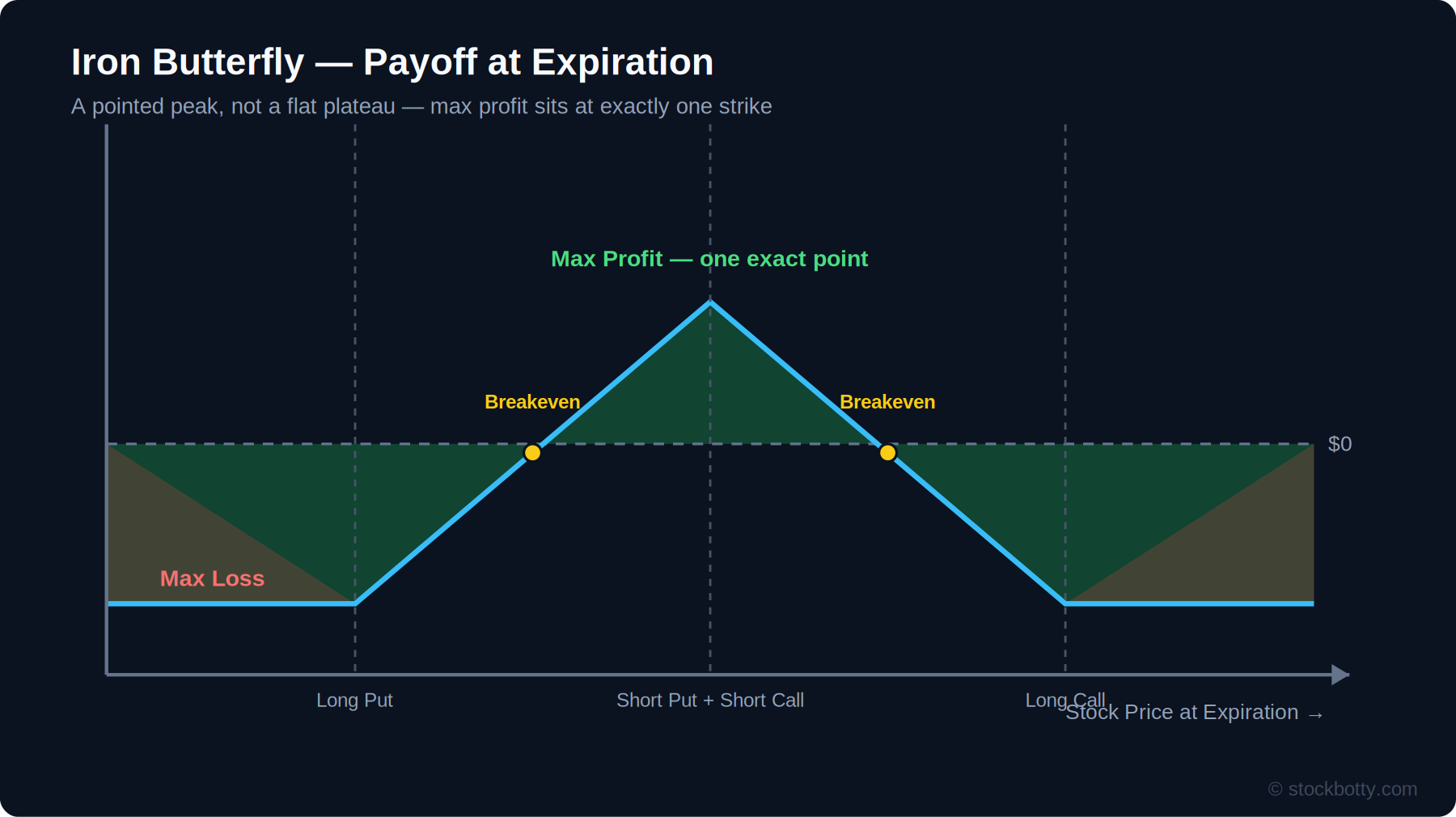
Unlike the iron condor’s flat-topped trapezoid, an iron butterfly’s payoff comes to a point. Maximum profit – equal to the net credit collected – only happens if the stock finishes exactly at the short strike at expiration. Moving away from that point in either direction, profit declines steadily until it flattens out at the maximum loss level once the stock reaches either wing.
Iron Butterfly vs. Iron Condor
Since these two strategies are so closely related, the choice between them usually comes down to a direct trade-off:
- Profit zone width: an iron condor’s flat top gives room for the stock to move between two strikes and still capture max profit. An iron butterfly’s peak is a single point – the stock has to land close to it to capture the largest profit, though a partial profit is still available across a range around that peak.
- Credit collected: because both short legs are sold at the money, an iron butterfly generally collects more net credit than an iron condor of similar wing width, since at-the-money premium is richer than the further out-of-the-money premium an iron condor’s short strikes typically collect.
- Precision required: an iron butterfly is a more concentrated bet on the stock landing near a specific level, while an iron condor is a bet on the stock staying within a broader range. Neither is strictly better – they express different degrees of conviction about exactly where the stock will settle.
Choosing Strikes and Expiration
- Short strike: placed at or very close to the current price, since the strategy’s thesis is that the stock stays near where it is now, not that it moves to a specific target level.
- Wing width: wider wings collect a smaller net credit relative to the width but raise the maximum loss; narrower wings do the opposite. Both wings are typically set to the same width for a symmetric payoff.
- Days to expiration: 30-45 days is common, the same range used for other premium-selling strategies on this site, balancing theta decay against the sharply rising gamma risk near the peak as expiration approaches.
When to Enter an Iron Butterfly
- Elevated implied volatility – since both short legs are sold at the money, high IV meaningfully increases the credit collected, the same principle that applies across every premium-selling strategy on this site.
- A stock you expect to pin near its current level through expiration, rather than simply stay within a broad range – a more specific thesis than the one behind an iron condor.
- After an anticipated volatility crush, such as right after an earnings report, when the stock is expected to settle rather than continue moving.
Managing the Trade
- Taking profits early matters even more here than with an iron condor, since the peak is a single point rather than a range – many traders close once a large share of the max profit is captured, rather than depending on the stock landing exactly on the strike at expiration.
- Defending a threatened wing works the same way as with an iron condor: rolling the untested side closer for additional credit, or rolling the tested side out in time and further in strike.
- Given how narrow the profit zone is, many traders manage an iron butterfly more actively than an iron condor, since a modest move can take the stock from near the peak profit to well down the slope toward one of the wings.
The Line Lifts Over Time (T+0)
The same concept covered for the iron condor applies here, in a sharper form. The pointed peak in the diagram above only describes the position on the exact day of expiration – before that, the position follows a rounder T+0 line, with the peak far less pronounced early in the trade’s life. Because the profit zone is narrower to begin with, the difference between the early, rounded T+0 shape and the final, sharp-pointed expiration shape is more dramatic than it is for an iron condor’s flatter top.
Greeks and Volatility Behavior
- Theta: positive, and typically larger in dollar terms near the strike than an iron condor’s, since both short legs are at the money where time decay is fastest.
- Vega: negative – the position benefits from a decline in implied volatility, the same as an iron condor.
- Delta: near zero at entry when the strike is placed at the current price, but shifts quickly as the stock moves away from that single point, faster than an iron condor’s delta shifts within its wider profit zone.
- Gamma: the defining risk of this strategy. Because both short legs sit at the same at-the-money strike, gamma is concentrated at exactly the point where the stock needs to land – gamma risk near expiration, a recurring theme across this site, is sharper here than in almost any other strategy covered, since there’s no width to the peak the way there is with an iron condor’s flat top.
Example Trade
Stock trading at $100. Sell the 100-strike put and the 100-strike call, both 35-45 days out, for $2.20 and $2.30 respectively ($450 total credit). Buy the 90-strike put for $0.60 and the 110-strike call for $0.55 (wings, $115 total cost). Net credit: $335.
- Max profit: $335, only if the stock finishes at exactly $100 at expiration
- Max loss: $665 (the $10 wing width, ×100, minus the $335 credit), if the stock is at or beyond $90 or $110
- Breakevens: roughly $96.65 and $103.35
Pros and Cons
Pros: defined risk on both sides, collects a larger net credit than a similarly-wide iron condor, benefits from time decay, works well after an anticipated volatility crush.
Cons: narrower profit zone requires more precision than an iron condor, gamma risk near the peak is sharper and builds faster, four legs mean higher transaction costs, a moderate move away from the strike can erode much of the potential profit quickly.
⚠ Risks Beyond the Basics
Most of the risks that apply to the iron condor apply here too, sharpened by the narrower structure. A few points specific to the iron butterfly.
Pin risk is more consequential here than almost anywhere else
Because maximum profit depends on landing at one exact strike, whether the stock closes a few cents above or below that level at expiration can meaningfully change the outcome – and since equity options are American-style, uncertainty about assignment right at the strike is a real, not theoretical, concern.
The credit advantage over an iron condor comes with a narrower margin for error
Collecting more premium than an iron condor isn’t free – it reflects the market pricing in a lower probability of the stock actually landing at that single point. A larger credit and a lower probability of full success are two sides of the same trade-off, not separately good news.
Early assignment and dividend risk apply to both short legs
The same American-style exercise risk covered throughout this site applies to both the short put and the short call here, and since both sit at the money, either one can move into or out of exercise territory quickly on a small stock move.
Weekend and overnight gap risk is amplified by the narrow zone
A stock sitting comfortably near the peak on Friday’s close has much less room to gap before it’s meaningfully off the peak than an iron condor’s wider zone would allow, making this strategy more exposed to a surprise move over a weekend or earnings date relative to its narrower profit range.
Frequently Asked Questions
What is an iron butterfly?
A four-leg, defined-risk options strategy that sells a put and a call at the same at-the-money strike, and buys a put and a call further out as protective wings. It profits most if the stock finishes exactly at the short strike at expiration.
What’s the difference between an iron condor and an iron butterfly?
An iron condor sells a put and a call at two different strikes, creating a wider, flat-topped profit zone. An iron butterfly sells both at the same strike, creating a narrower, pointed profit zone with a higher peak but less room for the stock to move and still profit.
Is an iron butterfly riskier than an iron condor?
Both have defined, capped risk, but an iron butterfly’s profit zone is narrower, so the stock has to land closer to the exact strike to realize the full profit. In that sense it demands more precision, even though the maximum dollar loss is still known in advance.
Why would I choose an iron butterfly over an iron condor?
An iron butterfly typically collects more net credit relative to its risk than an iron condor of similar width, since both short options are sold at the money where premium is richest. The trade-off is a narrower range in which that larger credit is actually realized.
What is the maximum loss on an iron butterfly?
The width of either wing minus the net credit received. Since both wings are typically the same width, this loss is capped and known in advance on both sides.