
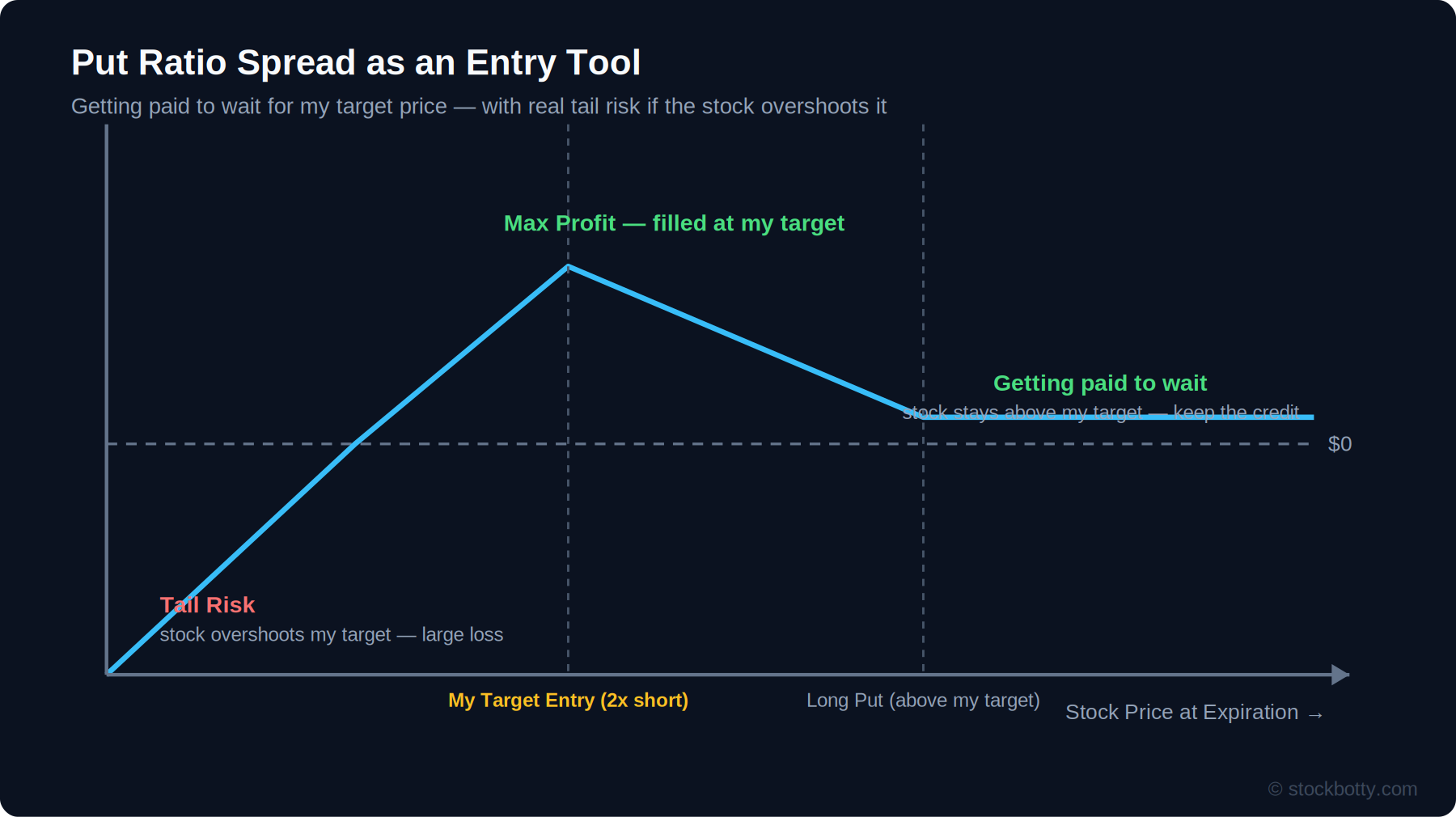
⚠ Before you read this: this is not a rescue technique – it’s how I sometimes structure an entry into a stock I already want to own, instead of using a plain limit order. It is not financial advice, not a recommendation, and it does not reduce risk the way it’s sometimes described elsewhere. It’s still a ratio spread, with the same large tail risk any put ratio spread carries if the stock overshoots my target. I’m documenting how I think about it, not suggesting you should use it the same way.
Everything else in this Playbook is about managing a trade that’s already gone wrong. This one is different – it’s an entry technique I use when I already know I want to own a stock at a lower price than it’s trading at today, and I’m not in a hurry to get there. Instead of a plain limit order sitting quietly in the background, I sometimes use a put ratio spread to get paid while I wait.
Why I’d Use This Instead of a Limit Order
A limit order costs nothing and does nothing while it waits – if the stock never reaches my price, I’ve lost nothing, but I’ve also gained nothing. A put ratio spread set up around the same target level can collect a credit up front. If the stock never gets there, I keep that credit. If it does get there, I can end up owning shares at my target price, the same outcome a limit order would have given me, except I was paid something for the wait.
Where this specifically appeals to me: I’m betting on a pullback in a stock I already want to own. If I catch my target level, I collect a genuinely nice premium for having called it. If the stock blows straight through my target instead, that outcome doesn’t feel like a foreign risk to me – I wanted the stock anyway, so buying more of it lower, even sharply lower, is the same risk I’d have accepted with an outright dip buy. What I’m really adding with this structure isn’t a new risk I wouldn’t otherwise take – it’s a way to get compensated for the scenario where the pullback I’m hoping for stalls out before it reaches me.
Why I Don’t Treat This as a One-Shot Trade
Because I’m not in a hurry, I don’t stop after a single cycle if the stock doesn’t test my target. If it expires without coming close, I can simply open the next cycle and try again. A stock that keeps drifting near my target – landing nicely inside the “tent,” the peak of the payoff curve, without actually breaking through it – can pay out a solid premium two or three cycles in a row before anything else happens. Each cycle that doesn’t get me filled is still income while I wait; the cycle that finally does is the entry I was after all along. That’s the part of this that feels most like getting paid to be patient, rather than just getting paid once for guessing a level correctly.
The Structure
This is the same put ratio spread structure covered elsewhere on this site: I buy 1 put at a strike above my target entry price, and sell 2 puts at my target strike. If the stock stays above the long put strike, everything expires worthless and I keep the credit. If the stock settles right around my target strike at expiration, I’ve captured the maximum value of the structure. Below that, the extra uncovered short put takes over, and losses can grow quickly.
Correcting a Framing I’ve Seen: This Doesn’t “Reduce Risk”
I want to be direct about something I think gets misrepresented. This isn’t a lower-risk way to buy a stock – it’s a differently-shaped risk than a plain limit order, and in a sharp decline, it’s a considerably larger one. A limit order’s worst case is that I don’t get filled. A put ratio spread’s worst case, if the stock crashes well past my target, is a loss meaningfully larger than the credit I collected – the same large, technically-bounded-at-zero risk that’s true of any naked short put, since that’s structurally what the uncovered leg of this spread is. I use this because I’m comfortable with that trade-off for a stock I already wanted to own, not because I think it’s made the trade safer.
The Share-Count Detail I Watch For
Something worth being precise about: because this is a 1×2 ratio, not a 1×1 spread, full assignment on both short puts means I’d be obligated to buy twice the shares a single short put would require, at my target strike. If I only wanted 100 shares at my target price, I need to size this with that in mind – either by treating the structure as intentionally sized for 200 shares, or by planning to manage the position before both short puts are assigned in full. This is easy to miss if I think of the trade as “I’ll get filled at my price” without accounting for the ratio.
A Worked Example
Stock trading at $160. I’d be comfortable owning it around $135 – about 16% lower – but I’m not paying $160 for it today. I buy the $145 put and sell two $135 puts, 30-45 days out. The $145 put costs me $3.20 ($320); the two $135 puts bring in $1.90 each ($380 total). Net credit: $60.
- If the stock stays above $145: everything expires worthless, I keep the $60 credit, and I never had to buy anything.
- If the stock settles around $135 at expiration: this is close to the best case – I’ve captured close to the maximum value of the structure, and I’m likely to end up owning shares near my target price.
- If the stock falls well below $135 – say to $110: the extra uncovered short put is now working against me hard. This is where the resemblance to a “smart limit order” breaks down completely, and the position behaves like a naked short put that’s deep in trouble.
Where This Can Go Wrong
- A sharp, fast decline doesn’t stop at my target. The whole premise assumes the stock either stays up or settles near my chosen level. A crash that blows through my target and keeps going turns this from “getting paid to wait” into a real, large loss.
- I might end up with more shares than I planned for. The 1×2 ratio means full assignment is a 200-share event at my strike, not 100 – I have to actually want that much exposure at that price, not just be comfortable with the idea in the abstract.
- The margin required is real, not incidental. Because the extra short put is uncovered, my broker holds meaningfully more collateral against this position than a covered limit order would ever tie up, for the entire time the position is open.
- I don’t get to change my mind for free. A limit order can be canceled with no cost. Unwinding this structure early, especially after the stock has moved, means buying back options that may have moved against me.
⚠ Risks Beyond the Basics
A few additional things I keep in mind when I use this as an entry tool specifically.
This only makes sense for a stock I’d genuinely want to own more of at my target
Because full assignment can mean 200 shares, not 100, I only use this when I’d actually be comfortable owning that much at that price – not as a way to dip a toe in.
The “free trade” framing understates the tail risk, the same way it does for any ratio spread
A small credit collected up front doesn’t change the size of the risk below my target – it only offsets it slightly. I’ve seen this pitched as low-risk because it “just” waits for a price I already wanted; the credit doesn’t erase what happens if the stock keeps falling past that price.
Early assignment on the short puts is a real possibility, not just a theoretical one
As covered throughout this site, American-style equity options can be exercised early. If the stock is trading well below my short strike with little time value left, I could be assigned before expiration, on my own schedule or not.
Repeated cycles don’t make the tail risk go away
Running this two or three times in a row without incident can start to feel safe – but each new cycle carries the same full tail risk as the first one. A string of quiet cycles doesn’t reduce the risk of the one where the stock actually does crash through my target; it just means I haven’t seen that outcome yet.
I still need an exit plan if the thesis breaks
Wanting to own a stock at $135 today doesn’t mean I’ll still want to at $95, if something about the company has genuinely changed. This structure doesn’t decide that for me – I still have to be willing to close it at a loss if my reason for wanting the stock in the first place no longer holds.
Frequently Asked Questions
How is a put ratio spread different from a limit order?
A limit order costs nothing to place and pays nothing while it waits. A put ratio spread used the same way can collect a credit while I wait, and if the stock never reaches my target, I keep that credit instead of walking away with nothing.
Does using a put ratio spread this way reduce risk?
No, and I don’t think it should be described that way. It’s still a ratio spread with the same uncapped-below-breakeven risk any put ratio spread carries. Using it as an entry tool changes the intent, not the underlying risk structure.
If I’m assigned, do I get exactly the number of shares I wanted?
Not necessarily. Because a 1×2 ratio spread sells two puts for every one it buys, full assignment on both short puts obligates me to buy twice the shares a single short put would, at my target strike. I plan my sizing around that possibility, not around a single 100-share assumption.
What happens if the stock crashes well below my target price?
The position can lose significantly more than the credit collected, since below the breakeven the extra uncovered short put behaves like any naked short put – losses grow as the stock keeps falling, technically bounded at zero but large enough in practice to plan around carefully.