
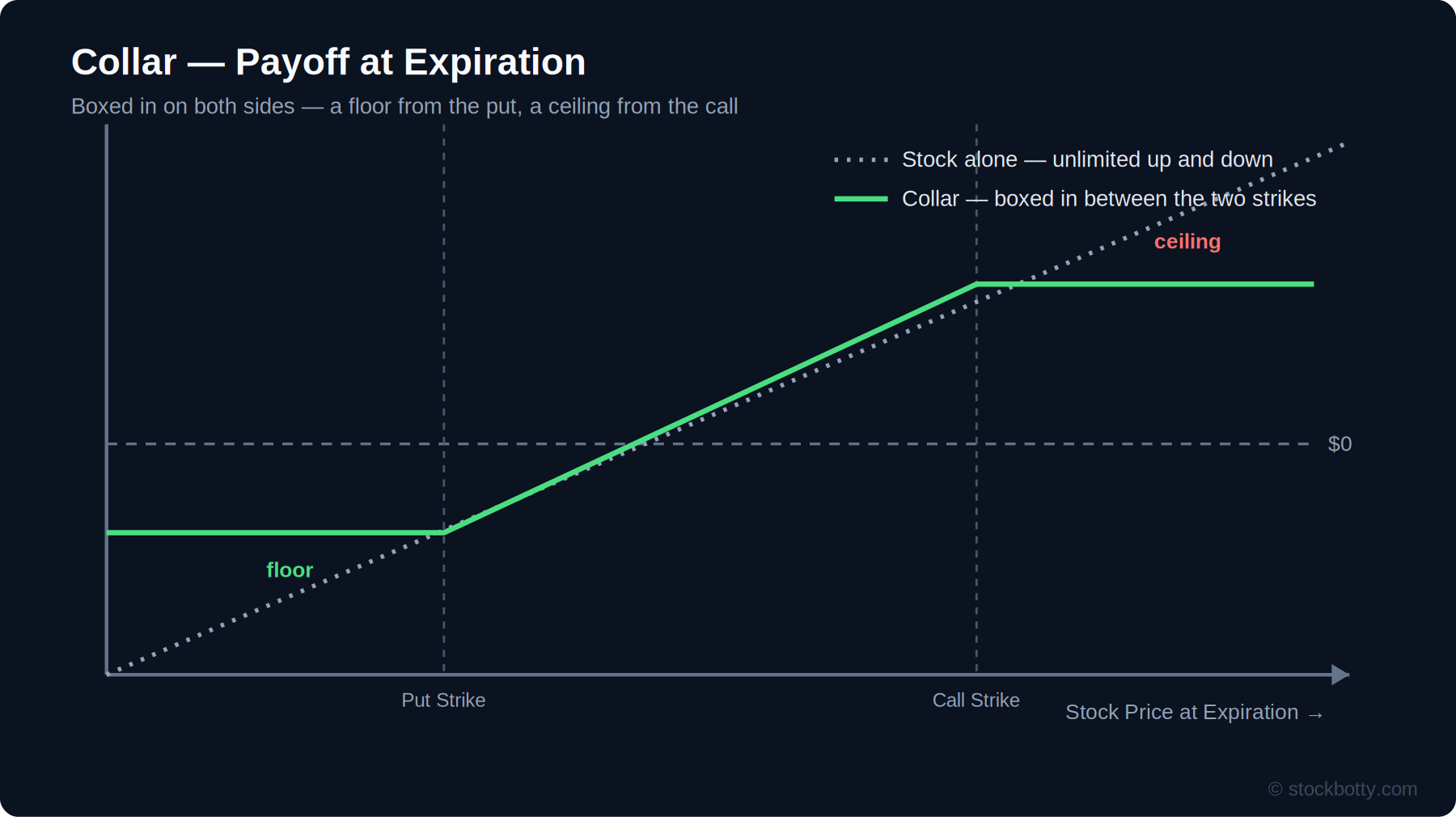
A collar combines the two strategies already covered in the covered call and protective put guides into one position: buy a put below the current price for downside protection, and sell a call above it to help pay for that protection. The result is a stock position boxed in on both sides – a floor from the put, a ceiling from the call.
Structure
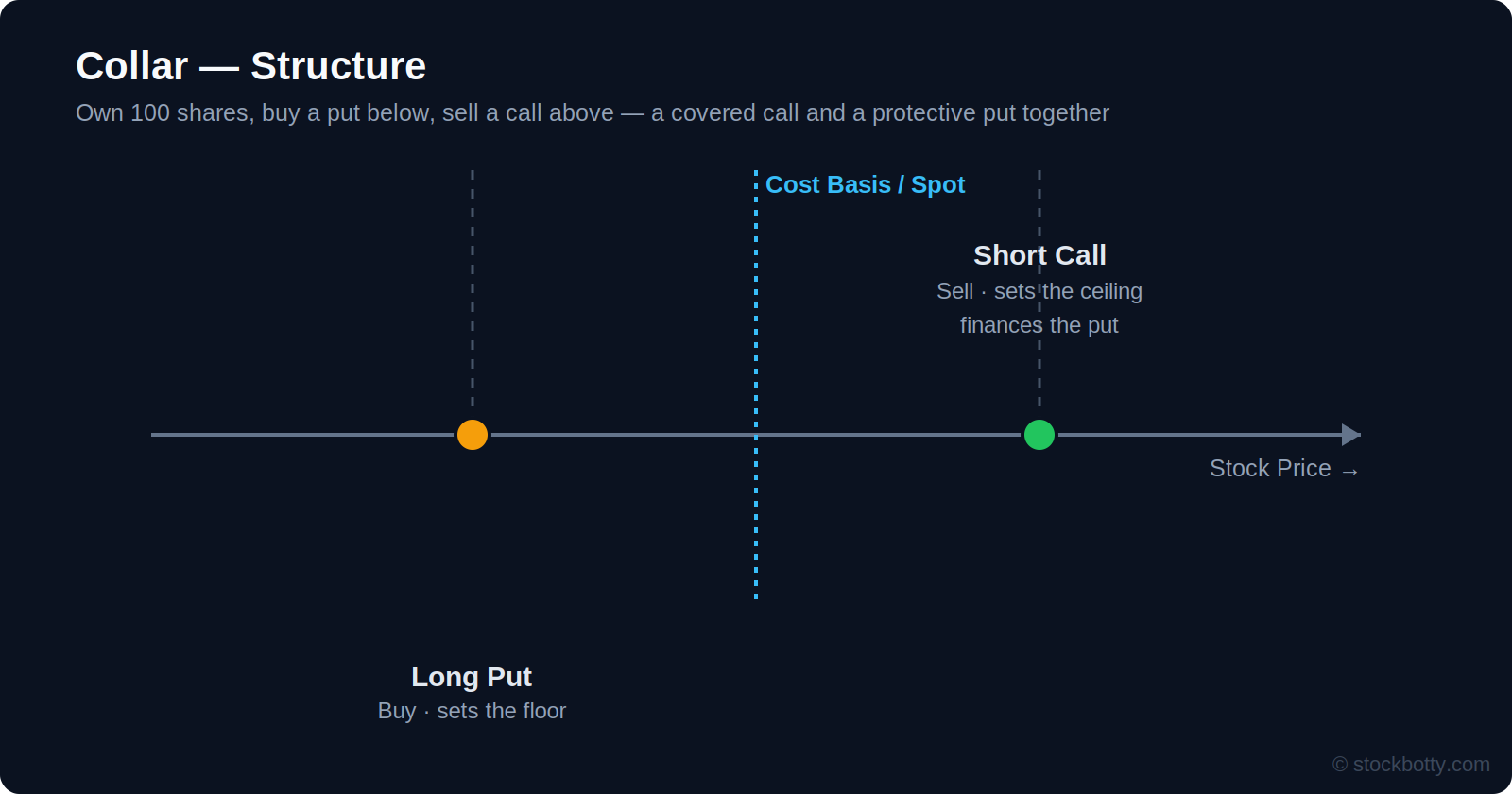
Own 100 shares, buy 1 put below the current price, and sell 1 call above it, typically the same expiration for both. The call’s premium offsets some or all of the put’s cost – when the two roughly cancel out, this is often called a costless or zero-cost collar, though that outcome depends on where the strikes land relative to current pricing, not something guaranteed by the structure itself.
Payoff at Expiration
Below the put strike, losses are floored – the position doesn’t decline further no matter how far the stock falls. Above the call strike, gains are capped – the position doesn’t benefit further no matter how far the stock rises. Between the two strikes, the position moves with the stock like any ordinary shareholding. This is the covered call’s ceiling and the protective put’s floor, applied to the same shares at the same time.
Financing the Put With the Call
The core trade-off of a collar is straightforward: give up some upside to pay for downside protection, instead of paying for that protection out of pocket the way a standalone protective put does. How close the two strikes sit to the current price determines the balance – a tighter collar (strikes closer to the current price) protects sooner and may cost less or even net a small credit, but caps upside more aggressively; a wider collar leaves more room to run in both directions, at a higher net cost for the insurance.
A Capital-Efficient Variant: Deep ITM Call, Far OTM Put
One specific way to build a collar shifts both strikes toward the extremes: sell a call that’s deep in the money instead of near the money, and buy a put that’s far out of the money instead of close to the current price. This version is worth walking through on its own, since it behaves differently from a standard collar in a few important ways.
Because a deep ITM call has a delta close to 1.00, selling it against the shares brings the position’s net delta close to zero – the same effect covered in the deep ITM tactic in the covered call guide. The stock and the short call largely offset each other, which means the combined position is far less sensitive to further price moves in either direction than a standard, more moderately-struck collar would be. The far OTM put, meanwhile, is cheap precisely because it’s unlikely to be needed – it’s there specifically for a severe, tail-risk decline, not as protection against an ordinary pullback.
The capital efficiency argument for this setup is real but depends on the specifics: because the position’s net delta is low, some brokers extend more favorable margin treatment to a hedged stock-plus-deep-ITM-call position than they would to an unhedged equivalent, which can meaningfully improve return on capital relative to tying up full collateral in a cash-secured put at a similar effective exposure. This isn’t universal – margin treatment for hedged positions varies by broker and by account type, and it’s worth confirming directly rather than assuming.
One nuance worth being precise about: because the short call’s delta is close to 1.00, this setup captures noticeably less further upside than a standard collar with a more moderate call strike, not more – the deep ITM call is already tracking the stock almost dollar-for-dollar on the way down as well as up, which is exactly why the net position moves so little either way. The appeal of this version isn’t additional upside participation; it’s the combination of high probability of retaining most of the current value, defined tail protection from the far OTM put, and not being on the clock the way a short put alone would be – since the position includes real shares, there’s no expiration forcing a decision the way there is with a naked option position, and any adjustment can be made on a schedule that suits the position rather than one dictated by an approaching expiration on an unwanted loss.
Choosing Strikes and Expiration
- Standard collar: strikes placed symmetrically or near-symmetrically around the current price, often used to protect a position that’s run up significantly without selling it outright.
- Deep ITM / far OTM variant: the call strike sits well below the current price (deep in the money) and the put strike sits well below that (far out of the money), trading upside participation for capital efficiency and defined tail risk.
- Days to expiration: 30-45 days for the call side is common, matching the rolling cadence used for standalone covered calls elsewhere on this site. The put can be set to a longer expiration if it’s meant as longer-term tail protection rather than something actively managed each cycle.
When to Use a Collar
- Protecting a large unrealized gain without selling and triggering a taxable event, while partially or fully financing that protection with the call premium.
- A concentrated position that can’t easily be diversified away, where both downside protection and some financing of that protection matter.
- Uncertainty ahead of a specific event, where the trader wants to stay invested but isn’t comfortable with full exposure to a large move in either direction.
Managing the Trade
- If the stock stays between the strikes, both options expire worthless and a new collar can be established for the next cycle, similar to the rolling routine used for standalone covered calls.
- If the stock rallies through the call strike, the same roll-up-and-out decision covered in the Playbook’s covered call rescue entry applies to the call side of a collar.
- If the stock falls toward the put strike, the put can be sold for a profit on that leg while the shares are kept, rather than waiting to see whether the decline continues.
Greeks and Volatility Behavior
- Delta: close to +1.00 from the shares, offset by the short call’s negative delta and pushed further down by the long put’s negative delta – a standard collar sits meaningfully below +1.00 net; the deep ITM variant sits closer to zero.
- Theta: mixed – positive on the short call, negative on the long put, the same opposing forces covered separately in the covered call and protective put guides.
- Vega: also mixed for the same reason – negative on the short call, positive on the long put, largely offsetting depending on the specific strikes chosen.
- Gamma: concentrated near whichever strike the stock is closest to as expiration approaches, the same gamma risk near expiration covered throughout this site.
Example Trade
Standard collar: stock trading at $100, cost basis $80. Buy the 90-put for $2.00 ($200), sell the 110-call for $1.90 ($190). Net cost: $10. Floor at $90 (a $10 gain from cost basis, protected), ceiling at $110 (a $30 gain from cost basis, capped) – a defined range of outcomes for $10 of net cost.
Deep ITM / far OTM variant: same stock. Sell the 80-call (deep ITM, delta near 0.90) for $21.50, buy the 70-put (far OTM) for $0.80. Net credit: $20.70. The position’s net delta is now low, most of the current value is effectively locked in, and the far OTM put only pays off in a severe decline – at the cost of very little further upside participation from here.
Pros and Cons
Pros: defined floor and ceiling, often costs little or nothing net (or can even net a credit in the deep ITM variant), doesn’t require selling the stock to protect gains.
Cons: caps upside, the deep ITM variant caps it more aggressively than a standard collar, still absorbs losses in full between the current price and the put strike, more complex to manage than either a covered call or protective put alone.
⚠ Risks Beyond the Basics
A few points worth knowing given that a collar combines two strategies already covered separately on this site.
A tight collar can trigger constructive sale tax treatment
Under US tax rules, a collar constructed tightly enough around the current price can be treated as a constructive sale of the stock, potentially triggering tax on unrealized gains even though the shares weren’t actually sold. This is a real, specific tax rule, not a general caution – confirming the details with a qualified tax advisor matters more than any general description of it here.
The gap between current price and put strike is still a real deductible
The same point covered in the protective put guide applies directly here – the floor sits at the put strike, not at today’s price, and everything in between is absorbed in full.
Margin benefits for the deep ITM variant aren’t guaranteed across brokers
The capital efficiency argument for a deep ITM call with a far OTM put depends on how a given broker treats a hedged stock-plus-options position for margin purposes. This varies, and assuming a specific margin benefit without confirming it directly can lead to sizing a position around capital that isn’t actually available the way expected.
Early assignment and dividend risk apply to the short call side
The same American-style exercise risk covered throughout this site applies to the call leg of a collar, particularly around ex-dividend dates if it’s in the money with little extrinsic value left – more likely for the deep ITM variant than for a standard collar’s more moderate call strike.
Frequently Asked Questions
What is a collar?
A strategy that combines a protective put and a covered call on the same shares – buying a put below the current price for downside protection, and selling a call above it to help finance that protection, capping the upside in exchange.
Can a collar be free to put on?
Sometimes, when the call premium collected roughly equals the put premium paid – often called a costless or zero-cost collar. This isn’t guaranteed; it depends on where the two strikes are placed relative to current implied volatility.
What is a deep in-the-money covered call with a far out-of-the-money put?
A specific collar variant using a deep ITM call, whose delta near 1.00 substantially reduces the position’s net exposure, paired with a cheap, far OTM put that only protects against a severe decline. It trades away most near-term upside participation for capital efficiency and tail protection.
Does a collar always protect all unrealized gains?
No. It sets a floor at the put strike, not at the current price. Any decline between the current price and the put strike is still absorbed in full, the same deductible-style gap covered in the protective put guide.
Are there tax considerations specific to a collar?
Yes. A collar constructed too tightly around the current price can, under US tax rules, be treated as a constructive sale of the stock, potentially triggering tax on unrealized gains even without selling. This is a genuine tax nuance worth confirming with a qualified advisor before using a tight collar.