
A protective put buys a put option against shares you already own – one contract per 100 shares. It’s the most direct form of portfolio insurance in options trading: it sets a floor under a stock position, at the cost of a premium. This guide covers how it works, what it actually protects against, and the parts of the “insurance” analogy that are easy to misread.
Structure
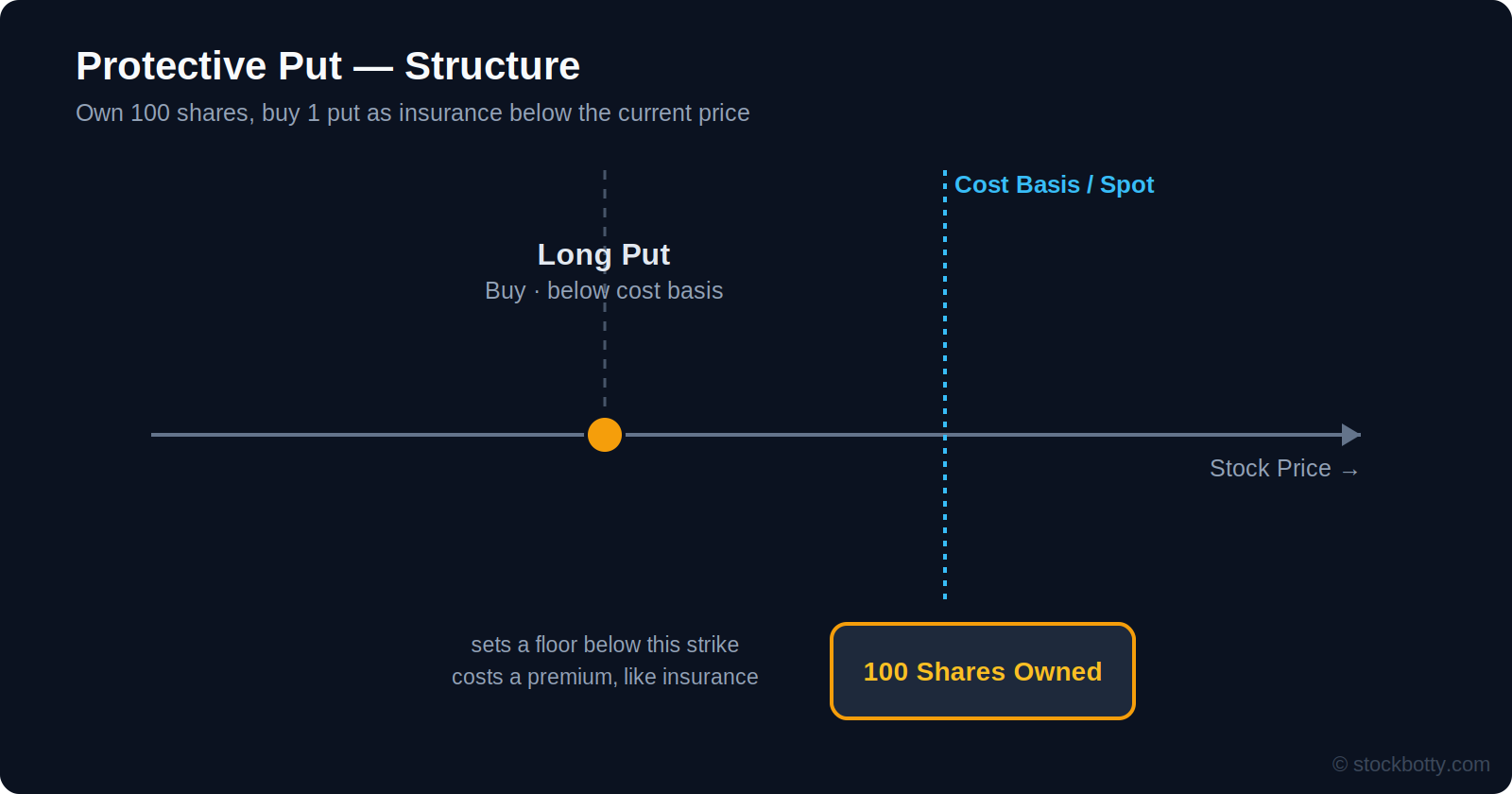
Own 100 shares of a stock, then buy 1 put option at a strike below the current price. You pay the premium up front. If the stock stays above the strike through expiration, the put expires worthless and the only cost was the premium. If the stock falls below the strike, the put gains value roughly dollar-for-dollar with the decline below that level, offsetting further losses on the shares.
Payoff at Expiration
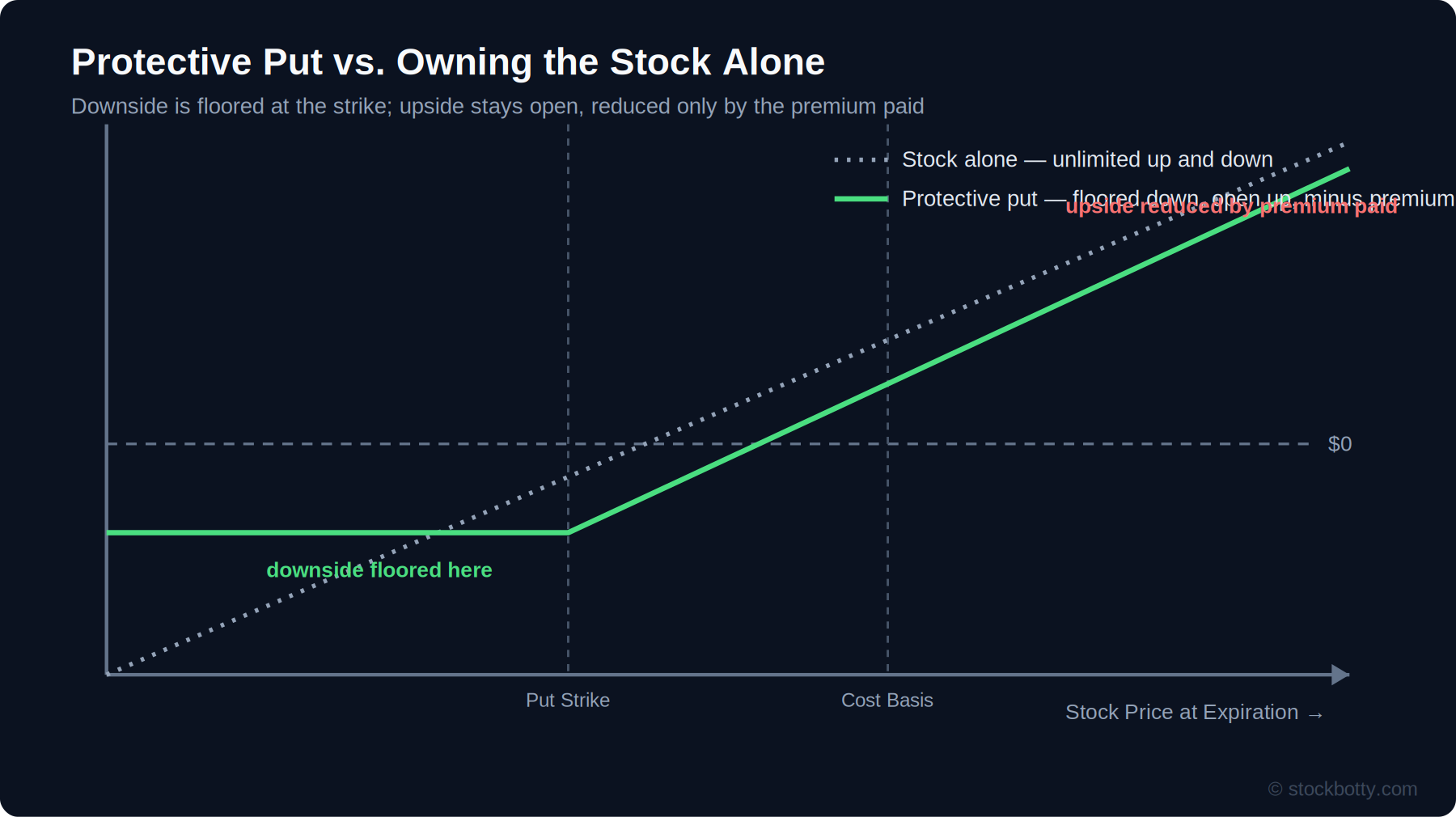
Above the strike, a protective put tracks the stock almost exactly, just shifted down slightly by the premium paid – full upside participation, minus the cost of the insurance. Below the strike, the lines diverge: owning the stock alone keeps falling with no floor, while the protective put flattens out, with losses capped at the strike minus the premium paid.
This is the trade-off in one picture: unlike a covered call, a protective put keeps upside fully open – it simply costs something to own, the same way any insurance policy does, whether or not it’s ever used.
Choosing Strikes and Expiration
- Strike selection: a strike closer to the current price costs more but protects sooner; a strike further out of the money costs less but leaves a larger gap of unprotected decline before the floor kicks in.
- Days to expiration: protection bought for a specific known event (earnings, a product announcement) is often sized to just cover that window. Ongoing protection is typically rolled forward periodically, similar to renewing an insurance policy.
- Cost versus coverage: the closer the strike sits to the current price, the more complete the protection, and the more expensive it is – the same trade-off as choosing a lower deductible on an insurance policy.
When to Use a Protective Put
- Protecting unrealized gains on a position that’s run up significantly, without selling and triggering a taxable event or giving up further upside.
- Hedging through a specific known event – earnings, a court ruling, an FDA decision – where the range of outcomes is wide and a large gap is a real possibility.
- A concentrated position that can’t easily be diversified away (restricted stock, a large single holding), where insuring against a severe decline matters more than the ongoing cost of the insurance.
Managing the Trade
- If the stock stays above the strike, the put expires worthless, and a decision has to be made whether to buy protection again for the next period – the same renewal decision as any insurance policy.
- If the stock declines toward the strike, the put gains value, and can be sold for a profit on the put itself (while keeping the shares) rather than waiting to see whether the decline continues.
- Combined with a covered call, a protective put on the same shares becomes a collar – financing some or all of the put’s cost with premium collected from selling a call, at the cost of also capping the upside.
Greeks and Volatility Behavior
- Delta: close to +1.00 from the shares, partially offset by the long put’s negative delta – still net long the stock’s movement, but somewhat less than the shares alone.
- Theta: negative on the long put – the same time decay covered on the Greeks page works against this position, since it’s a long option position, the mirror of the positive theta seen in most premium-selling strategies on this site.
- Vega: positive on the long put – a rise in implied volatility increases the put’s value, which is part of why protective puts are more expensive to buy exactly when the market is nervous and protection feels most necessary.
- Gamma: concentrated near the strike as expiration approaches, the same dynamic covered throughout this site – the put’s protective value can shift quickly if the stock is hovering near the strike close to expiration.
Example Trade
Stock trading at $100, cost basis $80. Buy the 90-strike put, 45 days out, for $2.00 ($200 per contract).
- If the stock stays above $90: the put expires worthless, the only cost is the $200 premium, and the shares participate fully in any further gain.
- If the stock falls to $70: the shares are down $30 from the current price, but the put is now worth roughly $20, offsetting most of the decline below $90 – the floored loss is capped at $10 per share below the strike, plus the $2 premium paid, versus the $30 an unprotected position would have lost.
- If the stock rises to $115: the shares gain $15, minus the $2 premium paid for the put – full upside participation, reduced only by the cost of the insurance that wasn’t needed.
Pros and Cons
Pros: defined, known floor on further losses, upside stays fully open, doesn’t require selling the stock to protect gains, works well for hedging through a specific known event.
Cons: costs a premium whether or not the protection is ever used, only protects below the strike, not from the current price down; repeated renewal over time is a recurring cost, not a one-time expense.
⚠ Risks Beyond the Basics
Protective puts are often described simply as “insurance.” A few points worth being precise about before treating the analogy as complete.
The gap between current price and strike is a real deductible
A protective put doesn’t protect from the current price – it protects from the strike price downward. A moderate decline that doesn’t reach the strike is absorbed in full, the same way a deductible works on an insurance claim. Choosing a strike closer to the current price reduces this gap, at a meaningfully higher cost.
Repeated cost compounds over time
Buying protection cycle after cycle, the way an insurance policy is renewed, is a recurring drag on returns if the stock never actually needs the protection. This cost is easy to underweight when looking at a single cycle in isolation.
Protection is most expensive exactly when it feels most necessary
Because the put is long vega, its cost rises with implied volatility – which tends to be elevated precisely during the periods of market stress when the desire for protection is highest. Buying protection proactively, before volatility spikes, is generally more cost-effective than buying it reactively during a selloff.
The married put tax treatment is a real nuance, not something to assume
A put bought on the same day as the underlying stock (a “married put”) can receive different tax treatment under US rules than one purchased later against stock already held. This is a genuine distinction worth knowing exists, but it’s a tax question, and confirming the specifics with a qualified tax advisor matters more than any general description of it.
A far out-of-the-money put can create a false sense of security
A cheap put bought far below the current price costs little, but also leaves a large uncovered decline before it does anything. Treating a distant, low-cost put as meaningful protection against a moderate decline overstates what it actually covers.
Frequently Asked Questions
What is a protective put?
A strategy where you buy a put option against shares you already own, one contract per 100 shares. It sets a floor below which the position can’t lose further value, at the cost of the premium paid for the put.
Does a protective put fully protect against losses?
No. It only floors losses below the put’s strike price. Between the current price and the strike, the position still absorbs the decline in full, similar to a deductible on an insurance policy – the put only pays off past that point.
What is a married put?
A protective put bought on the same day as the underlying stock. Under US tax rules, a married put can receive different tax treatment than a put purchased later against stock already held, though this is a tax question best confirmed with a qualified advisor.
How is a protective put different from a stop-loss order?
A stop-loss order triggers a market sale once a price is hit, with no guaranteed execution price, especially during a gap. A protective put guarantees the right to sell at the strike price regardless of how far the stock gaps below it, at the cost of the premium paid up front.
What is the cost of repeatedly buying protective puts?
Each cycle of insurance costs a premium, and if the stock doesn’t decline, that premium simply expires worthless, the same way unused insurance does. Repeatedly buying puts as ongoing protection is a recurring drag on returns, not a one-time cost.