
Early assignment, pin risk, and dividend risk show up in the risk section of nearly every strategy guide on this site, each time explained briefly in the context of that specific strategy. This page pulls all of it together in one place – what assignment and exercise actually are, how the process works mechanically, why early assignment happens, and what to do about it – so the other guides can point here instead of repeating it.
Exercise vs. Assignment – Two Sides of the Same Event
Exercise is the action taken by the person holding a long option – the buyer – to use their right to buy (a call) or sell (a put) the underlying at the strike price. Assignment is what happens to the person on the other side of that same contract – the seller – who is now obligated to fulfill it. Every exercise produces exactly one assignment; they’re the same event seen from opposite sides of the trade.
How the Process Actually Works
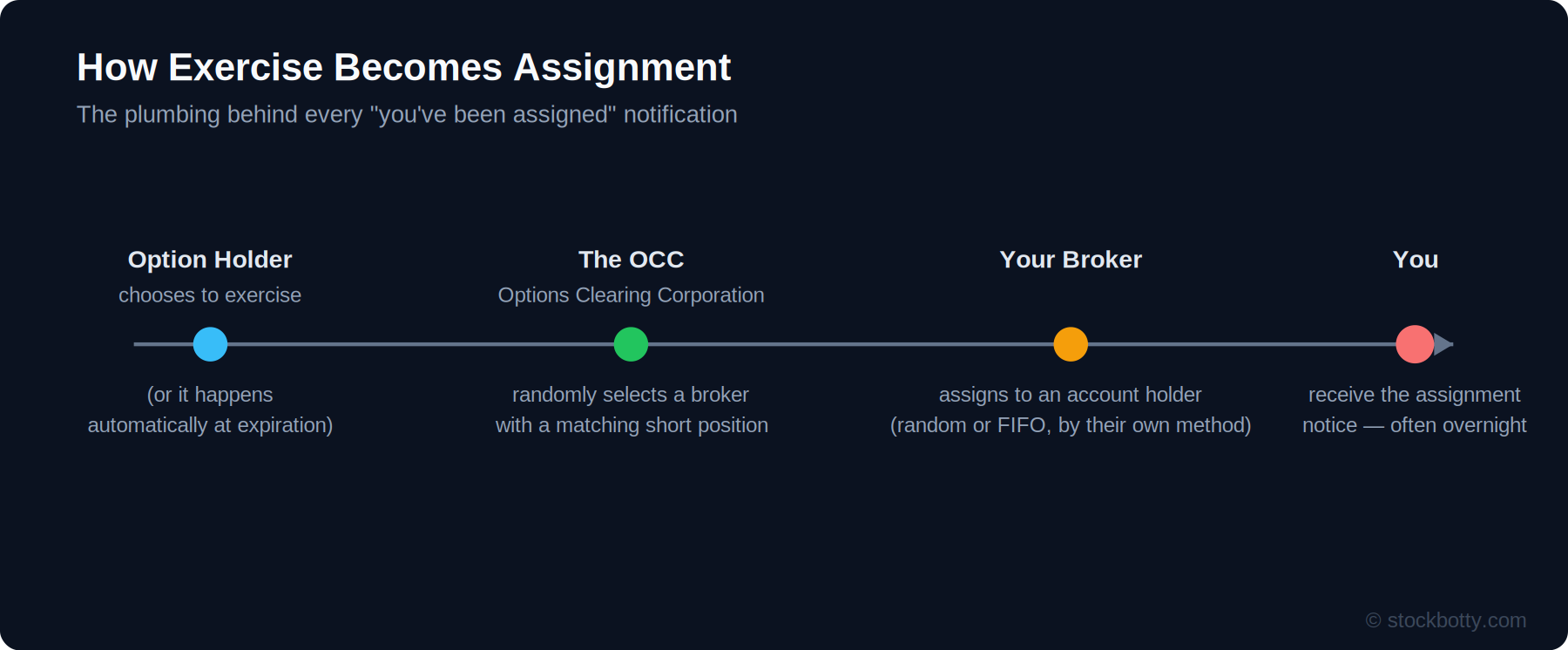
When an option is exercised, the notice goes to the Options Clearing Corporation (OCC), which clears and guarantees every listed options trade in the US. The OCC randomly selects a broker holding a matching short position on that same option. That broker then has to assign the obligation to one of its own account holders who is short that option – using whatever method the broker has chosen, commonly random selection or first-in-first-out. This is why assignment notices often arrive overnight: the process runs after market close, once the day’s exercise decisions are finalized.
American vs. European Style – When Exercise Can Happen
As covered in the overview above, this distinction determines the entire timing question. American-style options – most single-stock and ETF options – can be exercised at any point before expiration, which is what makes early assignment possible at all. European-style options – most broad index options – can only be exercised at expiration, removing early assignment as a risk entirely.
Early Assignment – When and Why It Happens
- Little extrinsic value left: the more an option’s value is intrinsic rather than extrinsic, the more attractive early exercise becomes for the holder, since there’s little time value being given up by exercising now instead of waiting.
- Dividend capture on short calls: a call holder can exercise early specifically to own the stock before the ex-dividend date and collect the dividend, if the call’s remaining extrinsic value is smaller than the dividend itself. This is the single most common, predictable driver of early assignment.
- Interest rate considerations on deep ITM puts: a put holder exercising early receives cash from the sale immediately rather than waiting until expiration; when interest rates are meaningfully positive, the value of that cash sooner can outweigh a small amount of remaining extrinsic value, making early exercise of deep in-the-money puts more common than many traders expect.
Pin Risk – Uncertainty Right at the Strike
When a stock closes very close to a strike price at expiration, it isn’t always clear until after the close whether an option will actually be exercised – a stock that settles at exactly the strike, or within a few cents of it, creates genuine uncertainty about the resulting position. Because this uncertainty often isn’t resolved until the following trading day, a position can carry unplanned exposure over a weekend without the trader knowing for certain what they’re holding.
Cash Settlement vs. Physical Delivery
Exercise style (American or European) determines when an option can be exercised. Settlement type determines what actually happens when it is – a separate question that’s easy to conflate with the first, since index options are usually both European-style and cash-settled, but the two aren’t the same thing by definition.
- Equity and ETF options: physically settled. Exercise or assignment results in real shares changing hands at the strike price, the case covered throughout the rest of this page and this site.
- Index options (SPX, XSP, and similar): cash-settled. An index itself isn’t a security that can be delivered, so instead of shares changing hands, the difference between the strike and the index’s settlement value is simply paid in cash. This also removes the dividend-capture driver of early assignment entirely, since there are no shares or dividends involved at all.
- Futures options: exercising a futures option typically results in a position in the underlying futures contract itself, not cash and not physical delivery of a commodity. That futures position then carries its own margin requirements and its own separate settlement rules, which – depending on the specific contract – may themselves be cash-settled or physically settled once the future itself expires. This layered structure is covered in more depth in a dedicated guide to futures options on this site.
What Assignment Actually Means, by Position
- Short call assigned: the shares are sold at the strike price. If the call was covered by shares already owned, they’re simply delivered. If it was uncovered, the account is now short shares outright.
- Short put assigned: shares are purchased at the strike price. If the put was cash-secured, the reserved cash covers the purchase. If it wasn’t, the account may need to use margin to cover the unplanned purchase.
- Long option exercised voluntarily: the buyer’s own decision, with the corresponding effect on whoever ends up assigned on the other side.
Automatic Exercise at Expiration
Options that finish in the money by even a small amount at expiration are typically automatically exercised by the OCC, a process sometimes called exercise by exception, unless the holder specifically instructs their broker otherwise. This means a position doesn’t need any action from the holder to be exercised right at expiration – it happens by default once an option is meaningfully in the money at the close.
How to Avoid Unwanted Assignment
- Watch extrinsic value directly, not just whether an option is in or out of the money – an option with very little time value left is at meaningfully higher risk of early exercise than the same moneyness with more time value remaining.
- Close or roll short calls ahead of an ex-dividend date if they’re in the money with little extrinsic value left, since this is the most predictable and avoidable driver of early assignment.
- Don’t assume a position is safe simply because it hasn’t been assigned yet – early assignment can happen at any point once an option is a reasonable candidate for it, not only right before expiration.
Managing an Assignment After It Happens
Once assigned, the resulting stock position can be managed the same way any stock position can – held, sold, or in the case of a put assignment, used as the starting point for a covered call, the same cycle covered in the wheel strategy. The specific rolling and adjustment techniques used to avoid or manage assignment before it happens are covered in more depth, with real worked examples, throughout the Playbook.
Frequently Asked Questions
What is the difference between exercise and assignment?
Exercise is the action an option buyer takes to use their right to buy or sell the underlying. Assignment is what happens to the option seller on the other side of that same contract, who is now obligated to fulfill it.
How does the OCC decide who gets assigned?
When an option is exercised, the Options Clearing Corporation randomly selects a broker holding a matching short position. That broker then assigns the obligation to one of its own account holders, using a method of its own choosing, commonly random selection or first-in-first-out.
Why does early assignment happen?
Most commonly because an option is deep in the money with little extrinsic value left, making exercise attractive to the holder. On calls, it’s especially common right before an ex-dividend date, when a holder exercises specifically to capture the dividend.
What is pin risk?
The uncertainty that arises when a stock closes very close to a strike price at expiration, making it unclear whether an option will be exercised. This can leave a trader unsure of their actual position until the following trading day.
How can I avoid unwanted assignment?
Close or roll a short option before it moves deep in the money with little time value left, especially ahead of an ex-dividend date on a short call. Monitoring extrinsic value directly is more reliable than assuming an option won’t be exercised early.
What is the difference between cash settlement and physical delivery?
Physical delivery means actual shares change hands at the strike price, as with most equity and ETF options. Cash settlement means the difference between the strike and the settlement value is paid in cash instead, as with most index options, since an index itself can’t be delivered.